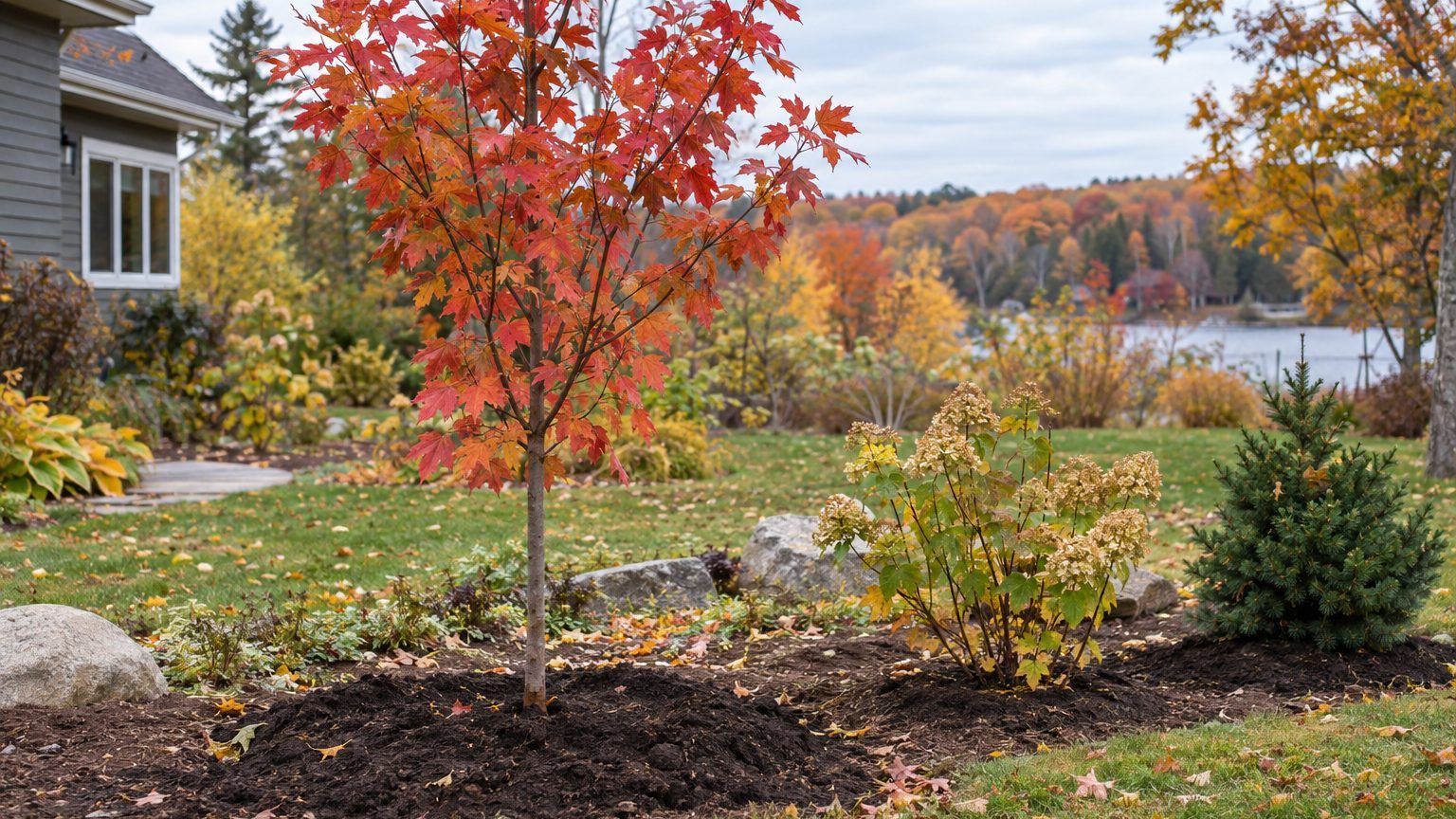

For Boise, the conservative deadline for planting trees and shrubs in fall runs from August 26 to September 9, which is six weeks before the first fall frost (October 7 to October 21, per NOAA). That is the safe target, not the hard stop. Roots keep growing in soil that is workable and above freezing, and the ground freezes well after the air does. Higher, colder parts of Idaho hit their limit earlier, so the calendar shifts as you climb.
The deadline in Idaho
Air and soil run on different clocks. Leaves and stems react to the first hard freeze, while roots react to the ground. Soil stores summer heat and cools slowly, so it often stays workable for weeks after frost has blackened the tomato vines. A newly planted tree uses that stretch to push roots out of the nursery root ball and into native soil before dormancy. Fall planting works because of that overlap.
Where the date comes from
Cornell Cooperative Extension states the rule this way: “Fall is an excellent time for transplanting, provided you get them to their new home at least 6 weeks before the ground freezes, allowing them time to establish roots before winter dormancy.” The rule counts from frozen ground, which nobody publishes as a neat statewide date. First frost is the number we can work with. NOAA’s 1991-2020 Climate Normals for the Boise station put the first 32°F freeze between October 7 and October 21, the band where the probability of a freeze runs from 30 to 70 percent. Count six weeks back from that band and you get August 26 to September 9. Write that down as the safe target for the Boise area.
The true limit falls later. Ground freezes after the first frost, sometimes by a good margin, depending on the year, snow cover and soil type. Planting after early September in the Boise area is therefore a calculated risk, not a mistake. The odds get worse week by week, and that is the pattern to keep in mind if you are reading this at the end of September with a tree still sitting in its pot. The safe window has closed in the low valley, but the soil there is nowhere near frozen, and October frost is still ahead.
Colder parts of Idaho
Boise sits in a low valley. Most of Idaho is higher and colder, with far shorter seasons. In those places the first fall frost arrives earlier than the Boise range, and the ground freezes earlier too, so the deadline moves earlier rather than later. The USDA Plant Hardiness Zone Map (2023 edition, built on 1991-2020 normals) runs from 3b to 7b across the state, which tells you how much local conditions differ. Use your own first-frost date, not Boise’s, and count back from it. The First and Last Frost Dates in Idaho guide is the place to look yours up.
One more point about the Boise numbers. The mean daily minimum of the coldest month there is 25.4°F (NOAA, 1991-2020 normals), well under freezing. The ground does freeze in winter, so the six-week logic applies. Idaho is not a place where you can plant all winter, unlike the Gulf Coast. For a sense of how the same arithmetic plays out on the Northern Plains, see How Late Can You Plant Trees and Shrubs in Fall in South Dakota?
What to plant late, and what to wait on
Hardiness comes before timing. The mean daily minimum of the coldest month is the figure that decides whether a plant survives winter here at all. In Boise it is 25.4°F, according to NOAA’s 1991-2020 normals. That is a mean of the daily lows, so individual nights run colder. Zones from the USDA system are built on a different variable, the average annual extreme minimum, and they range from 3b to 7b across Idaho. Check the rating of the plant against the zone of your own yard, not against Boise’s.
Container-grown and balled-and-burlapped trees and shrubs that are fully hardy in your zone are the best late-season bets. Deciduous ones especially: once the leaves drop, the plant loses little water and can devote what it has to roots. Maples, lilacs, spireas and most oaks fit that description. A container plant also arrives with an intact root system that hasn’t been cut back for shipping, which gives it a head start on a shortened season.
| Plant type | Late-fall verdict | Reason |
|---|---|---|
| Hardy deciduous trees and shrubs in containers | Good | Little water loss after leaf drop, roots keep growing in cool soil |
| Hardy deciduous trees, balled and burlapped | Good | Intact root ball, but plant promptly and water in well |
| Evergreens, needled or broadleaf | Risky late | Foliage keeps losing water all winter while roots are limited |
| Plants rated near your zone’s limit | Wait for spring | A weak root system meets the coldest weeks with no reserve |
Evergreens are where late planting goes wrong most often. Pines, spruces, arborvitae and broadleaf types such as boxwood and rhododendron never shut off completely. Needles and leaves lose moisture on every dry, windy day, and a root system that has barely moved into the surrounding soil cannot keep up once the ground stiffens. If you want evergreens in the ground before winter, get them in early in the window, and give them a spot out of the worst wind. Idaho winters combine dry air, strong sun and cold soil, which is the exact recipe for browned foliage.
The plants to be most cautious with are those whose hardiness rating sits right at your zone’s limit. In a mild winter they may pass, but a hard one will test a young plant with shallow roots far more than it tests an established one. For those, hold borderline plants and evergreens until spring if your safe window has already closed. Nurseries in most of the state restock in spring, and a spring-planted shrub gets a full season to root before its first winter. The Planting and Caring for Trees, Shrubs and Perennials guide covers hole width, planting depth and staking for either season.
Watering and mulch until the ground freezes
The first winter is about roots, not growth. Top growth stops as days shorten, and whatever energy the plant has goes underground. A tree that looks unchanged through April may have doubled its root reach. So skip fertilizer that pushes tender new shoots, and hold off on anything but light pruning of damaged wood. Your job is to keep the soil around the root ball evenly moist while roots do their work.
Water deeply, then keep going
Idaho falls are typically dry, and a dry fall is more dangerous to new plantings than a cold one. Water slowly so it soaks down through the root ball and the soil around it, rather than running off. Check by pushing a trowel or long screwdriver into the soil beside the root ball. If it comes out dry, water. If it comes out damp, wait. If your yard depends on irrigation water that gets shut off for the season, plan to water new trees with a hose after the ditch runs dry. Keep watering until the ground freezes, including on mild afternoons after the leaves have dropped, as long as the soil is not frozen. Roots don’t quit just because the branches are bare.
Mulch in a ring, not a volcano
Mulch does two jobs at once in fall: it holds moisture and it evens out soil temperature, which slows freeze-and-thaw swings around the roots. NC State Extension’s Gardener Handbook gives two figures that agree with each other. On weeds: “A 2-inch to 3-inch layer of mulch suppresses most annual weed seeds and makes it easy to hand-pull any that do germinate.” On trees: “Provide a 3-inch layer of mulch to reduce water loss and maintain uniform soil moisture and temperature around roots.” Stay within that 2-inch to 3-inch range. More is not better.
Spread it in a wide ring that reaches at least to the edge of the planting hole, and leave a few inches of bare soil around the trunk so the root flare stays visible. Mulch piled against the bark holds moisture against it, invites rot and gives mice and voles a sheltered place to chew through winter. A doughnut is right; a volcano is wrong. The Mulching Without Killing the Plant guide walks through the common mistakes in more detail.
What goes wrong
Planting too late for the local climate is the most common failure, and the colder your elevation, the sooner it bites. A shrub set in the ground just before a hard freeze has no time to root. It may look fine until spring, then leaf out weakly or not at all. In higher parts of Idaho the safe window closes earlier than the Boise range of August 26 to September 9, so check your local first-frost date before you buy. If the calendar says you are past the limit, plant it in spring instead and keep the pot watered and sheltered in the meantime.
Winter burn shows up on evergreens as brown, scorched needles or leaves in late winter. Sun and wind pull water out of the foliage while frozen or dry soil keeps the roots from replacing it. Fall watering, a decent mulch layer and a windbreak on the exposed side all help. Young plants with shallow root systems suffer worst.
Heaving is the quiet one. Repeated freezing and thawing pushes shallow root balls upward, sometimes enough to expose roots to dry air. Check new plantings during winter thaws and again in early spring. If a root ball has lifted, press it back into place by hand and re-cover it with soil and mulch.
Drying out is the last problem, and it is common in a dry fall. A plant can go into winter with a dry root zone simply because nobody watered after the rains stopped. Roots in dry soil are more vulnerable to cold as well, so the watering advice above does double duty. For more on the state’s conditions, browse the Idaho guides.
Common questions
Can I still plant a tree in Idaho in October?
Often, yes, if the soil is workable and the plant is hardy in your zone. In the Boise area the first freeze typically arrives between October 7 and October 21 (NOAA), but the ground freezes later than the air. A hardy, container-grown deciduous tree planted in early October has a fair chance of rooting in before dormancy. In higher, colder parts of the state, that same month may already be too late.
Does the six-week rule apply everywhere in Idaho?
The rule applies wherever the ground freezes, and Boise’s coldest-month mean minimum of 25.4°F (NOAA, 1991-2020) says it does. The dates change with elevation, though. Colder parts of the state reach both first frost and frozen ground earlier, so count back from your own local frost date. The Boise figure of August 26 to September 9 is a reference for the low valley, not for the whole state.
How much mulch should go around a new tree?
NC State Extension recommends “a 2-inch to 3-inch layer of mulch” for weed suppression and “a 3-inch layer” around trees to reduce water loss and even out soil moisture and temperature. Keep the mulch in a ring and pull it back from the trunk so the base stays exposed. Depth beyond 3 inches does not add benefit and increases the risk of rot and rodent damage.
Should evergreens wait until spring?
They are the group most likely to suffer from a late start, because their foliage keeps losing water all winter. If the safe window has passed where you live, spring planting is the lower-risk choice. If you do plant one in fall, give it deep watering until the ground freezes and place it out of the strongest wind. Deciduous trees and shrubs tolerate a later date better, since they drop their leaves and stop losing water through them.