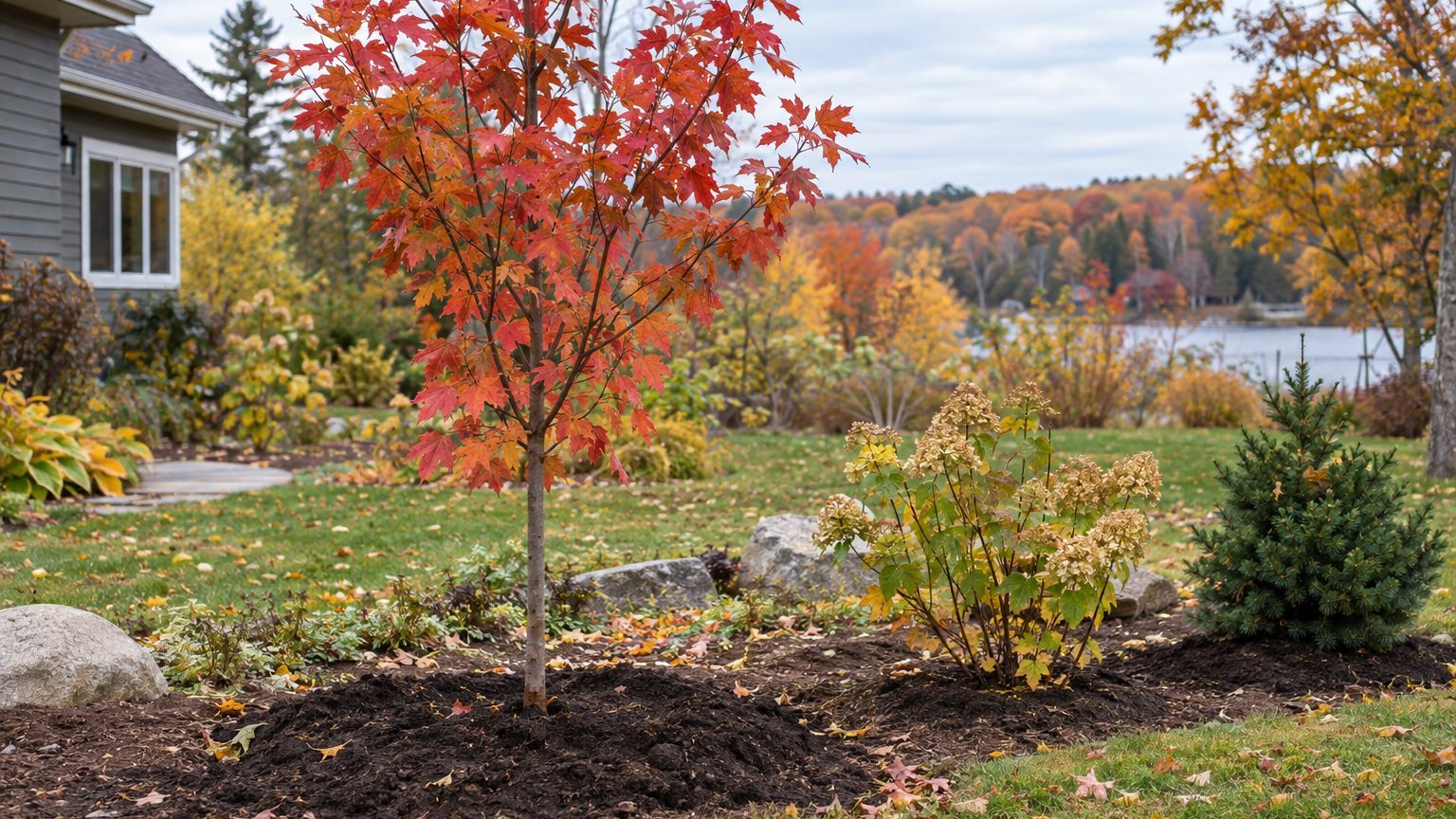

The safe target in Iowa is to have trees and shrubs in the ground six weeks before the first fall frost. Around Des Moines, that works out to September 2 to September 13. You can plant later and often get away with it, because roots keep working until the soil freezes solid. But each week past that window thins the margin, and northern Iowa runs out of room sooner than the central part of the state.
The deadline in Iowa
Why roots outlast the air temperature
Leaves drop and the top of a tree shuts down when days shorten. Underground, things move slower. Soil soaked with a summer’s worth of heat cools gradually, and roots keep pushing outward as long as the ground is workable and above freezing. That gap between cold air and cold soil is the whole reason fall planting works. A tree set out in a September that still feels like summer is building roots through October and often into November, while the branches above it sit idle.
The real deadline, then, is the day the ground freezes, and in Iowa it does freeze. The mean daily minimum of the coldest month at Des Moines is 13.8°F, according to NOAA NCEI’s 1991-2020 Climate Normals. That is nearly 18 degrees under freezing on an average night, so frozen ground is a fact of life here, not a rare event.
Cornell Cooperative Extension (Orleans County) puts the planting rule this way: “Fall is an excellent time for transplanting, provided you get them to their new home at least 6 weeks before the ground freezes, allowing them time to establish roots before winter dormancy.” The catch is that ground freeze varies from year to year and from yard to yard, and few of us track soil temperature. Air frost is easier to pin down.
Working the dates from the first frost
NOAA’s 1991-2020 normals for the Des Moines airport station put the first 32°F freeze between October 14 and October 25 (the 30-70% probability band). Count six weeks back from that range and you land on September 2 to September 13. Treat that as the conservative target. Ground freeze usually arrives later than the first frost of the air, so a shrub planted in late September or early October is not automatically doomed. It just has less cushion, and the hardiness and watering details start to matter more.
Two adjustments push the date earlier. First, the airport station is the optimistic end of the picture. Iowa State Extension county figures (1950-2021) run about 10 days earlier in fall, so outside the city, lean toward the early edge of the window or ahead of it. Second, the colder part of Iowa, meaning the northern counties, gets its first frost earlier and its frozen ground earlier. A gardener near the Minnesota line should finish well before someone in the south. For county-level numbers, see First and Last Frost Dates in Iowa.
The same six-week arithmetic gives very different dates elsewhere. How Late Can You Plant Trees and Shrubs in Fall in Rhode Island? shows how it plays out in a state with a different frost calendar.
What to plant late, and what to wait on
Hardiness is the first filter. The USDA Plant Hardiness Zone Map (2023 edition, built on 1991-2020 normals) rates Iowa from 4b to 6a, and it uses a single variable: the average annual extreme minimum temperature. Your yard sits somewhere in that range, so check your own zone rather than assuming the state average. A plant rated for your zone or colder is a fair candidate for late planting. A plant rated right at the edge of your zone, with a root system that has barely started, is a gamble.
Container-grown and balled-and-burlapped stock that is fully hardy here establishes well in fall. The root system is mostly intact, the plant is dormant or nearly so, and the soil is still warm enough to invite new growth. Deciduous trees and shrubs are the easiest, since they lose their leaves and stop demanding water from roots that are still settling in.
| Plant type | Late fall outlook in Iowa | What to watch |
|---|---|---|
| Fully hardy deciduous trees and shrubs, container-grown | Good, even after the safe window | Water until freeze-up; mulch in a ring |
| Fully hardy deciduous trees, balled and burlapped | Good if planted while soil is workable | Firm footing; watch for heaving |
| Needled evergreens (pine, spruce, arborvitae) | Best inside the safe window | Winter wind and sun pull water from needles |
| Broadleaf evergreens (boxwood, rhododendron) | Risky late; spring is safer | Winter burn on leaves |
| Shrubs rated at the edge of your zone | Wait for spring | Cold hits before roots anchor |
Evergreens deserve extra caution. Needles and leaves keep losing moisture all winter, and on sunny, windy days the loss outpaces what cold-soil roots can replace. A needled evergreen planted early enough to root in has a reserve to draw on. One planted just before freeze-up does not. Broadleaf types like boxwood and rhododendron are the touchiest, since their leaves show scorch quickly.
The practical rule to write down: once the safe window has passed, plant only fully hardy deciduous container or balled stock, and hold evergreens and borderline-hardy shrubs until spring. Spring planting is not a consolation prize. Plants set out then get a whole growing season before their first Iowa winter. For the basics on digging, backfilling and spacing, see Planting and Caring for Trees, Shrubs and Perennials.
Watering and mulch until the ground freezes
Keep the root ball moist
Fall in Iowa can turn dry, and a new root system has a small footprint. Nothing the plant can reach beyond the original root ball will help it yet. So the job is to keep that zone moist, not soggy, until the ground locks up. Push a trowel or finger into the soil beside the root ball. If it is dry at that depth, water slowly and deeply enough to soak through, rather than giving the surface a quick sprinkle that never reaches the roots.
Keep going after the leaves drop. A bare branch does not mean the plant has stopped needing water, and roots stay active while the soil is workable. Water on days when the ground is not frozen, and stop when freeze-up makes it impossible. Evergreens go into winter better when the soil around them is moist, since they keep losing water through the cold months.
Mulch in a ring, not a volcano
Mulch does two jobs in fall: it evens out soil moisture and temperature, and it keeps weeds from competing with new roots. The NC State Extension Gardener Handbook (chapter 11, Woody Ornamentals) gives the depth. For weeds: “A 2-inch to 3-inch layer of mulch suppresses most annual weed seeds and makes it easy to hand-pull any that do germinate.” For trees: “Provide a 3-inch layer of mulch to reduce water loss and maintain uniform soil moisture and temperature around roots.” The source is a North Carolina one, but the physics of a mulch layer does not change at the state line.
The two sentences point to the same depth. Keep mulch in that 2-inch to 3-inch range, spread as a wide ring that leaves the trunk itself bare. More is not better. Mulch piled against the bark holds moisture where it does harm, invites rot and gives rodents a cozy place to chew. A flat, donut-shaped ring that reaches out over the planting area does the job. Our piece on Mulching Without Killing the Plant covers the common mistakes in detail.
The first winter is about roots, not growth. A plant put in this fall is not trying to get taller; it is trying to anchor itself and build the water-gathering system it will rely on next summer. That is why fertilizer can wait, since it tends to nudge leafy growth the plant cannot support yet. It is also why pruning should stick to broken or dead wood. Every bit of top growth adds to the plant’s water demand, and the roots are still catching up.
What goes wrong
Planting too late, and drying out
The most common failure is simple timing. A plant that goes in just before the ground locks up has had no real chance to grow roots, and it meets the coldest stretch of winter with only the root ball it arrived with. Iowa’s coldest-month nights average 13.8°F at Des Moines, and northern parts of the state run colder and freeze sooner. That is punishing for a plant with no anchor. A dry fall makes it worse. Roots in a dry root ball do not grow, and a plant that enters winter thirsty is weaker when the cold arrives.
Winter burn and heaving
Evergreens suffer a different way. Winter sun and wind pull moisture from needles and leaves while frozen soil keeps roots from replacing it, leaving brown, scorched foliage by late winter. Plants that got their six weeks have a far better chance, and those that did not are the ones that show it.
Then there is heaving. Iowa soil freezes and thaws repeatedly through winter and early spring, and a shallow, loosely anchored root ball can be pushed upward as the ground swells. Left alone, the roots end up exposed to air and wind. Check new plantings after each midwinter thaw and again in early spring, and gently press any lifted root ball back into place, then add soil or mulch to cover exposed roots. A ring of mulch at the recommended depth helps moderate those swings in the first place.
Common questions
Can I plant a tree in Iowa in November?
Sometimes. If the soil is still workable, the tree is fully hardy in your zone and it is a deciduous container or balled specimen, it can establish roots before the ground locks. The odds are lower than with planting inside the safe window, so water it well and mulch it at the 2-inch to 3-inch depth. Evergreens and borderline plants are better held until spring.
Does the six-week rule count from the first frost or from ground freeze?
Cornell Cooperative Extension counts from when the ground freezes. Because few people can say when that will be, this article counts from the first fall frost instead, which gives a conservative date. The ground usually freezes later than the air does, so the true limit typically falls after the safe window.
Is fall or spring better for planting trees and shrubs in Iowa?
Both work. Fall offers warm soil and cooler air, which is easier on new plants. Spring avoids winter’s hazards for evergreens and borderline-hardy species and gives roots a full season before their first winter. Many gardeners use fall for hardy deciduous stock and spring for everything touchier.
Do northern and southern Iowa use the same dates?
No. Northern Iowa is colder, with an earlier first frost and earlier frozen ground, so planting deadlines move earlier there. Southern Iowa gets a bit more time. More local timing lives in the Iowa guides. One more wrinkle: the Des Moines airport dates come from NOAA’s 1991-2020 normals, while Iowa State Extension county figures cover 1950-2021 and run about 10 days earlier in fall, so your own county may land closer to the early side.