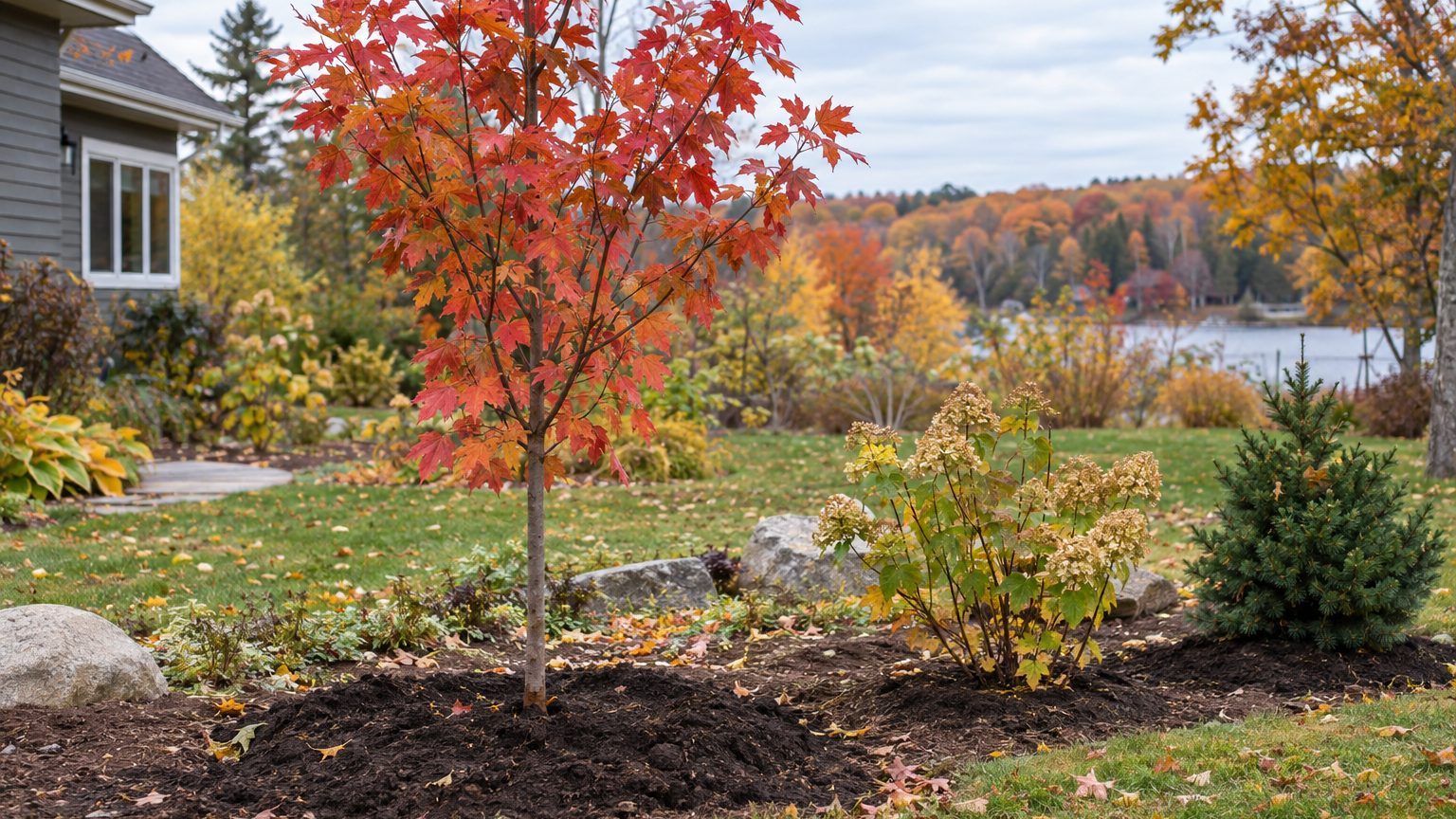

In Rhode Island, the conservative cutoff for fall planting trees and shrubs is September 12 to September 22, six weeks before the first fall frost (October 24 to November 3 at the Providence reference station). That is the safe target, not the hard limit. Roots keep working until the soil freezes, which happens later, so hardy container and balled plants set in October can still succeed if you water them well.
The deadline in Rhode Island
Air and soil run on different clocks. A frosty morning in late October says almost nothing about what’s happening six inches down, where soil that soaked up summer heat cools slowly, much like a brick oven after the fire goes out. Tree and shrub roots stay active in that warm, moist ground long after the leaves have dropped. They are using the weeks before dormancy to anchor themselves, and the plant that gets those weeks goes into winter with a head start.
How the six-week rule works out
The rule comes from Cornell Cooperative Extension (Orleans County), which says: “Fall is an excellent time for transplanting, provided you get them to their new home at least 6 weeks before the ground freezes, allowing them time to establish roots before winter dormancy.” Note what it counts from. The clock starts at frozen ground, an event that arrives after the first frost of the air, not at the frost itself.
NOAA’s NCEI U.S. Climate Normals for 1991-2020, which give 32°F freeze probabilities, put the first fall frost at the Providence airport station between October 24 and November 3. Count six weeks back from that range and you land on September 12 to September 22. Treat that as the date to write on the calendar. The ground itself freezes later than the first frost, so the true biological limit sits past this window. Planting after it is not doomed, just less forgiving.
Where your yard lands
That Providence figure is a reference point, not a statewide guarantee. Suburban and rural gardens typically see their first fall frost earlier than an airport does, often by one to two weeks, and more at higher elevation. Colder pockets of the state, farther north and higher up, hit the deadline earlier, so move your planting cutoff earlier too. Your county’s own frost data is the better guide, and the First and Last Frost Dates in Rhode Island page covers how the dates shift around the state.
Does the ground freeze here at all? Yes. The mean daily minimum of the coldest month at Providence is 22.1°F (NOAA NCEI Climate Normals, 1991-2020), well below freezing, so the six-week logic fully applies. The USDA Plant Hardiness Zone Map 2023 places the state in zones 6a to 7b, a range that reflects average annual extreme minimums and varies across the state. Gardeners in much colder states run the same arithmetic from earlier frosts, as in How Late Can You Plant Trees and Shrubs in Fall in Iowa?. Statewide guidance for yards like yours lives in the Rhode Island guides.
What to plant late, and what to wait on
Not every plant reads the calendar the same way. A sugar maple in a container, fully hardy for this climate, has the reserves and the genetics to handle a short fall. A rhododendron or a holly has a different problem: its leaves keep losing water all winter, and a half-established root system cannot always keep up. The lateness of the date matters less than what kind of plant you’re putting in.
The safest late bets
Container-grown and balled-and-burlapped trees and shrubs that are fully hardy in this zone are the best candidates for a late planting. Their roots come with a lump of soil attached, so the transplant shock is smaller than with a bare-root stick. Deciduous trees have already shut off their leaf-water demands, which means all that remains is root work. If the soil is workable and the plant is solidly hardy for a region where the coldest month averages 22.1°F at night, plant hardy deciduous trees and shrubs now, and wait for spring on anything borderline or evergreen-sensitive.
| Plant type | Late-fall risk in Rhode Island | What to do |
|---|---|---|
| Hardy deciduous trees and shrubs (container or balled) | Low; leaves are off, so roots carry the load | Plant while soil is workable, water until freeze-up |
| Needled evergreens such as arborvitae, spruce, pine | Moderate; they keep losing water through winter | Plant earlier in fall or wait for spring; protect from wind |
| Broadleaf evergreens such as rhododendron, holly, boxwood | Higher; leaf scorch on sunny, windy winter days | Prefer spring; if planting now, site out of wind and winter sun |
| Plants rated only just hardy for your zone | Highest; first winter tests an unestablished plant | Wait for spring so roots have a full season first |
The ones worth waiting on
Evergreens are the group that tricks people, because they look so settled in a nursery pot in October. In frozen soil they cannot pull water up to replace what the needles or leaves lose to wind and sun. A well-rooted evergreen manages. A freshly planted one often browns by March. If your yard is exposed, or sits farther inland where the ground freezes earlier, hold off.
The other category is borderline plants: anything whose hardiness rating only just covers your yard. Rhode Island’s winters are mild by northern standards (the USDA 2023 map runs 6a to 7b), but a plant at the edge of its range needs a full season of root growth before it faces a cold snap. Fall planting takes that season away. Spring planting gives it back. For the broader how-to on setting plants in the ground, the Planting and Caring for Trees, Shrubs and Perennials guide walks through hole depth, root flare and backfill.
Watering and mulch until the ground freezes
The first winter is about roots, not growth. Anything you see above ground in the first year is a bonus; what matters is whether the root system grows outward into native soil before dormancy locks it. A tree that puts on three inches of new twig in its first fall but has a tight, circling root ball will struggle for years. One that looks static above the surface but has spread roots into the surrounding soil is already ahead.
Water deeply, then keep going
Fall rain in Rhode Island is unreliable, and a dry October can leave the soil around a new planting dry even while the surface looks damp. Soak the root zone slowly and thoroughly rather than sprinkling, so water reaches the bottom of the root ball and the soil just beyond it. Check by pushing a finger or a trowel into the soil near the plant rather than judging from the surface. Keep this up until the ground freezes. Roots that go into freeze-up dry are the ones that suffer most from winter desiccation, especially on evergreens.
Stopping early is the common mistake. Gardeners see the leaves fall, assume the plant has gone to sleep, and put the hose away. But the roots are still working, and the soil can stay unfrozen for weeks after the first frost.
Mulch in a ring, not a volcano
Mulch evens out the soil’s temperature swings and slows moisture loss. NC State Extension’s Gardener Handbook (chapter 11, Woody Ornamentals) says: “A 2-inch to 3-inch layer of mulch suppresses most annual weed seeds and makes it easy to hand-pull any that do germinate.” On trees specifically, it adds: “Provide a 3-inch layer of mulch to reduce water loss and maintain uniform soil moisture and temperature around roots.” The two statements land at the same depth, so use a 2-inch to 3-inch layer, and do not go deeper because you think more is safer.
Spread it in a wide, flat ring that extends out over the root zone, and leave a bare gap right at the trunk or stem. Mulch piled against bark holds moisture against the tissue, invites rot and gives rodents a cozy hiding spot. A volcano of mulch looks tidy and does damage. For more on depth, materials and placement, see Mulching Without Killing the Plant.
What goes wrong
Most failures with fall planting trace back to four problems, and each is avoidable once you know what it looks like.
Timing and winter burn
Planting too late for the local climate is the most basic error. The Providence dates are a reference; in a colder inland yard, the ground freezes sooner and the six-week window closes earlier. A tree planted just ahead of freeze-up has little time to anchor. If you’re past the safe window, plant in spring instead unless the plant is a hardy deciduous one and the soil is still workable.
Winter burn is the second problem, and it mostly hits evergreens. On sunny or windy days, needles and leaves lose water faster than frozen or half-established roots can replace it. The tips turn tan or brown, often not until late winter. Near the coast, salt-laden wind adds to the stress. Plant evergreens out of the prevailing wind, water them well before the ground locks up, and consider a burlap windbreak on the exposed side for the first winter.
Heaving and drying out
With nights in the coldest month averaging 22.1°F at Providence, Rhode Island soil freezes and thaws repeatedly through winter. Shallow, freshly planted root balls can be pushed upward by that cycle, sometimes leaving roots exposed to air. Mulch moderates the swings. In late winter and early spring, walk the yard and check new plantings; if one has lifted, gently press it back and firm the soil.
Drying out is the quietest failure. A dry fall followed by a frozen winter can leave a new planting short of water for months, and the damage often shows only in spring, when buds fail to open or branches die back. A trowel test in November costs nothing and catches the problem while there’s still time to fix it with a slow soak.
Common questions
Is it too late to plant a tree in Rhode Island in mid-October?
The conservative window, September 12 to September 22, has passed, but the ground has not frozen. A fully hardy, container-grown or balled deciduous tree or shrub can still establish if the soil is workable and you water deeply until freeze-up. Evergreens and borderline plants are better held for spring.
Does the six-week rule count from the first frost or from frozen ground?
Cornell Cooperative Extension counts back from when the ground freezes. Our dates count back from the first fall frost (October 24 to November 3 at Providence) because the ground freezes later, which makes September 12 to September 22 a cautious target rather than the true limit.
Do I need to plant earlier if I live inland or at higher elevation?
Yes. Suburban and rural sites typically get their first fall frost earlier than the airport reference, often by one to two weeks, and higher ground is colder still. Move the deadline earlier, and check your own county’s frost data before choosing a date.
Which hardiness zone should I use when buying plants?
The USDA Plant Hardiness Zone Map 2023 lists Rhode Island as 6a to 7b, based on average annual extreme minimum temperatures. That is a range across the state, so look up your own location and choose plants rated comfortably for it, especially if you plan to plant late.