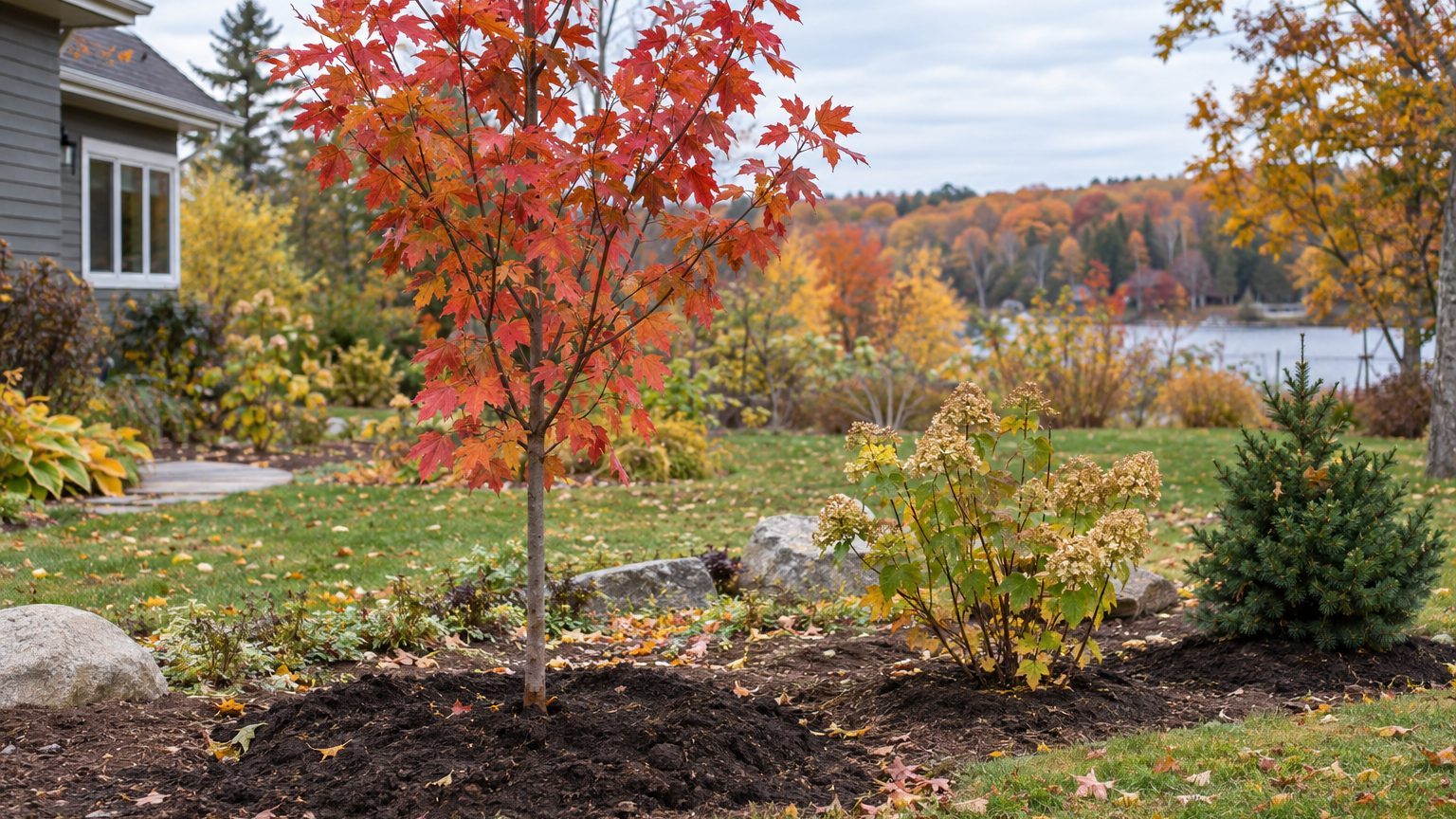

The safe target in Manitoba is to get trees and shrubs in the ground by about August 11, six weeks before the first fall frost, which averages September 22 at the Winnipeg airport station. Plants that go in later often survive, especially hardy container stock, but every week past that date shortens the time roots have to settle in before the soil locks up. Colder districts to the north and on higher ground should count those six weeks back from an earlier frost.
The deadline in Manitoba
A frost that blackens the leaves does not stop a tree’s roots. Top growth shuts down first. The roots keep working while the soil is workable and above freezing, which in a prairie fall can go on for weeks after the first cold night. That is the whole reason fall planting works. The plant isn’t trying to grow anything you can see. It is spending its time anchoring itself and reaching into the surrounding soil before winter.
Cornell Cooperative Extension puts the rule this way: “Fall is an excellent time for transplanting, provided you get them to their new home at least 6 weeks before the ground freezes, allowing them time to establish roots before winter dormancy.” The clock runs from frozen ground, not from the first frost of the air, and the ground freezes later.
Working backward from the first frost
Environment and Climate Change Canada’s 1981-2010 Canadian Climate Normals for the Winnipeg Richardson International A station give a first fall frost of September 22 on average. Read that as the middle of a window, not a safe date. In one year out of two the frost arrives later than that, and in the other half it arrives earlier, sometimes well before anyone has finished the yard work.
Count six weeks back from September 22 and you land on August 11. That is the conservative target, because the true limit, the day the ground freezes, usually falls later than the first frost. The buffer is deliberate. Plan to have trees and shrubs planted on or before August 11 around Winnipeg, and earlier in colder districts. Anything after that is a judgment call, not a failure.
The ground does freeze here, so the rule applies across the province. The mean daily minimum of Winnipeg’s coldest month is -21.4 °C (Canadian Climate Normals, 1981-2010), which is not a climate where soil stays open all winter. Natural Resources Canada places Winnipeg in Canadian hardiness zone 3b, using 1991-2020 normals. That is the Canadian system, not a USDA zone, and it doesn’t convert to one.
What moves the date earlier or later
Direction matters. The farther north you garden, or the higher the ground, the earlier the first fall frost arrives, so the planting deadline moves earlier too. A gardener in a colder district can’t borrow the Winnipeg date. The airport station is one reading in a large province, and northern and upland districts run weeks behind it in spring and ahead of it into winter. The First and Last Frost Dates in Manitoba guide lays out how that plays out across the province.
The rest is weather. A long, mild fall keeps the soil open and rewards late planting. A cold snap in late September can close the window on the same plant that would have been fine the previous year. Advice from other provinces won’t transfer straight across either. The calendar for the coast, for instance, is laid out in How Late Can You Plant Trees and Shrubs in Fall in British Columbia?, and it runs on a different clock than a place where the ground locks solid.
What to plant late, and what to wait on
Which plant you buy matters as much as which week you plant it. Start with hardiness, and be careful with the tag. Winnipeg sits in Canadian zone 3b, and Natural Resources Canada is blunt that there are no simple conversions between its system and USDA zones. The Canadian system is built on seven climate variables, the USDA system on one, and Canadian zone 4a alone overlaps nine USDA zones, from 3a to 7a. A plant sold with only a USDA number on the label tells you less than it seems to. Look for something proven on the prairies.
Good candidates for late planting
Container-grown and balled plants that are fully hardy in this zone are the best bets after the safe target has passed. A container plant arrives with its root system intact, and a balled plant brings a chunk of its original soil. Both can keep rooting into your yard as long as the ground stays open. Bare-root stock is a different story and is generally better as a spring job.
| Plant type | Late fall planting | Reason |
|---|---|---|
| Fully hardy deciduous trees and shrubs, container or balled | Reasonable, if the soil is still workable | Bare branches lose little water, and roots keep growing |
| Hardy perennials in containers | Reasonable, earlier is better | Compact root systems settle quickly |
| Borderline plants, hardy only to a milder zone | Wait for spring | A first winter with an unestablished root system is the hardest test |
| Evergreens | Safest before the safe target; later is a gamble | Needles keep losing water all winter |
What to hold until spring
Two groups are risky here. The first is anything borderline for zone 3b. A plant that would survive a normal winter once established can still die in its first winter, when the roots are new and the crown has no reserves. The second is evergreens. Pines, spruces and junipers keep losing moisture through their needles all winter, while frozen soil prevents the roots from replacing it. Evergreens that went in well before the safe target have had time to prepare. Those planted late are the ones that come out of winter brown.
The rule of thumb is simple. If the plant is borderline in Canadian zone 3b, or it is an evergreen and the safe target has passed, wait for spring. Cheap end-of-season markdowns are tempting, and they are usually cheap for a reason. The Planting and Caring for Trees, Shrubs and Perennials guide covers how to handle stock you buy now but can’t plant right away.
Watering and mulch until the ground freezes
A tree planted in fall still needs water, and a dry autumn is common enough that it can’t be left to chance. Newly planted stock has a small root system sitting in a loosened patch of soil, and that patch dries faster than the ground around it. Water slowly and deeply so it soaks below the root ball rather than running off, and keep doing it through the fall. Push a trowel into the root zone. If it is dry a few inches down, the plant is thirsty, whatever the surface looks like.
Keep watering right up to freeze-up
Don’t stop watering at the first frost. Roots are still active, and soil going into winter with plenty of moisture buffers the root zone. Give a last deep soak while the ground is still soft, then let winter take over. That last soak matters most for evergreens, which will keep pulling on whatever moisture the soil holds.
Mulch in a ring, not a volcano
Mulch does two jobs here. NC State Extension’s Gardener Handbook states one plainly: “A 2-inch to 3-inch layer of mulch suppresses most annual weed seeds and makes it easy to hand-pull any that do germinate.” On trees, the same handbook adds: “Provide a 3-inch layer of mulch to reduce water loss and maintain uniform soil moisture and temperature around roots.” The two purposes give the same order of depth, so there is no reason to go higher.
Spread the mulch in a wide ring around the planting, and keep it clear of the trunk so the bark stays dry. Piling it against the trunk in a cone traps moisture against the bark, invites rot, and gives voles a sheltered place to nest and chew all winter. Water deeply until freeze-up, then lay down a 2-inch to 3-inch ring of mulch. The details, including how to correct a volcano already in place, are in Mulching Without Killing the Plant.
Expect nothing visible from a fall planting, and resist the urge to push it. The first winter is about roots, not growth. A tree that spends that season extending its root system will grow faster the following summer than one that was pushed into new top growth in September. Fall fertilizer, especially nitrogen, encourages tender new shoots that winter kills anyway. Skip it, and skip heavy pruning too.
What goes wrong
The most common failure is simply planting too late for the climate. A shrub set in just before the ground freezes has had almost no time to root, and it enters winter sitting in loose soil with nothing holding it there. A plant like that may leaf out normally in spring and then decline through the summer, which makes the cause easy to miss. The six-week rule and the August 11 target exist to prevent exactly this.
Winter burn is the classic evergreen problem. Sun and wind pull water out of the needles while the roots, locked in frozen soil, can’t replace it. The damage shows up in late winter and spring as brown or bronzed foliage, usually on the side facing the wind. A deep soak before freeze-up and a mulch ring both help, though neither is a guarantee for a late-planted evergreen.
Heaving is the problem for shallow root balls. Repeated freezing and thawing pushes the soil up and can lift a new tree partly out of the ground, exposing roots to cold air. It is worst for plants with small root systems that haven’t grown into the surrounding soil, which is why late planting and heaving go together. After each winter thaw, check new plantings, and if one has lifted, firm the soil back around it once the ground softens.
Finally, a dry fall can undo a well-timed planting. If rain never arrives and the gardener assumes it will, the root ball goes into freeze-up bone dry. Winter then does the rest. A dry fall calls for watering, not waiting, and that is the one failure on this list that is entirely preventable.
Common questions
Can I still plant trees in October in Manitoba?
Sometimes. October is well past the conservative August 11 target, and the first fall frost averages September 22 at the Winnipeg station, so half of years bring it later. If the soil is still workable, hardy container or balled stock can go in, provided you water deeply and mulch. Evergreens and borderline plants are better held for spring.
Is September 22 the date the ground freezes?
No. It is the average first fall frost, an air temperature from Environment and Climate Change Canada’s 1981-2010 normals. The ground freezes later. Cornell’s rule counts six weeks back from when the ground freezes, so the August 11 date built from the frost is conservative, and the real limit usually falls after it.
Does my USDA zone apply to Manitoba plants?
Not directly. Winnipeg is in Canadian hardiness zone 3b, according to Natural Resources Canada, and that system doesn’t convert to USDA zones. NRCan notes that Canadian zone 4a alone overlaps nine USDA zones, from 3a to 7a. Choose plants that are proven in the Canadian system or known to do well on the prairies.
Do northern Manitoba gardens follow the same date?
No. The August 11 date comes from the Winnipeg station, and northern and upland districts run weeks behind it in spring and reach their first frost earlier. Count six weeks back from your own first frost, not Winnipeg’s. Keep in mind too that the normals average 1981-2010, so your own yard’s record from recent falls is the better guide.