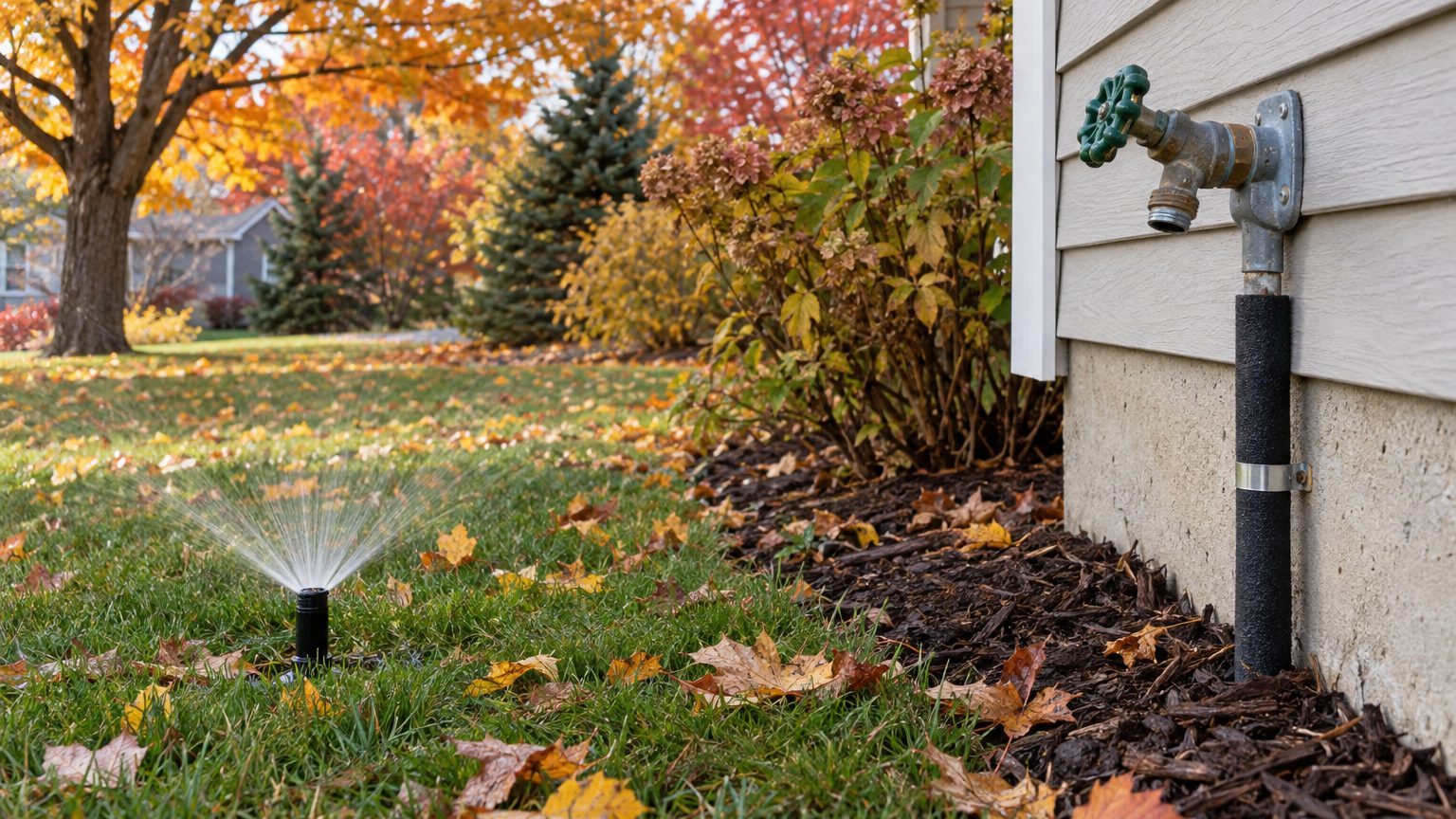

Drain the system before the first hard freeze, not after the first light one. In Missouri, that means closing out sprinklers and outdoor faucets ahead of the October 18 to October 29 stretch when the first fall frost typically arrives in Kansas City. Colder northern Missouri gets there sooner, and the milder south gets there later. The steps below cover the timing, the three ways to clear a sprinkler line, and the faucet mistakes that crack pipes inside walls.
When to do it in Missouri
Finish the job before the first hard freeze, not after the first light one, and for most of Missouri that means having sprinklers drained and outdoor taps shut off before the October 18 to October 29 first-frost window opens. That range comes from the NOAA NCEI 1991-2020 Climate Normals, specifically the span in which the chance of a 32°F reading at the Kansas City International station sits between 30 and 70 percent (NOAA NCEI station data). Treat the front edge of that band as your deadline, not the back edge.
Why a light frost is not the trigger
A light frost is one clear night when the air dips to freezing for a few hours and the soil, still holding fall warmth, barely notices. Buried pipe comes through fine. A hard freeze is different: temperatures stay below freezing long enough, and night after night, that the cold works through the ground and into anything holding water. The parts that fail first are the ones out in the air, such as the backflow preventer standing above the lawn, exposed valve assemblies, and the hose bibs on the house.
Nobody in Missouri gets to skip this. NOAA’s 1991-2020 normals for the Kansas City reference station put the mean daily minimum of the coldest month at 19.5°F. That is the typical overnight low in midwinter, not a record cold night, and it sits well below the point where water in a pipe turns to ice. A full blowout is the right call here, not an optional extra.
Adjusting for where you live
The Kansas City International station sits well north of the city center, and the downtown station warms up about five days earlier in spring, which tells you how much local conditions shift over short distances. Across the state the spread is bigger. The USDA Plant Hardiness Zone Map 2023 (which is built on average annual extreme minimum temperature) places Missouri in zones 5b to 7b, so a yard in the northern counties lives with earlier and harder cold than one near the Arkansas line. Northern Missouri should work ahead of the Kansas City dates; southern Missouri gets a little more breathing room, though not enough to justify waiting for a frost to show up.
Early cold snaps do not read the probability table. A band that runs from October 18 to October 29 means some years bring freezing nights sooner. Watch the ten-day forecast in early October, and when forecast lows start touching freezing, move the job to the weekend instead of the “sometime soon” pile. The same weekend works well for the rest of the yard, and Winterizing a Lawn covers what else belongs on that list. For other seasonal timing across the state, see the Missouri guides.
Sprinkler lines: drain or blow out
Water expands as it freezes, and pipe does not. Ice forming in a rigid line pushes outward until something gives, usually a fitting, a valve body, or a stretch of pipe at a low point where water pooled. The damage is often invisible until spring, when the system pressurizes and a geyser shows up at a crack that formed months ago. Sprinkler heads, the solenoids on zone valves, and the backflow preventer are all made to hold water under pressure, but none of them tolerates being frozen solid.
Being buried does not make the plumbing safe. The low spots collect water, the valve manifold sits close to the surface, and the backflow assembly stands in open air. In a state where the coldest month averages a low of 19.5°F, every one of those parts gets tested.
Three ways to clear the lines
Each method removes water differently, and each leaves a different amount behind.
| Method | How it works | Where it falls short |
|---|---|---|
| Manual drain | You open drain valves at the low points and let gravity pull water out | Only works if the system was built with those valves and the pipe slopes toward them; water can stay trapped in heads and dips |
| Automatic drain | Valves open on their own when line pressure drops after shutoff | Convenient, but pockets of water can remain between the valves and at the heads |
| Compressed-air blowout | Air pushed through the system one zone at a time forces water out through the heads | Needs the right equipment and care; too much pressure or running air through a zone too long can damage heads and fittings |
Given Missouri winters, blowout is the method the climate points to. Drain valves alone can leave enough water behind to split a fitting during a hard freeze, so they work best as a backup to the air, not a replacement for it. Whichever way you go, the first step is shutting off the water supply to the system, and the last is leaving the manual valves in the position the installer recommends for winter.
Blow out every zone with compressed air rather than trusting drain valves alone, and do it before the first-frost window opens. Treat blowout as an every-fall routine, not a repair step for when something already leaked.
When hiring a professional makes sense
Blowouts are not casual work. Compressed air is under pressure, and a heavy blast can send a sprinkler head or a bit of debris flying, so eye protection is mandatory and nobody should stand over a head while the air is running. A home compressor that is too small or too strong for the job is a common way to break fittings.
Hire a pro if the system has no drain valves and no clear shutoff, if it has many zones and you are not sure how to sequence them, if you do not own a compressor with adequate capacity, or if you are simply not confident about the pressure. Book before the cold arrives instead of calling in a panic after the first freezing forecast. A service visit is cheap compared with digging up a split main line in April.
Outdoor faucets and hoses
Faucets need less work than sprinklers, but the order matters, and the whole job amounts to turning valves. Nothing here involves cutting, soldering, or replacing pipe. If a step does not go smoothly, stop and call a plumber.
The shutdown sequence
Do these in order, once per outdoor tap:
- Disconnect every hose, splitter, sprayer, and timer from the faucet, and drain and store the hoses.
- Find the interior shutoff valve that feeds that faucet, usually in a basement, crawl space, or utility area, and close it.
- Go back outside and open the faucet fully so the water trapped between the valve and the spigot can run out.
- Leave the outside tap open through winter so any residual water has room to expand.
If you cannot find an interior valve, if it will not turn, or if it drips when closed, do not force it. A stuck valve is a plumber’s job, and one that fails under pressure can turn a five-minute chore into a flooded basement. Homes built without a dedicated shutoff for the outdoor tap are more common than most owners expect.
Why a frost-free faucet still fails with a hose attached
A frost-free faucet puts the actual valve seat far back inside the wall, in the heated part of the house, with a long stem running out to the handle. When the tap is off, the water behind the valve drains outward through the barrel, provided the barrel slopes down and nothing blocks the opening. Attach a hose and the water in the hose holds the drain closed. The barrel stays full, freezes near the cold end, and splits, often inside the wall where nobody sees it until the tap is turned on in spring. Details on how these fixtures work are in Frost-Free Outdoor Taps, and Winterizing Outdoor Faucets Before the First Freeze goes deeper on the routine.
Whether the faucet is frost-free or not, take every hose off by the time the October 18 to October 29 window opens. The hose is what turns a well-designed fixture into a burst pipe.
What goes wrong here
Most winter damage in Missouri comes from timing and forgetfulness, not from bad equipment. The failures repeat year after year, and each one shows a recognizable sign when the system comes back on.
The early cold snap before anyone has drained
The first-frost band is a probability range, and some autumns run ahead of it. A run of freezing nights in mid October, with the sprinklers still charged and the hoses still on, is the classic setup. In spring it looks like a zone that never reaches full pressure, water bubbling up in the yard, a cracked head, or a backflow preventer leaking from its body. Prevention is scheduling: treat the start of the October 18 to October 29 range as the deadline, and act earlier the moment the forecast shows freezing lows approaching. If a cold night surprises you, shut off the supply, open the drains, and clear what you can, then finish the full job on the next mild day. One light night rarely does damage, but a repeat performance can.
The forgotten hose and the flooded valve box
A single hose left on a faucet is the most common cause of a burst pipe inside a wall. The tell is a drip or spray inside the house, or a damp spot on drywall or ceiling, when the spigot is opened in spring. The symptoms and next steps overlap with Frozen Pipes. Prevention takes a walk around the property with a checklist, hose by hose.
Valve boxes are the quieter problem. Boxes sunk in the lawn collect runoff, and standing water around the valves freezes solid. The result is a valve that weeps or fails to close in spring. Walk the yard one last time before the first-frost window opens, lift the lids to see what is sitting in the boxes, clear debris, and make sure the lids are back on. Anything that needs plumbing work goes to a professional.
Common questions
Is one light frost enough to damage sprinkler lines?
Usually not. One brief frost rarely freezes buried pipe, but it can threaten exposed parts like the backflow preventer and hose bibs, and it signals that hard freezes are close. Treat it as a warning to finish the job, not as permission to wait.
Can I wait until November to winterize in Missouri?
You can, but the risk climbs quickly. NOAA’s 1991-2020 normals put the first-frost band at October 18 to October 29 for the Kansas City International station, and the mean daily minimum of the coldest month is 19.5°F. Yards north of Kansas City hit cold even sooner, so waiting is a gamble.
Do automatic drain valves mean I can skip the blowout?
Not safely. Automatic drains release water at certain points, but pockets can remain in heads and between valves. A blowout clears the rest, and in a climate with winter lows well below freezing, it is the more reliable choice.
What if a freeze arrives before I have drained everything?
Shut off the water supply to the system, open the drains and outdoor taps, remove hoses, and clear what you can. Then finish the complete job once temperatures rise. After the thaw, check heads, valve boxes, and the backflow preventer for leaks when you turn the system back on in spring.