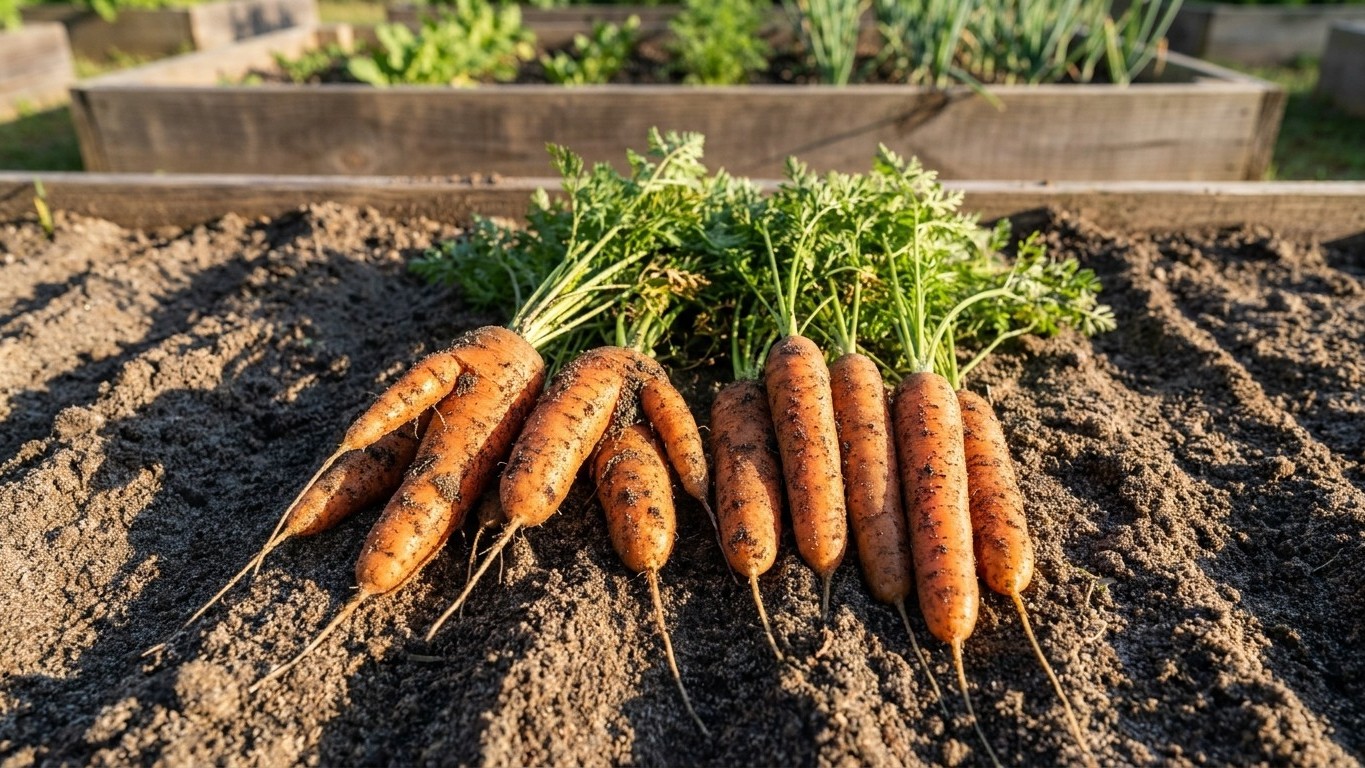

Texas does not have one carrot pest calendar that this page can vouch for. No verified list of insects or animals, and no dates for when they arrive, are published here. What the verified facts do cover is what the ground, the weather and the kitchen counter do to a carrot. In Texas’s state soil, that is a lot: forked roots, failed seedlings, split skins, and harvested roots that wilt before you eat them.
The short answer
Start with the ground. The soil USDA lists as representative of Texas is the Houston Black series, a Vertisol. That is a shrink-swell clay that cracks open when dry and turns to glue when wet. The representative surface layer runs 20 percent sand, 54 percent clay and 26 percent silt, which puts it firmly in heavy clay territory. Organic matter sits at about 3.0 percent, the surface pH is about 7.9 (alkaline), and drainage is moderately well drained. Those figures come from USDA NRCS Soil Data Access, and they describe the mapped surface of the series, not a worked garden bed. Treat the pH as the series’ number, never as yours.
Now set that beside what a carrot wants. Utah State University Extension describes the crop’s need plainly: deep, sandy, well-drained soil rich in organic matter. Heavy or rocky soil makes the root fork. Houston Black is the opposite of that description on the sand side, with more than half clay and only a fifth sand. So in ground like this, yes, a carrot will tend to fork. The taproot hits resistance, splits around it and comes up as a twisted or multi-legged root.
The fix is in the soil, not the seed packet. Utah State University Extension says heavy soil needs plenty of compost and double digging. Double digging means loosening the ground a second spade depth down, so the root has somewhere to go. A raised bed filled with loose, compost-rich mix gets you to the same place by another route. Switching varieties will not fix it, and the source names none anyway.
One caution matters more than any number above. A state spans hundreds of soil series, and this is a starting point, not a diagnosis. River bottoms, hill country and any lot a builder has scraped or filled can look nothing like Houston Black. Your yard may be sandy, rocky, or a thin layer of topsoil over rubble. If you want the longer treatment of forking, the page on Will Carrots Fork in Texas Soil? goes deeper. For the overall picture, start with Growing Carrots in Texas.
Carrots are also sown in place. There is no transplanting, so the 70 to 100 days to harvest count from the day the seed goes in the ground. The soil you prepare on that day is the soil the root lives in for the whole run.
The test that settles it in your own garden
The state’s soil is not your soil. You can find out what you have in an afternoon with a spade and a hose, and it costs nothing. Work through these in order.
- Dig a hole. Pick the spot where the carrots would go and dig straight down at least one full spade blade deep, then keep going as far as you can manage. A carrot root wants that depth clear, so this is the depth you are judging.
- Look at what comes out. Check the color change from top to bottom, and note any stones, roots, brick, broken concrete or a layer where the spade simply stops. Rocky ground and hard layers are exactly what makes roots fork. A sudden change in color or texture a few inches down often means fill or a scraped lot.
- Feel the texture. Take a handful from the depth where roots will grow, moisten it, and rub it between your fingers. Gritty means sand. Smooth and silky means silt. Sticky, shiny and able to be rolled into a long, tight ribbon means clay. Heavy clay is the texture the Houston Black figures describe.
- Watch the water. Fill the hole with water and let it drain, then fill it again and watch. If water vanishes steadily, drainage is working. If it sits there long after you would expect, the bed will stay wet and heavy. This page carries no published drain time to compare against, so judge it against your own yard: a spot that drains far slower than the rest of the garden is the warning.
- Note how it behaves dry and wet. Clay that cracks into wide gaps in a dry spell and turns to sticky mud after rain is behaving like a shrink-swell soil. You will see the same thing on the surface of the bed.
- Send a sample for testing. A soil test gives you your own pH and organic matter numbers, which nothing on this page can. Your county Extension office can tell you how to submit a sample.
- Decide. Loose, deep, sandy ground that drains may need only compost. Heavy, slow-draining or stony ground calls for plenty of compost and double digging, or for a raised bed.
Do the test before you buy seed. It takes the guesswork out of the whole season, and the timing question comes after it. Once the bed is settled, the sowing window is the next decision, covered in When to Sow Carrots in Texas: Counting Back From the Last Frost.
What goes wrong here
Heavy clay and a hot, variable climate cause a short list of predictable problems. Each one has a fix that starts with the bed rather than the plant.
- Forked, twisted roots in heavy ground. Clay, stones and compacted layers turn the taproot aside. Work in plenty of compost and double dig, or build a raised bed and fill it with loose, compost-rich soil. Pull out stones and rubble as you go.
- Poor germination in a hot spell. Carrot seed is slow to come up and needs its bed kept moist the whole time. A heavy soil that bakes into a crust, or a bed that dries between waterings, leaves gaps in the row. Keep the seedbed evenly damp until the seedlings are up, and check it daily in warm weather. This page publishes no soil temperature threshold, so use the sowing-date guidance rather than a number from memory.
- Splitting from uneven water. A shrink-swell clay swings between cracked-dry and glue-wet, and a root that swells fast after a long dry stretch can split. Water on a steady schedule rather than in floods and droughts, and build organic matter into the bed so it holds moisture more evenly.
- Things that chew. Insects and animals do feed on carrots, but no verified pest list or seasonal calendar is published here, and inventing one would do you no good. Ask your county Extension office what is active in your area, and watch the tops and the row for damage as the crop grows.
- Losses after harvest. A pulled carrot keeps losing moisture through its leaves. Clemson Cooperative Extension says to harvest about 65 to 75 days after planting and store carrots at 33 °F and high humidity to prevent wilting. That is just above freezing, not cellar temperature. Stored at 50 °F, carrots sprout and soften in a fraction of the time. Bunched carrots, tops still on, keep about 10 to 14 days. Cut the tops off first, because leaves keep drawing moisture out of the root. Trimmed carrots keep for months.
Common questions
Will carrots fork in Houston Black clay?
They tend to. With 54 percent clay and only 20 percent sand at the surface, it is the heavy soil Utah State University Extension warns about. Plenty of compost and double digging, or a raised bed, is the remedy. Your own garden may differ, so do the digging test first.
Is there a Texas calendar for carrot pests?
Not on this page. The verified facts here do not name pests or give dates for them. Your county Extension office is the place to ask, since what is active depends heavily on where in the state you garden.
How long from seeding to harvest?
Count 70 to 100 days from seeding. Carrots are sown in place and never transplanted, so the clock starts the day the seed goes in. Clemson Cooperative Extension gives about 65 to 75 days after planting as its harvest window, so check roots as you approach the early end of the range.
How should I store harvested carrots?
Cut the tops off first, since the leaves keep pulling moisture from the root. Then store the roots at 33 °F and high humidity, as Clemson Cooperative Extension advises. Bunched carrots with tops on keep about 10 to 14 days. Trimmed carrots keep for months.