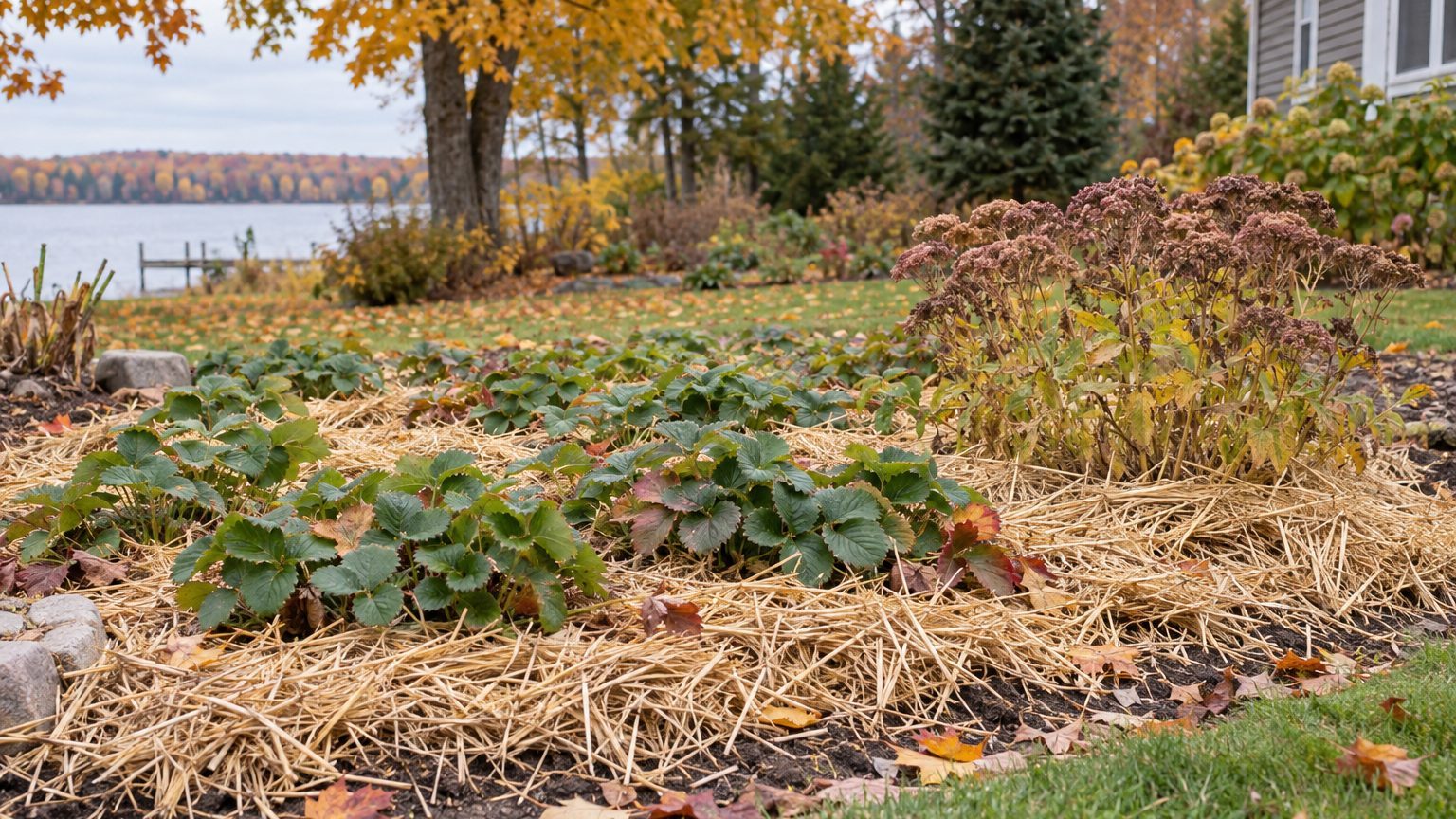

Wait for the ground to freeze, then mulch. In Omaha, the first fall frost lands between October 15 and October 26, but that marks the start of the wait, not the signal to spread straw. Winter mulch for strawberries and borderline perennials goes down in late fall, once hard freezes have stiffened the soil surface. Mulching early is the common mistake, and it costs more plants than a late job ever does.
When to put winter mulch down in Nebraska
Why the timing runs backward
Most gardeners think of mulch as a blanket that keeps plants warm. It doesn’t. A blanket holds in heat your body makes, and soil makes almost none. What winter mulch actually does is keep frozen soil frozen. Without it, a sunny January afternoon can thaw the top layer, and that night it refreezes. Each round expands and contracts the soil, and shallow-rooted plants get pushed slowly upward until their crowns sit exposed on the surface.
Lay mulch in early October and you get the opposite of what you wanted. The soil is still warm, the mulch holds that warmth in, and the plants stay soft and active when they should be going dormant. Crowns sit in damp, insulated conditions that favor rot, and mice and voles find a ready-made shelter.
The numbers for Nebraska
NOAA’s NCEI U.S. Climate Normals for 1991-2020 put the first fall frost at the Omaha airport station between October 15 and October 26 (that is the band where the chance of a 32°F freeze runs from 30 to 70 percent). The same normals show the mean daily minimum of the coldest month at 15.2°F. That is an average, so individual nights run colder, and it settles the question: the ground here freezes solid every winter, and the heaving logic applies in full.
The USDA Plant Hardiness Zone Map (2023 edition, built on 1991-2020 normals) places Nebraska in zones 4a-5b. That is a range for the whole state, and it rests on a single variable, the average annual extreme minimum temperature. Use Omaha as the reference point and expect the rest of the state to shift around it.
So the window opens after the first-frost range, not inside it. Mulch in late fall, after the October 15 to October 26 first-frost window has passed and the soil surface has begun to freeze and stay frozen. The signal is the ground, not the calendar: when the top of the soil is stiff in the morning and has not fully thawed by afternoon, you are in the window.
Adjusting for your own yard
The airport figures are a reference, not a guarantee. NOAA’s station sits in a warmer, more sheltered spot than many suburban and rural gardens, which typically see their first fall frost one to two weeks earlier, and more at higher elevation. In the colder part of the state, farther north or higher up, freezing arrives earlier, so the mulching window opens earlier on the calendar too. Check the first-frost range for your own county on the First and Last Frost Dates in Nebraska page, then watch the soil. Other regional timing is collected in the Nebraska guides.
Strawberries
Strawberries are the plant most worth mulching in Nebraska, and the one most often done wrong. The crown, the short woody stem at soil level where leaves and roots meet, holds the next season’s flower buds. It sits right at the surface, with shallow roots that heave out easily. When a crown is pushed up and left bare through subzero stretches and wind, the buds inside can die, and you find out in May when the plant leafs out and never flowers.
Bare cold is the second threat. With the mean daily minimum of the coldest month at 15.2°F in Omaha (NOAA NCEI Climate Normals 1991-2020), and individual nights colder than that, an uncovered crown has no buffer when a cold snap hits a snowless stretch. Snow itself is excellent insulation. A dry, open winter is when strawberries suffer most.
What to use and how deep
Clean straw is the standard choice. Wheat or oat straw works because it stays fluffy, lets air move, and sheds water instead of holding it. Hay is a poor substitute because it is full of seed and will seed your bed with grass. Whole leaves tend to pack into a wet mat, so shred them first if you go that route.
For depth, the figure on the record comes from the NC State Extension Gardener Handbook: “A 2-inch to 3-inch layer of mulch suppresses most annual weed seeds and makes it easy to hand-pull any that do germinate.” On trees it adds: “Provide a 3-inch layer of mulch to reduce water loss and maintain uniform soil moisture and temperature around roots.” Neither sentence is about strawberries specifically, but they set the order of depth for any organic mulch, and straw settles over winter, so lay it loose and even across the bed and cover the crowns. More is not better. A thicker blanket holds moisture against the crowns, and that is how rot starts. The full planting and care picture is in Growing Strawberries.
Pulling it back in spring
Uncovering matters as much as covering. Mulch strawberries after the first hard freezes, well past October 15 to October 26, and pull the straw off the crowns in early spring as soon as new leaves begin to push up pale yellow-green beneath it. Rake it gently into the aisles instead of hauling it away. It keeps weeds down, keeps berries off the soil later, and sits close by to throw back over the plants on a frost night during bloom. Leave it smothering the crowns and the new growth stretches, weakens, and rots.
Perennials and borderline plants
Most established perennials that are rated for zones 4a-5b under the USDA system need no winter mulch at all. They evolved here. The plants that benefit are in three groups: anything planted this fall, anything rated at the edge of the local range, and anything with a shallow crown that heaves easily.
Fall-planted perennials lead the list, because their roots haven’t knit into the soil yet and heave out first. Garden mums, which gardeners often treat as annuals, are a classic example of a plant that tends to be lost when the soil thaws and refreezes around it. Coral bells and similar shallow-crowned plants behave the same way. Roses and some shrubs near their cold limit also appreciate a covering around the base. For perennial herbs, lavender and similar Mediterranean types are borderline in the colder part of the state, and Getting Perennial Herbs Through the Winter covers what each one needs.
| Plant situation | Why mulch helps | What to do |
|---|---|---|
| Perennials planted this fall | Roots not yet anchored, heave easily | Mulch ring after the ground starts to freeze |
| Shallow-crowned plants (mums, coral bells) | Crowns pushed up by freeze-thaw cycles | Mulch ring, check again after thaws |
| Borderline-hardy plants and herbs | Cold at the edge of their range | Mulch ring, more care in the colder part of the state |
| Established, locally hardy perennials | Usually adapted already | Often nothing needed |
Use a ring, not a pile. Spread mulch around the crown in a wide circle and leave a gap right at the stem or crown itself, so no mulch touches the plant. The depth reference is the same NC State Extension line, “A 2-inch to 3-inch layer of mulch,” and as with strawberries, going deeper does not add protection. A heap against the stem holds moisture on the bark or crown and gives rodents cover. The same logic runs through Mulching Without Killing the Plant.
On timing, treat perennials like strawberries. Wait until the soil surface has started to freeze, well after the first-frost range of October 15 to October 26 at the Omaha reference station, then lay the ring. Gardens farther north or at higher elevation freeze sooner, so those beds get their mulch sooner as well.
What goes wrong
Mulching too early is the most common error. It looks like plants that stay green and floppy into November, then collapse, or crowns that turn mushy when you check them in spring. The fix is patience: wait for the ground, not the first frost, and if you are unsure, wait a bit longer. A late job costs little. A plant under warm mulch in a mild fall can rot before winter even starts.
Matting is the second problem. Wet whole leaves, or straw that was too fine or already damp, pack into a dense layer that blocks air and holds water against the crown. What you see is a slick, gray, sour-smelling mat. Prevent it by using clean, dry, fluffy material, shredding leaves, and keeping within the 2-inch to 3-inch order of depth from the NC State Extension Gardener Handbook.
Voles and mice are the third. A thick mulch layer gives them a warm tunnel system, and they chew crowns and bark from underneath where nobody sees it. The signs are runways in spring, gnawed crowns, and plants that lift out with no roots. Keeping mulch off the stem or crown, and not laying it until the ground has frozen, takes away both the early shelter and the easy access.
Last is forgetting to uncover. Pull mulch back from crowns when growth restarts in early spring, after the hardest freezes are done. If you leave it on, plants grow pale and weak underneath it. Keep it close by for frost nights, and use your county’s last-frost range from the frost dates page to judge how long the danger lasts.
Common questions
Can I mulch right after the first frost?
Not yet. In Omaha the first frost falls between October 15 and October 26 (NOAA NCEI Normals, 1991-2020), but the soil is still warm then. Mulching too soon traps that warmth and invites rot and rodents. Wait until hard freezes have set in and the soil surface stays frozen.
What is the best material for strawberries?
Clean straw. It stays loose, sheds water, and carries few weed seeds. Hay brings in seeds, and whole leaves tend to mat down when wet. Shredded leaves can work if straw is hard to find.
How can I tell the ground has started to freeze?
Press a trowel or your heel into bare soil in the morning. If the top layer is stiff and crunchy and stays that way through midday, you are there. Soil that thaws fully every afternoon and refreezes at night is the cycle that causes heaving, which is exactly what mulch is meant to stop.
Do all my perennials need mulch?
No. Established perennials that are rated hardy for zones 4a-5b under the USDA system usually need none. The ones that benefit are plants set out this fall, shallow-crowned plants that heave, and anything near the edge of its range.
One last nuance on the zone number: the USDA map is built on the average annual extreme minimum, a single cold night in a year, while heaving is caused by repeated thaws. A plant can be fully rated hardy for your zone and still be pushed out of the ground in a winter that swings back and forth.