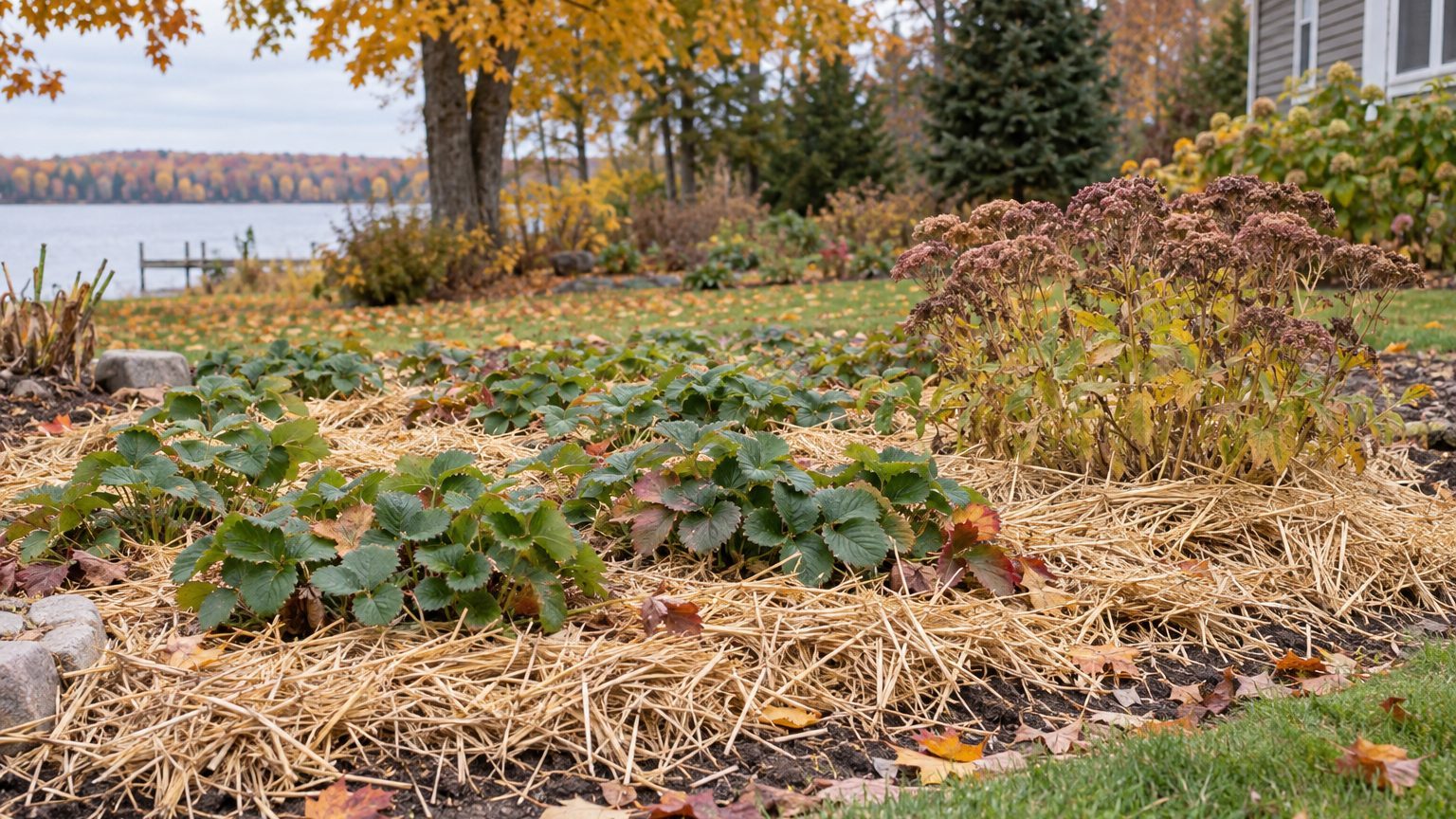

In South Dakota, winter mulch goes on after the ground starts to freeze, not when the first frost hits. At Sioux Falls, NOAA’s 1991-2020 normals put the first 32°F freeze between September 24 and October 4. The mulch itself belongs well after that window. Strawberries and borderline perennials follow the same rule: the goal is to keep frozen soil frozen, not to keep plants warm.
When to put winter mulch down in South Dakota
Think of winter mulch as a thermostat for the soil rather than a blanket for the plant. Once the ground freezes, a layer on top slows the swings: the January thaw that wakes a crown too early, the overnight refreeze that follows. Those swings do the damage. NOAA’s NCEI Climate Normals for 1991-2020 give Sioux Falls an average daily low of 8.5°F in its coldest month. That is a monthly mean, so individual nights run colder, and the ground here freezes every winter. The northern logic applies in full.
Mulch spread over warm fall soil does the opposite of what you want. It holds heat and moisture against the crown, and it gives mice and voles a sheltered place to set up before the real cold arrives.
Read the ground, not the calendar
NOAA’s NCEI normals for the Sioux Falls station (USW00014944) show the first fall freeze at 32°F landing between September 24 and October 4, the band where the odds run from 30 to 70 percent. A first frost is a nuisance for tomatoes and basil, but it does not freeze the soil. Plants still need the weeks after it to harden off as days shorten and nights cool, and strawberry crowns in particular use that stretch to prepare for dormancy.
So the practical signal is the soil, not the first frost. Wait until the surface has started to freeze and stays stiff through the afternoon, which lands well after the September 24 to October 4 frost window. In most years that means late fall, often around the time the last leaves are down and the garden has gone quiet. If a crust forms overnight and thaws by noon, you are close but not there. When it stays hard all day, spread the mulch.
Shifting the window for your county
Those dates describe an airport weather station, not your yard. NOAA’s data note that suburban and rural gardens often see the first fall frost one to two weeks earlier than the reference station, and more at elevation. Farther north in the state, fall comes earlier and the ground freezes earlier, so the mulching window slides earlier with it. The USDA Plant Hardiness Zone Map (2023 edition, built on average annual extreme minimum temperature) runs from 3b to 5b across South Dakota, which is a wide spread for a single set of instructions. Check your own county’s frost dates in the guide to first and last frost dates in South Dakota, then let the soil confirm the timing.
One more point for gardeners who like to finish chores early. A mulch pile waiting beside the bed costs nothing. Spreading it three weeks too soon can cost you a bed of crowns.
Strawberries
Strawberry crowns sit right at the soil surface, with the growing points exposed to whatever the weather does. That makes them more vulnerable than most perennials. Two things hurt them over a South Dakota winter. The first is bare cold: with an average coldest-month low of 8.5°F at Sioux Falls (NOAA NCEI, 1991-2020) and colder nights in the northern part of the state, an uncovered crown has no buffer. The second is heaving. When soil freezes, thaws and freezes again, it expands and contracts, and shallow-rooted plants get pushed up out of the ground. Roots snap, crowns sit exposed, and what looked like a healthy bed in November turns into a row of stranded plants in April.
Clean straw is the standard answer, and the word clean matters. Straw that still carries grain heads will seed itself into the bed and give you a weed problem on top of a strawberry problem. Hay is worse, since it is full of seed. Pine needles and shredded leaves can work, but whole leaves pack into a wet mat that smothers crowns.
For depth, the figure with a named source is from NC State Extension’s Gardener Handbook: “A 2-inch to 3-inch layer of mulch suppresses most annual weed seeds and makes it easy to hand-pull any that do germinate.” That sentence is about weeds, but it sets the right order of depth, and more is not better. Straw is fluffy and settles after the first snow, so lay it loosely over the plants and between the rows at that depth rather than packing it down. A tight, heavy layer is how crowns rot.
Timing follows the soil, as described above: after the ground has begun to freeze, which falls after the September 24 to October 4 frost window at the Sioux Falls reference station and earlier in colder parts of the state. For a fuller look at the crop through the season, see growing strawberries.
Spring matters just as much as fall. Straw left on too long blanches new growth and holds the bed cold and wet. Pull the straw back off the crowns once new leaves begin to show pale yellow-green, and keep it close at hand to drape back over the plants on nights when a late frost threatens. Most gardeners rake it into the aisles, where it keeps the fruit clean and the weeds down. This is also the stage where blossoms are most exposed, so keep an eye on the forecast after uncovering.
Perennials and borderline plants
Most well-established perennials chosen for the region need little help. They evolved for cold, and they have already built deep roots. Mulch pays off for a smaller group: plants set out this season or late last season, shallow-rooted types, and anything rated near the edge of what your zone allows. The USDA Plant Hardiness Zone Map (2023) puts South Dakota anywhere from 3b to 5b, so a plant that is comfortable in the southeast can be a gamble in the north. Read the tag against your own zone, not the state average.
The table below sorts common situations by what mulch is doing for them.
| Plant situation | What the cold does | Where the mulch goes |
|---|---|---|
| Perennials planted this year | Roots are shallow and heave easily | Over the root zone, kept off the crown |
| Shallow-rooted perennials such as garden mums | Freeze-thaw pushes them out of the ground | A ring around the plant after the soil freezes |
| Roses and other plants at the edge of their zone | Bare cold on the lower stems and crown | Around the base, after the ground starts to freeze |
| Perennial herbs such as thyme or sage | Wet, cold soil as much as low temperatures | Lightly, with drainage in mind |
Herbs deserve a separate look because many of them hate wet feet more than they hate cold. The advice for getting perennial herbs through the winter covers that balance in more detail.
The depth guidance is the same range as before. NC State Extension: “A 2-inch to 3-inch layer of mulch suppresses most annual weed seeds and makes it easy to hand-pull any that do germinate.” For trees and shrubs it adds: “Provide a 3-inch layer of mulch to reduce water loss and maintain uniform soil moisture and temperature around roots.” Both sentences point to the same order of depth. Treat the top of that range as a ceiling.
The shape matters as much as the depth. Make a ring around the crown, not a pile on top of it. Keep a bare collar of soil right at the stem or crown and spread the mulch outward from there, after the ground has started to freeze. Mulch heaped against a crown holds moisture on the tissue that most needs to stay dry, and that is how a protective layer turns into a rot problem. A ring of shredded bark or chopped leaves also leaves a clear spot where you can see if something is nibbling at the plant.
What goes wrong
Four mistakes account for most of the winter mulch failures. All four are avoidable.
Mulching too early comes first. The soil is still warm, the plants are still hardening, and a layer on top keeps everything damp and mild. Crowns can rot, and the bed becomes shelter. The fix is patience: wait for frozen ground, which comes after the September 24 to October 4 frost window at Sioux Falls, per NOAA, and sooner in colder counties.
Matting and rot come next. Whole leaves, wet grass clippings and heavy straw packed down by snow form a soggy blanket. You will find slimy, dark crowns in spring and a smell that tells you what happened. Use loose straw, shredded leaves or chopped material, and keep to the 2-inch to 3-inch range the NC State handbook describes. If you are unsure how much is too much, the guide to mulching without killing the plant walks through it.
Voles and mice follow. A thick, cozy layer laid down before the cold sets in is an invitation, and they chew bark and crowns under cover of it. Spreading mulch after the ground freezes cuts the window for nesting, and keeping it pulled back from trunks and stems takes away the hiding place against the plant itself.
Forgetting to uncover is the last. Once growth starts under straw, it is pale and weak and easy to damage. Walk the beds on the first run of mild spring days and lift the mulch off any crown showing new growth, then keep it nearby for cold snaps.
Common questions
Can I mulch right after the first frost?
Not for winter protection. A frost at Sioux Falls, which NOAA’s normals place between September 24 and October 4 for the first 32°F freeze, does not mean the soil has frozen. Plants are still hardening off, and mulch laid now holds warmth and moisture. Wait until the ground surface has frozen and stays that way during the day.
How thick should the layer be?
NC State Extension’s handbook describes “a 2-inch to 3-inch layer of mulch” for suppressing weed seeds, and “a 3-inch layer of mulch” around tree roots for moisture and temperature. Stay inside that range and keep it off crowns and trunks. Deeper is not better.
Does snow replace mulch?
A steady snow cover insulates soil well, but South Dakota winters do not guarantee it. Cold snaps with bare ground, wind that strips drifts off exposed beds and midwinter thaws all happen. Mulch covers those gaps.
Do my own dates match the Sioux Falls ones?
Often not. NOAA’s figures come from an airport station, and gardens in the suburbs and the countryside usually see first frost one to two weeks earlier, with more of a gap at elevation. The mulching window follows your ground, so check your own county’s dates, then confirm with the soil itself.
For more regional timing across the garden year, browse the South Dakota guides.