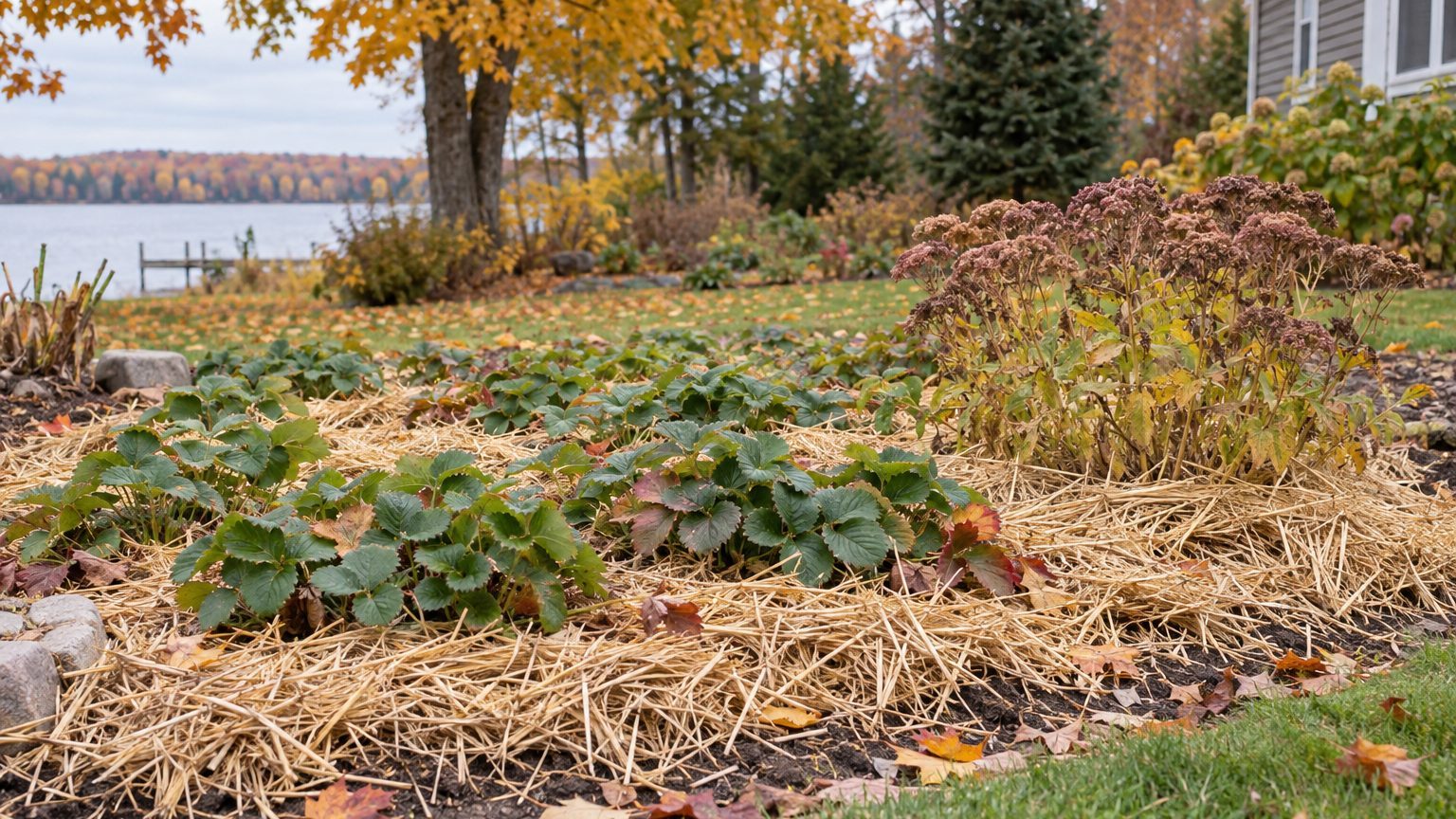

Mulch strawberries and perennials after the ground begins to freeze, not after the first frost. At Halifax Stanfield, the average first fall frost lands on October 18, so the right window opens well past that date. It opens once nights stay cold and the top of the soil stiffens, and it closes before deep snow settles in. Mulch too early and you build a warm, damp nest for rot and rodents. Colder inland and upland districts reach that point sooner.
When to put winter mulch down in Nova Scotia
Winter mulch has one job: keep soil frozen once it has frozen. That is the reverse of what most gardeners assume, and it explains the timing. A layer of straw doesn’t warm the ground. It slows change. Spread over soil that is still mild and wet, it holds that mildness and moisture against the plant instead of locking the cold in.
The cold is real here. Environment and Climate Change Canada’s 1981-2010 Canadian Climate Normals for the Halifax Stanfield station put the mean daily minimum of the coldest month at -10.4 °C. That is a typical night in the depth of winter, not a record low. It is far enough below freezing that the soil does freeze, so the logic of mulching after the freeze applies. Natural Resources Canada places Halifax in Canadian hardiness zone 6b, based on 1991-2020 normals. That system draws on seven climate variables and does not convert to USDA zones, so don’t compare it with the zone on an American plant tag.
Reading the ground instead of the calendar
The same Halifax station gives an average first fall frost of October 18. Read that as the midpoint of a window, not a safe date: in one year out of two, the first frost comes later. Frost is also only the opening signal. It tells plants to go dormant. It does not tell you the soil has started to freeze, and that is the signal you want. Mulch after the soil begins to freeze, which in Halifax means well past the average October 18 first frost.
A simple test beats any date. After a cold night, push a trowel or screwdriver into the bed. If the top crust is stiff and stays stiff through the morning, the bed is ready. If the soil is soft and workable by midday, wait. Strawberry foliage gives a second hint. It dulls and darkens after several hard frosts, and growth stops. Fall in Halifax runs into late fall before the ground commits, and the job should be done before snow buries the beds.
Earlier in the colder districts
Northern and upland districts run weeks behind Halifax in spring and ahead of it in fall. Their first frost arrives earlier, their ground freezes earlier, and their mulching window shifts earlier with it. The rule stays the same, wait for the freeze, but the calendar moves. Your own local dates are worth checking in First and Last Frost Dates in Nova Scotia. More regional timing lives in the Nova Scotia guides.
One caution about the numbers. The Canadian normals cover 1981-2010, while the hardiness zone uses 1991-2020. Neither describes this fall. Use them to place the window, then let the soil make the final call.
Strawberries
Why crowns need the cover
A strawberry plant keeps its growing point, the crown, right at the soil surface. By fall, that crown already holds the flower buds for next June’s berries. So the crown is the one part of the plant you can’t afford to lose, and it is also the part sitting closest to the cold.
Two things threaten it. The first is heaving. When soil freezes, thaws, and freezes again, ice forms in the top layer and pushes shallow roots and crowns upward. Each cycle lifts the plant a bit more, until the roots are in the air. The second is bare cold. An exposed crown in a dry winter wind can desiccate and die, even though the leaves above it looked fine in November. Snow is the best insulator, but Nova Scotia winters can melt it away mid-season, which is exactly when the plants get caught.
Mulch does not stop the cold. It keeps the temperature from swinging, so the soil stays frozen through a mild spell instead of thawing and refreezing.
Straw, depth, and the spring pull-back
Use clean straw, meaning seed-free wheat or oat straw, not hay, which is full of weed seed. Whole leaves are a poor substitute because they mat into a wet sheet that smothers crowns. Straw stays fluffy and sheds water.
For depth, the only figure in our sources comes from NC State Extension, and it concerns weeds, not winter: “A 2-inch to 3-inch layer of mulch suppresses most annual weed seeds and makes it easy to hand-pull any that do germinate.” Straw fluffs up and then settles, so a loose layer in that same range is a sensible ceiling for a strawberry bed. Cover the plants and the aisles between them. Going deeper adds weight and moisture against the crowns without adding protection.
Spring needs as much attention as fall. As the weather warms and the plants wake up, the leaves under the straw turn pale yellow, a sign they are growing in the dark. Pull the straw off the crowns once that pale growth appears, rake it into the aisles, and keep it nearby for frost nights during bloom. Open blossoms are the most frost-sensitive part of the plant, so the same straw becomes a frost-night cover. For varieties, planting, and care through the season, see Growing Strawberries.
Perennials and borderline plants
Most established perennials in a Canadian zone 6b garden need no winter mulch at all. Tough, deep-rooted plants such as hostas, daylilies, and sedums have handled Halifax winters for generations. Mulch earns its place on four groups.
- Perennials planted this fall, whose roots haven’t anchored yet
- Shallow-rooted plants prone to heaving, such as garden mums and coral bells
- Plants rated at or just below zone 6b, the borderline ones
- Evergreen-crowned perennials and herbs that suffer from drying cold
Perennial herbs such as thyme, sage, and lavender sit on the borderline in many gardens, and they dislike wet crowns as much as cold. Getting Perennial Herbs Through the Winter covers how to balance the two.
The timing matches strawberries. Wait for the ground to start freezing, and for colder districts, that point arrives earlier.
Shape matters as much as timing. Build a ring around the crown, not a pile on top of it. Leave the crown itself bare or only lightly covered, and let the mulch taper toward it. A mound on the crown holds moisture against the stems, which is where rot starts. For depth, NC State Extension’s handbook gives a figure that holds across plant types: “Provide a 3-inch layer of mulch to reduce water loss and maintain uniform soil moisture and temperature around roots.” That sentence is about trees, and the weed-control one quoted above runs 2 to 3 inches, so the two sources agree. Keep winter mulch in the 2- to 3-inch range, ringed around the crown, never heaped on it. The same handbook is available from NC State Extension. For a full look at the ring-versus-volcano problem, read Mulching Without Killing the Plant.
| Material | Works well for | Watch for |
|---|---|---|
| Clean straw | Strawberries, young perennials | Hay mistaken for straw brings weed seed |
| Shredded leaves | Perennial beds, shrub rings | Whole leaves mat and hold water |
| Evergreen boughs | Borderline plants, light cover over crowns | Needles can poke through, and the layer is thin |
| Bark or wood chips | Shrubs and woody plants | Piled against stems, they invite rot and rodents |
What goes wrong
Four mistakes account for most winter-mulch failures, and each shows up differently.
Mulching too early is the most common. The plant is still active, the soil is still mild, and the mulch holds in warmth and moisture. Crowns soften and turn brown at the base, and rodents move into the cozy layer before the cold arrives. Mulch only after the ground has started to freeze, and never as a deep pile against stems. A trowel test is the cheapest prevention.
Matting is the second. Wet whole leaves or straw laid on too heavy form a dense mat that holds water against the crown. The plant under it looks gray and slimy in spring. Shred leaves, fluff straw, and stay within the 2- to 3-inch range.
Voles are the third. Because the ground here freezes, thick mulch under snow cover becomes a protected tunnel system, and voles chew bark and crowns without being seen. Keep mulch a few steps back from the trunks of young trees and shrubs, and keep the layer from being thick near woody stems. If you’ve had damage before, cut tall grass around beds in fall so there is less cover.
The last mistake is forgetting to uncover in spring. Plants that sprout under straw grow pale, thin, and weak, and they stay damp when cold nights return. For strawberries, watch for yellow growth under the straw. For perennials, pull the mulch back from the crown as the soil thaws and new shoots show.
Common questions
Should I mulch strawberries right after the first frost?
No. At Halifax Stanfield the mean first fall frost is October 18 (Environment and Climate Change Canada, 1981-2010), and in half of years it comes later. A frost only starts dormancy. Wait until the soil begins to freeze and stays stiff after cold nights, which is well after that average date.
Is straw better than leaves?
For strawberry crowns, clean straw is the better choice because it stays fluffy and sheds water. Whole leaves mat and hold moisture. Shredded leaves work well around perennials and shrubs, where a ring of loose material is easier to manage.
How deep should winter mulch be?
Keep it within 2 to 3 inches. NC State Extension gives that range for weed suppression and a 3-inch layer for moisture and temperature around tree roots. More isn’t better: deep mulch holds water against stems and gives voles cover.
Do the Halifax figures apply to my garden?
They are a starting point. The first-frost date, the -10.4 °C coldest-month minimum, and zone 6b all describe the Halifax Stanfield area, not the whole province. Northern and upland gardens usually freeze earlier, so mulch earlier there. The frost and temperature normals cover 1981-2010, while the Canadian hardiness zone is based on 1991-2020 data.