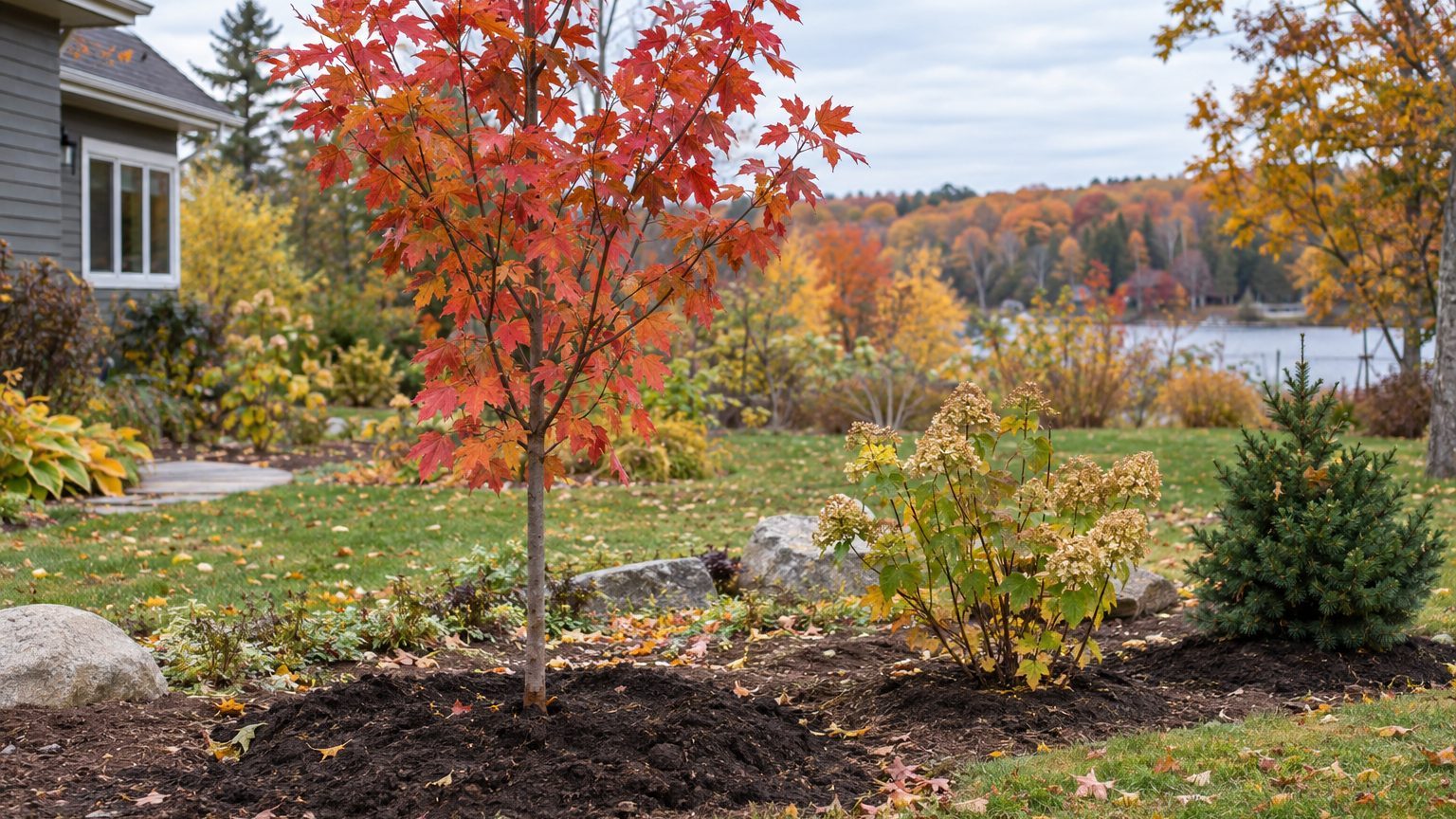

Six weeks before the first fall frost is the conservative cutoff for planting trees and shrubs in Nova Scotia. At Halifax Stanfield, where the first frost arrives on average October 18, that works out to a target of September 6. It is a safe date, not a hard wall. Hardy container and balled stock planted after it often does fine, because roots keep working until the soil turns cold. Each week of delay trims the margin, though, and colder districts inland run earlier.
The deadline in Nova Scotia
Trees and shrubs stop pushing leaves and shoots when nights cool, but their roots don’t clock out at the same time. Soil holds summer’s heat far longer than air does, so roots keep growing and anchoring while the surface above them looks like November. That is the whole logic of fall planting. Cornell Cooperative Extension states the working rule this way: “Fall is an excellent time for transplanting, provided you get them to their new home at least 6 weeks before the ground freezes, allowing them time to establish roots before winter dormancy.”
Notice what the rule counts from. It is the ground freezing, not the first frost, and the two are different events. Frost is an air temperature, and the soil freezes later. But almost nobody has a soil thermometer buried at planting depth, so a frost date is the practical stand-in, and it errs on the cautious side.
Working back from October 18
Environment and Climate Change Canada’s 1981-2010 climate normals for the Halifax Stanfield station put the average first fall frost on October 18. That is a mean, the midpoint of a window. In roughly one year out of two the frost lands later, and in the other half it lands earlier, so nobody should treat October 18 as a safe date. Count six weeks back from it and you get a conservative planting target of September 6, with late August through early September as the comfortable range for most of the Halifax area. Aim to have trees and shrubs in the ground by September 6 as the safe target, and earlier in colder districts.
That last clause matters. A province is not one climate. The Halifax Stanfield figure belongs to one station, and northern or upland districts get their first frost earlier, which pulls the planting target earlier by the same logic. If your property sits higher or farther north than the airport, shift your own deadline toward the start of September or before, not the end. The First and Last Frost Dates in Nova Scotia page lays out how those dates vary across the province.
The ground does freeze here, so the deadline is a real one. The mean daily minimum of the coldest month at the reference station is -10.4 °C (13.3 °F), from the same ECCC normals. That is cold enough that frozen soil is a normal part of every winter, and a root system that hasn’t settled by then has to survive on what it has. Canada’s own hardiness map, from Natural Resources Canada, places Halifax in zone 6b on the Canadian system (1991-2020 normals). That is not a USDA zone, and NRCan itself says there are no simple conversions between the two systems, because the Canadian one weighs seven climate variables instead of one. Gardeners comparing with the Upper Midwest can see how the same six-week logic plays out under a colder calendar in How Late Can You Plant Trees and Shrubs in Fall in Minnesota?
One more caveat on the numbers. Canadian normals cover 1981-2010, while US normals now use 1991-2020, so the frost date here describes a slightly older stretch of weather. Treat it as a guide to the season’s shape, not a promise.
What to plant late, and what to wait on
September 6 is the safe target, but the weeks after it are not off limits for every plant. What decides the outcome is how much the plant can tolerate when its roots are still small and the ground turns hard. Container-grown and balled-and-burlapped stock that is fully hardy for the area handles a late start best. These plants arrive with an intact root mass, so they skip the shock of bare roots, and a fully hardy species doesn’t need much of a root system to survive a cold winter dormant.
The risky categories are plants that sit near the edge of what the climate allows, and evergreens. Here is how the categories line up when planting runs past the early-September target:
| Plant type | After the September 6 target | Reason |
|---|---|---|
| Hardy deciduous trees and shrubs, in containers | Usually fine while the soil is workable | Dormant tops need little water, and roots still grow in unfrozen soil |
| Hardy trees and shrubs, balled and burlapped | Usually fine while the soil is workable | Intact root ball limits transplant shock |
| Borderline-hardy plants | Wait for spring | Little buffer against cold snaps with an unestablished root system |
| Broadleaf and needled evergreens | Plant early or wait for spring | Foliage keeps losing water all winter while roots can’t replace it |
Reading the hardiness tag
“Borderline” has to be measured against the local climate, and that takes some care with labels. The reference zone for Halifax is 6b on the Canadian hardiness system. A tag that cites a USDA zone is using a different yardstick, and the numbers don’t translate one to one. The better check is the actual cold. The coldest month’s mean daily minimum at the reference station is -10.4 °C, and that is an average. Individual nights go lower, so a plant that survives only on paper, with no margin, is a gamble even in a gentle winter. Buy from nurseries that grade plants for Nova Scotia or Atlantic Canada, and ask if the answer isn’t on the tag.
Evergreens deserve their own warning. Their needles and leaves keep transpiring through winter, and when the soil is frozen the roots can’t pull water up to replace what is lost. A freshly planted evergreen has a small root system to begin with, which is why it takes the biggest hit. Put evergreens and borderline-hardy plants in by the early-September target, or hold them for spring.
For the planting itself, the usual rules matter more late in the season, not less. Set the plant so the root flare, where the trunk widens at the base, sits at or slightly above the surrounding soil. Break up circling roots on container stock before backfilling. A plant buried too deep or with roots still wound in a circle has two strikes against it before winter starts. More on technique is in Planting and Caring for Trees, Shrubs and Perennials.
Watering and mulch until the ground freezes
A fall-planted tree has one job in its first winter: grow roots. Leaf and shoot growth is a spring problem. Every bit of energy the plant puts underground between planting and freeze-up is energy it won’t have to find next April, when new leaves and a dry spell arrive together. That is why watering matters so much after planting. The soil in the root zone needs to stay evenly moist, not soggy, for as long as it remains unfrozen.
Water deeply, then stop when the ground locks up
Slow, deep soaking beats frequent sprinkling. A light shower from a hose wets the top of the soil and encourages roots to stay shallow, while a long, slow soak carries water down into the root ball and the soil around it. Check the soil rather than the calendar: when it feels dry just below the surface, water again. Fall in Nova Scotia can bring long dry stretches, and a tree sitting in dry soil going into winter is stressed before the cold even starts. Keep watering until the ground freezes, then stop.
Skip fertilizer on new fall plantings. It encourages soft top growth that cold will burn, and the plant has no use for it while it is working on roots.
Mulch in a ring, not a volcano
Mulch evens out soil moisture and temperature around new roots. NC State Extension’s Gardener Handbook gives two figures that land in the same range. On weeds: “A 2-inch to 3-inch layer of mulch suppresses most annual weed seeds and makes it easy to hand-pull any that do germinate.” On trees: “Provide a 3-inch layer of mulch to reduce water loss and maintain uniform soil moisture and temperature around roots.” Stay inside that range. More is not better, and deep mulch is exactly how a ring turns into a volcano.
Spread it out across the root zone, in a wide ring, and pull it back from the trunk so bark stays visible and dry. Mulch heaped against the trunk holds moisture on the bark, which invites rot and gives rodents a sheltered place to chew. Keep the layer flat, like a doughnut around the stem. Practical details on materials and refreshing the layer are in Mulching Without Killing the Plant.
What goes wrong
The most common failure is plain lateness. Planting after the soil has started to freeze, or so close to it that roots never get a chance, leaves a plant dormant but unanchored. The six-week rule from Cornell exists because roots need that time, and the first frost at Halifax Stanfield averages October 18, with colder districts earlier. A tree that goes in during the last days of October may survive a mild winter and fail in a harsh one, and the difference comes down to luck. If the shovel hits frozen soil, keep the plant for spring rather than forcing it in.
Winter burn is the second problem, and it hits evergreens. Sun and wind pull moisture from needles and leaves while frozen roots can’t replace it, and the foliage turns brown by late winter. Young plants in exposed spots, such as open lawn or the windward side of a house, suffer most. Plants that got a deep watering before freeze-up and a proper mulch ring have a better chance.
Heaving is the third. Shallow root balls sitting in soil that freezes and thaws repeatedly can get pushed upward, leaving roots exposed to air and cold. Mulch evens out those swings, which is one reason the 2-inch to 3-inch layer pays off beyond weed control. If a plant looks like it has lifted in late winter, press it back gently into thawed soil and add mulch.
A dry fall is the quiet one. No storm, no frost damage, just dry soil and a plant that never had enough moisture to build roots. By the time dormancy arrives it is already behind, and nothing looks wrong until spring. Water while the ground is still workable, and the problem mostly takes care of itself.
Common questions
Is October too late to plant trees in Nova Scotia?
It is past the conservative target of September 6, which is six weeks before the October 18 average first frost at Halifax Stanfield. Hardy container or balled trees can still establish in October if the soil is workable, since the ground usually freezes after the first frost. The risk grows with each week, and colder or upland districts hit their limits sooner. Evergreens and borderline-hardy plants are better held for spring.
Is Nova Scotia’s zone 6b the same as USDA zone 6b?
No. Halifax is zone 6b on Canada’s plant hardiness system, according to Natural Resources Canada’s 1991-2020 normals. That system uses seven climate variables, while the USDA map uses one, and NRCan states there are no simple conversions between them. When a plant tag cites a zone, check which system it uses.
How deep should mulch be around a new tree?
NC State Extension recommends “a 3-inch layer of mulch to reduce water loss and maintain uniform soil moisture and temperature around roots,” and describes a 2-inch to 3-inch layer for suppressing weeds. Keep the layer within that range and pull it back from the trunk so it forms a ring, not a mound.
Should I just wait until spring?
For hardy container and balled plants, fall planting gives roots a head start, and the plant can use the spring growing season to grow instead of just survive. For evergreens, borderline-hardy plants, and anything you can’t get in the ground by early September, spring is the safer choice. Seasonal timing for other jobs is covered in the Nova Scotia guides.