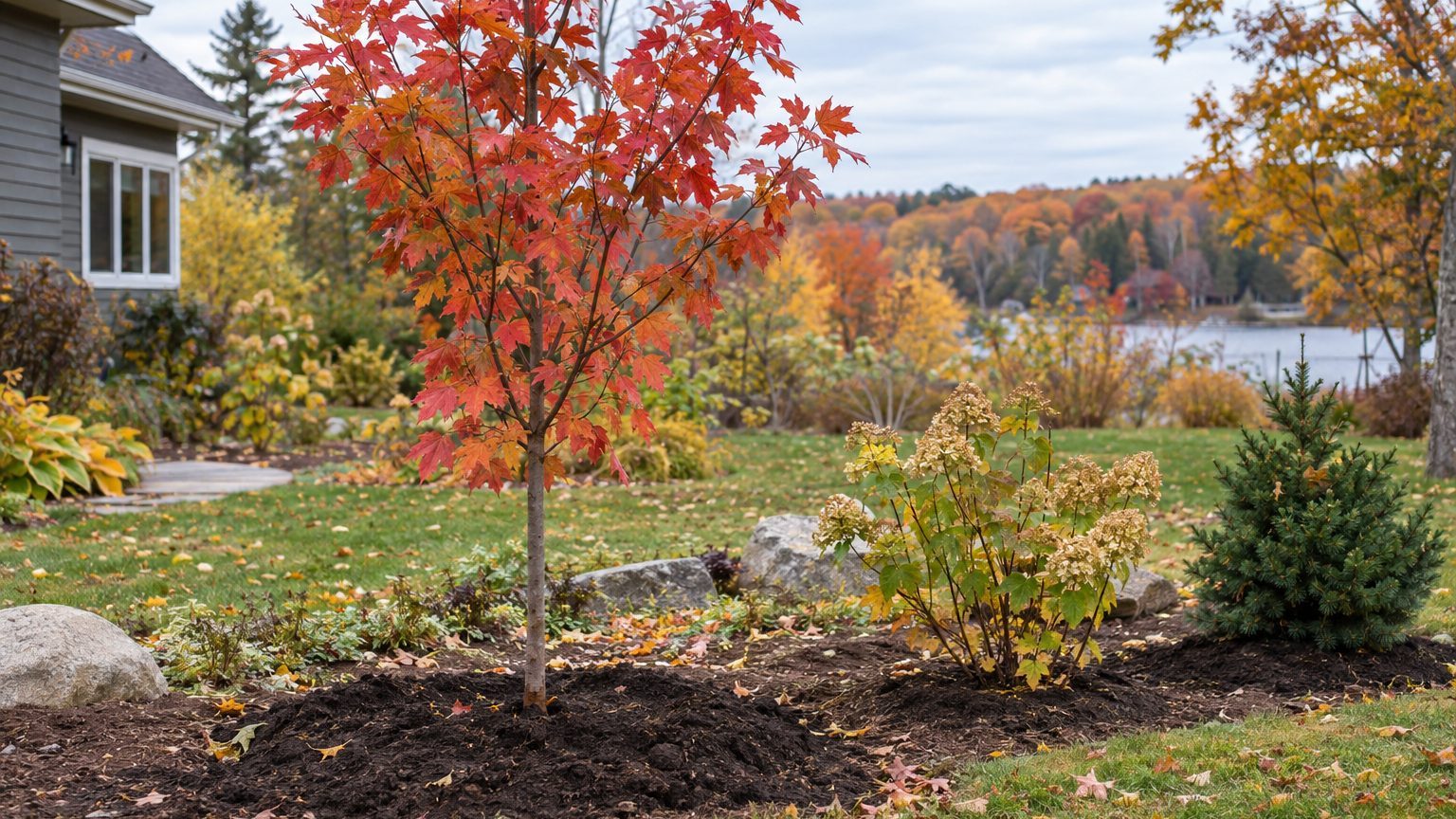

Plant trees and shrubs between September 5 and September 17 in Milwaukee and you are on the safe side of the line. That date is six weeks before the first fall frost, which NOAA’s 1991-2020 normals place at October 17 to October 29. Planting later works for many hardy plants. The real limit is the day the ground freezes, and that comes after the first frost, never before it. Farther north, every one of these dates arrives sooner.
The deadline in Wisconsin
Roots do not follow the air thermometer. A maple can drop its leaves in October and keep lengthening its roots for weeks afterward, as long as the soil stays workable and above freezing. That gap between the end of top growth and the freeze-up of the ground is the whole reason fall planting works. The tree has no leaves to feed, no heat to endure, and warm-ish soil to settle into.
Counting back from the first frost
NOAA’s 1991-2020 Climate Normals for Milwaukee (station USW00014839) put the first 32°F freeze of fall at October 17 to October 29. That range comes from the middle band of freeze probabilities, so some years are earlier and some later.
The planting rule itself comes from Cornell Cooperative Extension in Orleans County, New York: “Fall is an excellent time for transplanting, provided you get them to their new home at least 6 weeks before the ground freezes, allowing them time to establish roots before winter dormancy.”
Cornell counts from the ground freezing. Wisconsin gardeners rarely know that date in advance, so the practical move is to count six weeks back from the first fall frost instead. The numbers:
- First fall frost in Milwaukee: October 17 to October 29
- Six weeks earlier, the conservative planting target: September 5 to September 17
Treat that as the safe target, not the cutoff. Soil stays warmer than the air, so the ground freezes well after the first frost, and the true limit falls later than September. Plants that go in after the safe window are not doomed. They have less time to root, so they need more attention (more on that below).
Where the dates shift
Wisconsin is a long state, and the Milwaukee dates are a reference point rather than a statewide rule. Lake Michigan delays the first fall freeze right at the lakeshore. Inland southern Wisconsin typically freezes in early October, and the north freezes far earlier. The colder you are, the earlier everything on the fall calendar moves, so a gardener in the north should plant well ahead of September 5 to 17 rather than inside it.
Winter cold is not in question here. The mean daily minimum of Milwaukee’s coldest month is 17.2°F (NOAA Climate Normals, 1991-2020), well below freezing, so the ground does freeze and the deadline applies. The USDA Plant Hardiness Zone Map 2023 spans 3b to 6a across the state, which is why you should find your own town’s frost range in First and Last Frost Dates in Wisconsin and count back from it.
What to plant late, and what to wait on
Hardiness decides this more than the calendar does. The figure that matters is the 17.2°F mean daily minimum of Milwaukee’s coldest month. It is an average of the lowest temperature on each day of that month, so real cold snaps dip below it. A plant that merely tolerates 17°F on paper has no margin. Check the zone on the tag against the USDA system, and remember that the north runs colder than Milwaukee.
Container-grown and balled-and-burlapped plants that are fully hardy here establish well in fall. Their roots arrive mostly intact, and the cool, damp weather spares them the stress of a hot July. A hardy shrub in a pot can go in after the safe window if the soil is still workable, provided you keep it watered. Trees and shrubs sold with a tight, healthy root mass are the best candidates for a late start.
The risky ones
Two groups cause most of the grief. Evergreens, both needled and broadleaf, keep losing water through their foliage all winter while frozen soil blocks the replacement supply, so they need roots in place early. Plants at the edge of hardiness for your area have no cushion against a hard winter, and a fresh planting is already stressed. The rule for those is simple: if a plant is borderline hardy here, wait for spring, when it gets a full season of roots before its first test.
| Plant type | Inside the safe window | After the window |
|---|---|---|
| Hardy deciduous shrubs, container-grown | Good time to plant | Often fine while soil is workable; water until freeze-up |
| Hardy deciduous trees, container or balled | Good time to plant | Possible, but less root time; stake only if needed and mulch |
| Needled evergreens | Plant early in the window | Risky; consider waiting for spring |
| Broadleaf evergreens | Plant early in the window | Wait for spring in most cases |
| Borderline-hardy plants | Better saved for spring | Wait for spring |
The table is a guide, not a guarantee. Local conditions such as wind exposure, soil type and how early your area freezes can tip a plant from “possible” to “wait.” The basics of digging, backfilling and settling a root ball are laid out in Planting and Caring for Trees, Shrubs and Perennials, and they matter just as much in October as in May.
One practical habit helps: shop in late summer, when nurseries still have good selection, and plant within days of buying. A shrub that sits in its pot on the patio through September loses the very weeks you are trying to protect.
Watering and mulch until the ground freezes
Water deeply, then keep doing it until the ground freezes. Fall in Wisconsin can turn dry, and a new root system only a few months old cannot reach moisture the way an established tree can. A slow, soaking drink beats a light daily sprinkle, because it pushes water down where roots will follow. Check the soil near the root ball with a finger or trowel before each watering. If it is damp, skip it. Soggy soil suffocates roots just as surely as drought dries them.
Keep going after the leaves drop. Deciduous plants look dormant, but their roots are still working, and evergreens never stop using water. Many a fall planting dies not from cold but from a dry November that nobody noticed, since the plant looked fine above ground.
Mulch in a ring, not a volcano
Mulch earns its place by holding moisture and smoothing out temperature swings. NC State Extension gives two statements that point to the same depth. On weeds: “A 2-inch to 3-inch layer of mulch suppresses most annual weed seeds and makes it easy to hand-pull any that do germinate.” On trees: “Provide a 3-inch layer of mulch to reduce water loss and maintain uniform soil moisture and temperature around roots.” (NC State Extension Gardener Handbook, chapter 11, Woody Ornamentals.) A 2-inch to 3-inch layer is the target, and more is not better.
Spread it in a wide ring over the root zone, and pull it back from the trunk so bark stays dry and visible. A mound piled against the trunk, the dreaded mulch volcano, holds moisture against the bark, invites rot, and gives mice and voles a sheltered place to nest and chew through winter. For the full method, see Mulching Without Killing the Plant.
The first winter is about roots
Do not expect growth, and do not push it. A fall-planted tree or shrub spends its first winter and the following spring building the root system that will carry it through every summer afterward. Skip the fertilizer, which pushes tender top growth at the wrong time, and hold off on heavy pruning beyond removing broken branches. If the plant looks unchanged above ground for months, that is the job going as planned. The visible growth comes later, once the roots have something to feed it with.
What goes wrong
The most common failure is simply planting too late for the local climate. A shrub installed in the south of the state in late October has more room for error than the same shrub in the north in the same week, because the north freezes far earlier. If your frost range is early, the safe target is early too. When in doubt, count back from your own first frost, not Milwaukee’s.
Winter burn and drying out
Evergreens lose water through their needles and leaves all winter, and bright sun and wind speed that up. When roots sit in frozen ground they cannot replace the loss, so foliage turns brown and crisp by late winter. New plantings are the most exposed because their roots have not spread. Plant evergreens first in the window, water them well into late fall, and in windy, open sites consider a temporary screen on the side facing prevailing winter wind. Skip fall planting for evergreens once the safe window has passed if the site is exposed.
A dry fall causes a quieter version of the same damage. Roots dry out before freeze-up, and the plant enters winter already short on water. It is the most preventable problem on this list, and the fix is the deep watering described above.
Heaving of shallow root balls
Wisconsin soil freezes and thaws repeatedly through late fall and early spring. Plants set in shallow, or without enough root growth to anchor them, can be pushed upward by the expanding soil, exposing roots to air and wind. Mulch helps by keeping soil temperature steadier. After each thaw, look for a plant sitting higher than before, and if you find one, firm the soil back around it gently and add mulch.
None of these problems is a verdict against fall planting. They are the predictable cost of cutting the window short, and nearly all of them trace back to timing or watering. More local guidance is gathered in our Wisconsin guides.
Common questions
Can I still plant after the first frost?
For hardy, container-grown deciduous plants, often yes, as long as the soil is workable and not frozen. A light frost does not stop root growth. Freezing ground does. Water thoroughly, mulch in a ring, and accept that the plant has less time to root than one planted in September. Evergreens and borderline-hardy plants are better held until spring.
Is September 5 to September 17 a hard cutoff?
No. It is the conservative target, six weeks before the first fall frost in Milwaukee. The real limit is when the ground freezes, which falls later. Inside that earlier window you get the most root time. Planting after it is a trade of safety margin for convenience, and the margin shrinks fastest for evergreens.
Do these dates apply in northern Wisconsin and along the lake?
Not exactly. Lake Michigan delays the first fall freeze at the lakeshore, so the shoreline gets a little more time. Inland southern Wisconsin typically freezes in early October, and the north far earlier. Colder areas move all fall tasks earlier, including the planting deadline. Use your own town’s first-frost range and count back six weeks.
Does advice from other states apply here?
The logic travels, the dates do not. Cornell’s six-week rule comes from New York, and neighboring-region comparisons such as How Late Can You Plant Trees and Shrubs in Fall in New Hampshire? show the same reasoning with different calendars. Wisconsin’s own coldest-month mean daily minimum of 17.2°F in Milwaukee confirms that the ground freezes here, so a deadline counted from your local frost range is the one to use.