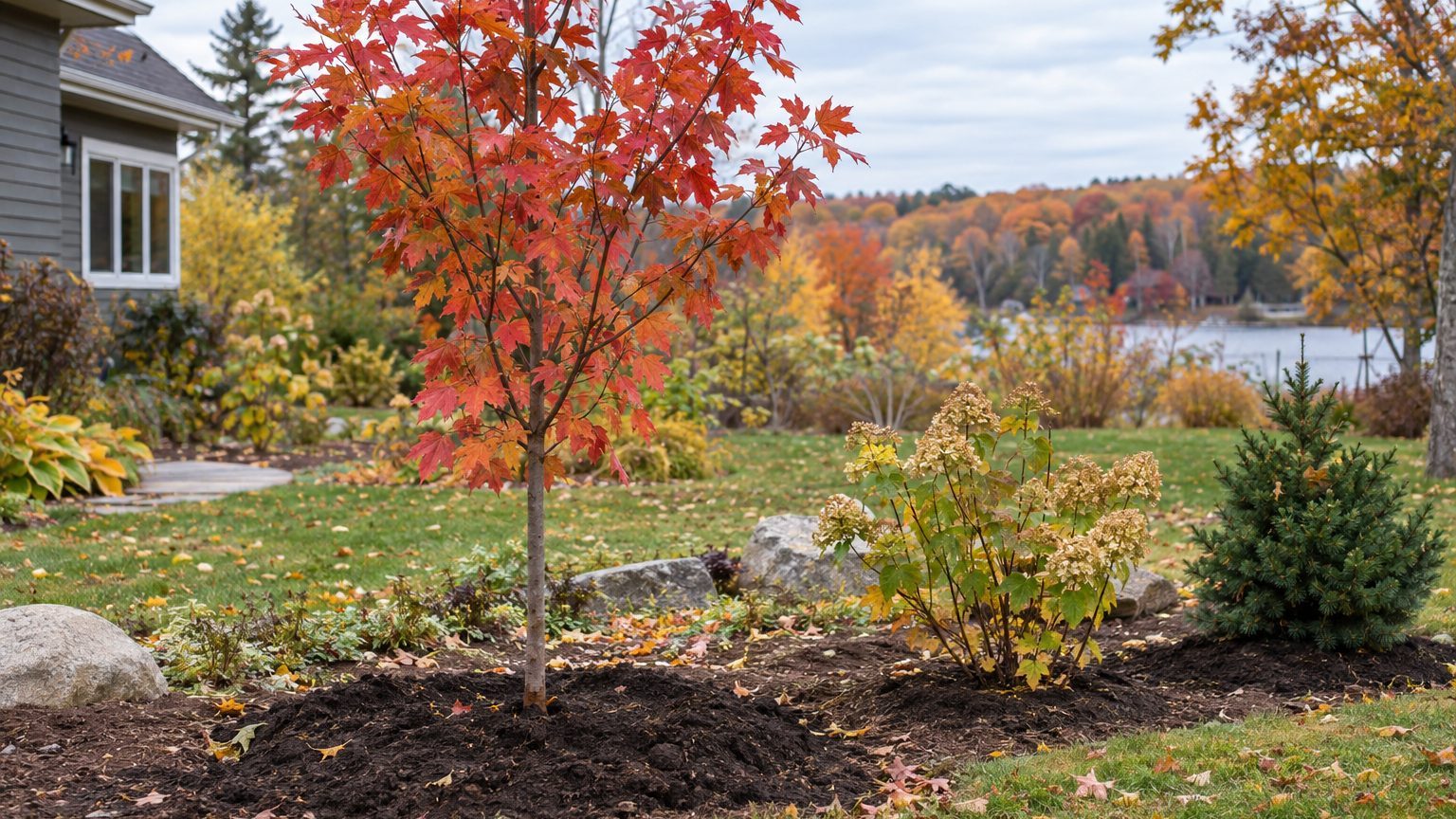

In Yukon, the safe target for fall planting is six weeks before the first fall frost, which at Whitehorse works out to mid-July. Later planting can work, and plenty of hardy container stock survives it. But every week past that target thins the margin. The true limit is the day the ground freezes, which arrives well after the first frost, so the weeks in between are borrowed time. Here is how to work out your own date.
The deadline in Yukon
Roots don’t take their cues from the air. Soil holds on to summer warmth long after nights start dipping below freezing, and roots keep growing as long as that soil is workable and above freezing. Leaves yellow and drop, top growth shuts down, and underground the plant is still reaching outward. That is the whole reason fall planting works. It is also why the deadline is set by the soil, not by the first frosty morning.
Cornell Cooperative Extension puts the rule this way: “Fall is an excellent time for transplanting, provided you get them to their new home at least 6 weeks before the ground freezes, allowing them time to establish roots before winter dormancy.” Notice what it counts back from. Not the first frost, but frozen ground. Since the ground freezes later than the air does, counting back from the first frost builds in a cushion, and that cushion is what makes the date conservative.
Environment and Climate Change Canada’s 1981-2010 normals for the Whitehorse A station put the average first fall frost on August 25. Count six weeks back and you land on July 14. Mid-July, six weeks before the first fall frost, is the safe target for getting trees and shrubs into Yukon ground. Plant by then and the roots get a full run at the soil before winter. Plant in the weeks after it and you are trading safety for convenience, a little more with each passing week.
Why August 25 is a midpoint, not a promise
That August 25 figure is a mean. In one year out of two, the first frost comes later than that. In the other half, it comes earlier, and in those years a mid-July deadline is already tight. Treat the date as the middle of a window, never as a guarantee.
It also describes one place. The figure comes from the Whitehorse A station, and Yukon is not one climate. Districts farther north and at higher elevation get their first fall frost earlier, so their planting deadlines move earlier too, not later. If you garden above the valley floor, shift your target toward the beginning of July or before. A closer look at first and last frost dates in Yukon helps you place your own yard. One more wrinkle: Canadian normals cover 1981-2010, while US figures cover 1991-2020, so the two sets of numbers don’t line up neatly.
Why this territory has no winter loophole
In mild parts of the continent, fall and even winter planting are the best option because the ground never really locks up. Yukon is the opposite. The coldest month at Whitehorse has a mean daily minimum of -19.2 °C (-2.6 °F, if you are comparing with US figures), according to the same Canadian normals. Natural Resources Canada places Whitehorse in plant hardiness zone 1b under the Canadian system, which is built on seven climate variables and does not convert to a USDA zone. The ground here freezes solid, so the deadline applies everywhere in the territory. Nobody should plan to plant in November.
Readers who also garden south of the border with British Columbia can compare notes in How Late Can You Plant Trees and Shrubs in Fall in British Columbia?, though that province’s climate spreads across a much wider range.
What to plant late, and what to wait on
Not every plant handles a short fall window equally. The safest candidates are those already holding a full root system in a pot or a ball of soil, and that are fully hardy for this zone. The risky ones are plants living near the edge of what the climate allows, and evergreens that keep losing water through their foliage all winter while frozen soil can’t replace it.
Good candidates for the late window
Container-grown shrubs and trees that are rated hardy for Canadian zone 1b or colder are the best bet. Their roots are intact, they come out of the pot with soil attached, and they settle in faster than anything that has been dug and moved. Balled and burlapped trees can also work if they are fully hardy, though the ball is heavier to handle and dries out faster if it sits around. Whatever you buy, check the hardiness tag for the Canadian zone, not a USDA one. The two systems don’t map onto each other, and a plant that is “one zone short” is a gamble the first winter is happy to collect on.
What to hold until spring
Anything borderline hardy should wait. A plant that barely survives a normal Yukon winter has no spare strength for a first winter with undeveloped roots. Evergreens deserve extra caution too. Spruces, pines and other conifers keep their needles, and needles keep losing moisture in cold, dry, sunny weather. A plant with a thin root system has no way to keep up, which is exactly the setup for winter burn. Bare-root stock is best planted in spring while still dormant, and by late summer there is little reason to try it.
| Plant type | Late planting outlook | Main concern |
|---|---|---|
| Hardy container-grown shrubs and deciduous trees | Good, if in the ground by mid-July or soon after | Needs steady water until freeze-up |
| Hardy balled and burlapped trees | Fair to good, early in the window | Heavy ball can dry out before planting |
| Evergreens | Risky after mid-July | Water loss from needles all winter |
| Plants at the edge of zone 1b hardiness | Wait for spring | No margin for a young root system |
| Bare-root stock | Wait for spring | Needs dormancy and a full growing season |
The decision to write down: if it is rated hardy for your zone and in a container, plant by mid-July; if it is borderline or an evergreen, buy it now if you like, but plant it next spring. Nurseries sometimes discount stock in late summer. A discount is a poor reason to plant something that has no time to root.
Watering and mulch until the ground freezes
The first winter is about roots, not growth. A newly planted tree or shrub is spending its energy on pushing roots into the surrounding soil. You won’t see that work, and you shouldn’t try to coax visible growth on top of it. Skip fertilizer in late summer, since it can push tender new shoots that frost will kill. Hold off on pruning beyond removing broken branches. What the plant needs is moisture at its roots and an even soil temperature around them, and both come down to water and mulch.
Water deeply and slowly, enough that moisture reaches the full depth of the root ball and the soil beyond it, then let the top layer dry slightly before the next soaking. Shallow sprinkling teaches roots to stay near the surface, which is the wrong habit going into winter. Fall in a dry year is the situation to watch closely, because rain can’t be counted on to do the job. Poke a trowel or a finger into the soil near the root ball. If it is dry a few inches down, the plant is thirsty, whatever the weather looks like. Keep this up until the ground freezes, since that is the point when roots can no longer take up water.
Mulch earns its keep here. NC State Extension’s Gardener Handbook says: “A 2-inch to 3-inch layer of mulch suppresses most annual weed seeds and makes it easy to hand-pull any that do germinate.” On trees, it adds: “Provide a 3-inch layer of mulch to reduce water loss and maintain uniform soil moisture and temperature around roots.” Two different purposes, same order of depth. Keep mulch within that 2-inch to 3-inch range, spread in a flat ring that stops short of the trunk. More is not better.
The usual mistake is the volcano: mulch piled against the trunk in a cone. It holds moisture against the bark, invites rot, and gives mice and voles a sheltered place to nest and chew through winter. A ring leaves the base of the trunk bare and exposed to air, and spreads outward over the root zone where the benefit actually lies. For a deeper look at the technique, see Mulching Without Killing the Plant, and for the broader routine of setting plants in the ground and looking after them, Planting and Caring for Trees, Shrubs and Perennials covers the rest.
What goes wrong
Planting too late for this climate is the leading cause of failure, and it rarely looks like failure in the fall. The plant seems fine, the leaves hold or drop on schedule, and nothing signals trouble until spring, when buds don’t open or the shoots die back to wherever roots managed to anchor. If you planted well past mid-July and the ground froze before roots could spread, the plant had no foundation to wake up on. Since the first fall frost can come before August 25 in about half of years, a planting made right at the safe date still has little slack. If you missed mid-July by more than a couple of weeks, consider heeling the plant into a sheltered spot or keeping it potted and setting it out next spring.
Winter burn is the next problem, and evergreens take the worst of it. On cold, bright, windy days needles lose water faster than frozen soil can deliver it, and the tips turn brown by late winter. A tree with a well-established root system can usually survive a spell of this. A newly planted one is far more exposed. Deep watering until freeze-up is the best protection, since a plant that goes into winter with moist soil around its roots has a reserve to draw on. Placement matters too, so pick a spot out of the harshest wind where you can.
Heaving is the slow one. When soil freezes, thaws and freezes again, it can push shallow or loosely set root balls upward, leaving roots exposed to cold air. Firm the soil well around the ball at planting and keep the mulch ring in place, since steady soil temperature is what calms the cycle. Check in spring and gently press down any plant that has lifted.
Drying out in a dry fall finishes the list, and it is the easiest to prevent. Water is free insurance, and the effort is small compared with replacing a tree. More local planting advice is collected in the Yukon guides.
Common questions
Can I still plant in September in Yukon?
You can, but the odds are against you. By September, the safe target of six weeks before the first fall frost has long passed, and the first frost at Whitehorse averages August 25, with colder districts getting it sooner. A hardy container plant, watered deeply and mulched, may make it through. An evergreen or a borderline plant probably won’t. When in doubt, wait for spring.
Does the first frost end the planting window?
No. Frost is an air temperature, and roots respond to soil. Planting can technically continue until the ground freezes. The trouble is that the soil is cooling and the time left for rooting shrinks daily. The first frost is a useful marker for counting back, but it is not the true cutoff.
Is the Whitehorse date the same everywhere in Yukon?
No. The August 25 average comes from the Whitehorse A station, and it is a mean, so half of years see frost later and half earlier. Districts farther north or at higher elevation get their first fall frost earlier, which moves the planting deadline earlier as well. If your yard sits above the valley floor, give yourself extra time.
What if I miss the deadline?
Keep the plant in its container, set it somewhere sheltered, and keep it watered until the ground freezes. Then plant in spring as soon as the soil is workable. A pot sitting over winter is not risk-free, since roots in a container are more exposed to cold than roots in the ground, so a protected spot out of wind is worth the effort.