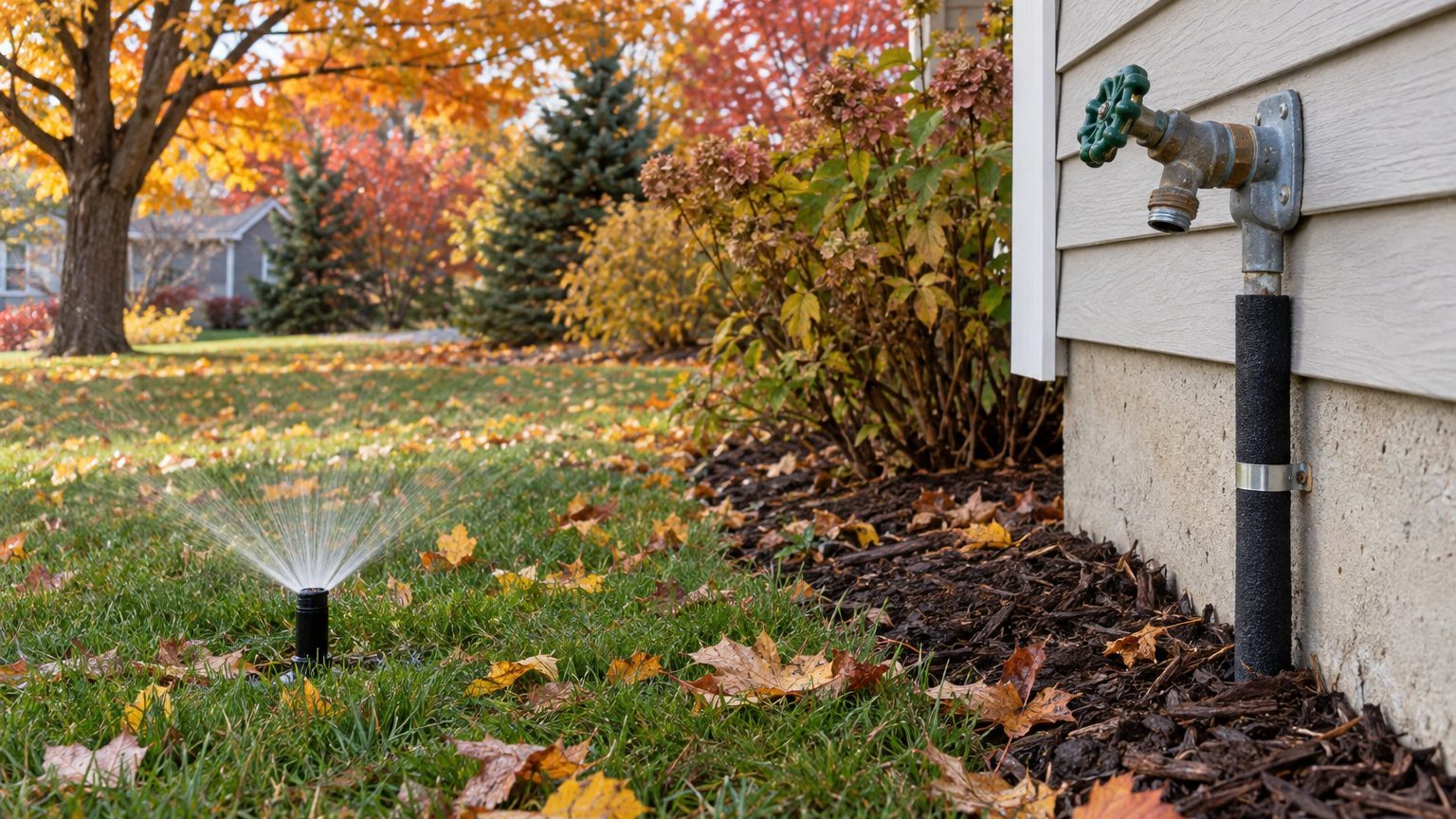

In Indiana, sprinklers and outdoor faucets need to be shut down before the first hard freeze. At Indianapolis that freeze typically arrives between October 21 and October 30, based on NOAA’s 1991-2020 Climate Normals. The coldest month there averages a nightly low of 20.9°F, so water left in a line will freeze, and a full blowout is the right call here rather than an optional extra. Hoses off, interior valves closed, lines emptied. Do it during the dry, mild weeks before that range, not the evening a cold front shows up in the forecast.
When to do it in Indiana
Finish before the first hard freeze, not after the first light one. At the Indianapolis station, NOAA NCEI’s 1991-2020 Climate Normals put the first fall 32°F freeze (the 30-70% probability band) between October 21 and October 30, so the working window is the stretch of weeks leading up to that range. Have sprinklers blown out and hoses off before the October 21 to October 30 first-freeze range begins.
The difference between “light” and “hard” matters more than the calendar. A light frost on a clear night will blacken tomato vines and basil, yet the water in buried pipe barely notices. Pipes freeze when cold lasts for hours and gets down into the ground, and the parts that go first are the ones above it: the backflow preventer, the exposed fittings, the outdoor spigot. Waiting for a killing frost in the garden as your signal is waiting too long. By then the first overnight freeze has already tested the exposed parts of your system.
Indiana does not offer a shortcut. In a mild-winter climate where nights rarely drop below freezing, a full blowout is often unnecessary and a quick check of the controller and the spigots covers it. That reasoning does not carry over. With a coldest-month mean minimum of 20.9°F (NOAA NCEI Climate Normals 1991-2020, Indianapolis), an average January night sits well under freezing, and a typical winter will include stretches far colder than that average. Every Indiana system holding water needs to be emptied.
Where you live in the state shifts the date
Indianapolis is the reference point, and the rest of the state moves around it. The colder north has an earlier first fall frost, so northern Indiana homeowners should work toward the early edge of the range or ahead of it. Southern Indiana runs later in autumn than the north by a fortnight or more, which gives homeowners there more breathing room, though not a reason to put it off. A weekend at the end of the first half of October is a sensible target for the north, with the south a little later. Treat the Indianapolis range as a deadline for the finished job, not a start date.
The USDA Plant Hardiness Zone Map (2023 edition) places Indiana in zones 5b to 7a. That system rests on one variable, the average annual extreme minimum temperature, so it describes how cold the worst nights get across the state, and it differs between Lake Michigan and the Ohio River. Use it as a reminder that the state is not uniform, and use your own local forecast and the Indiana frost dates for fine-tuning. The rest of the Indiana guides cover what else belongs on the fall to-do list.
Sprinkler lines: drain or blow out
Water that sits in a sprinkler line when the temperature drops will freeze and expand, and the pipe, fitting or valve body that contains it will give way. PVC mains split along their length. Fittings pop apart at the glued joints. Valve bodies and the backflow preventer crack, often hairline at first. You will not see any of it until spring, when the pressure comes back on and the system starts leaking into the lawn. Draining and blowing out are simply two ways of getting that water out before it freezes.
Three methods compared
| Method | How it works | Weak point | Fit for Indiana |
|---|---|---|---|
| Manual drain | Shut the supply, open drain valves at low points so gravity empties the pipe | Water stays in any dip, sag or head body that sits below the drain | Works only on systems built with enough slope to the drains |
| Automatic drain | Valves open on their own when line pressure falls, letting water out | Can stick or clog, and low spots still hold water | A partial backup, not a full answer |
| Compressed-air blowout | Air pushed through each zone forces water out of the lines and heads | Too much air pressure damages parts, and an inexperienced hand can miss zones | The standard approach for a climate with a 20.9°F coldest-month minimum |
Gravity drains look attractive because they cost nothing, and on a system laid out with consistent slope they do much of the job. The trouble is that few residential layouts are that clean. Add years of settling soil, and pockets of water form that no drain valve reaches.
Which one Indiana calls for
With nights regularly dropping far under freezing, a compressed-air blowout is the dependable method, and many Indiana installers treat it as routine for that reason. Manual and automatic drains are useful for relieving the main line and the backflow assembly, but air is what clears the lateral lines and sprinkler heads. Plan the blowout for the weeks before the first hard freeze, zone by zone, with the water supply to the system shut off first.
The sequence matters. Close the main supply to the irrigation system, drain the backflow preventer according to its design, connect the compressor to the blowout port, and run each zone in turn until only mist comes from the heads. Then repeat the pass once, because water collects and travels. Never stand over a head or a pipe fitting while it is under air, and wear eye protection. Switch the controller to its off or rain setting afterward so zones don’t try to run through the winter.
Hiring a professional is the sensible move in three situations. The first is when you do not own or cannot safely rent a compressor with the capacity your system needs. The second is when the lines are an unknown quantity (a house you just bought, with no layout drawing). The third is when you suspect water is already in the line from a cold night, since forcing air into a possibly frozen pipe can cause damage. A pro also knows the pressure limits for each pipe and head type, which is the part a first-timer is most likely to get wrong.
If you are already pulling the compressor out of the garage, it is a good moment to turn to the yard itself. The same weeks suit the tasks in Winterizing a Lawn.
Outdoor faucets and hoses
This job asks for no tools. Hoses come off, splitters and spray nozzles come off, and every bit of water has to be able to leave the faucet. A hose left connected keeps the faucet full, because it traps water behind the spigot and in the short length of pipe feeding it. That trapped water is what freezes first and what splits the pipe back inside the wall, where it can stay unseen for months.
The routine is short. Disconnect and drain every hose, then coil and store them. Find the interior shutoff valve for each outside spigot, usually in a basement, crawl space or utility room, and close it fully. Go outside and open the faucet to let the remaining water run out, and leave it open all winter so any leftover drops have room to expand. If the interior valve has a small bleeder cap, loosening it lets the last water out, and that counts as turning a valve, not plumbing work. Anything beyond that, such as replacing a faucet, re-soldering a line or cutting into a wall, is a job for a plumber. For a longer walkthrough, see Winterizing Outdoor Faucets Before the First Freeze.
Why a frost-free faucet still fails with a hose attached
A frost-free faucet carries its shutoff seat at the end of a long stem, deep inside the heated part of the house, so the water stops where it is warm. Its barrel is also built to slope slightly downhill and drain itself every time the faucet is closed. A hose changes that. Attach one, or leave a nozzle on the end, and water cannot leave the barrel. It sits in the unheated stretch of pipe just behind the wall, where it freezes and splits the tube. Nothing looks wrong from outside. The leak waits until you turn the water back on in spring.
So even a frost-free model needs the hose off before the first hard freeze. If you are not sure which type you have, the length of the stem and a sloping body are the usual signs, and Frost-Free Outdoor Taps explains how to tell. Pull every hose off by the time the first-freeze range of October 21 to October 30 approaches, and leave the outdoor taps open.
What goes wrong here
The most common failure is timing. Indianapolis’s typical first 32°F freeze falls between October 21 and October 30, but that range is the middle of a probability band, not a guarantee. Some years deliver a freeze before it, and someone who was planning to get to the sprinklers “next weekend” ends up draining a system that has already been through a hard night. The spring symptom is a zone that will not hold pressure, a geyser at a cracked head, or a soggy patch of lawn that never dries.
The forgotten hose and the flooded valve box
Next comes the forgotten hose. One left on the back spigot is enough: the spigot freezes, the pipe behind it splits, and the damage stays hidden until the first spring use. Then you hear a hiss inside the wall or find a damp patch on a basement ceiling or drywall near the exterior wall. The cure is a habit: every spigot gets checked for a hose, and the side and back of the house get walked before the date, not just the front.
The third failure is the valve box. These buried boxes hold the control valves for each zone, and they fill with rainwater or runoff. If water sits in the box and freezes, it cracks the valve body or the fittings around it. Spring brings a valve that will not close fully, a zone that leaks continuously, or a box that is permanently full of water. Draining the valves as part of the blowout and checking that the box has gravel beneath it and a lid on top prevents most of it. Do not skip the lid, because leaves and soil fill the box and trap moisture against the valves.
One more habit helps. A freeze that comes early often arrives just as households decide whether to start the furnace, and the Indiana heating season timeline is a useful companion to this one. If a pipe does freeze, Frozen Pipes covers what to do. Mark your calendar for a check in the weeks before October 21, with hoses and valve boxes first on the list. The fact most people miss is that the ground and the walls hold their cold longer than the air does, so a pipe that froze in a January snap may not thaw until well after the weather has turned.
Common questions
What if a hard freeze arrives before I have blown out the sprinklers?
Wait for temperatures to climb back above freezing before running air through the system. Forcing air into a line that may already hold ice can crack pipes. Once it thaws, do the blowout, or call a professional if you are unsure what condition the lines are in. Then check for leaks in spring.
Is turning off the controller and the main valve enough?
No. Shutting the supply stops new water from entering, but everything already in the lines, heads and valves stays there and can freeze. Draining or blowing out is what removes it. With a coldest-month mean minimum of 20.9°F at Indianapolis, leftover water has plenty of cold to work with.
Do I need to winterize a frost-free faucet?
Yes, though the job is lighter. Remove the hose and any attachment, and if there is an interior shutoff valve, close it and open the outdoor tap to drain. The faucet is built to empty itself, but only when nothing is connected to it.
Does the date change between northern and southern Indiana?
It does. Indianapolis, with a first fall freeze typically between October 21 and October 30, is the reference point. Farther north the first frost comes earlier, so winterize sooner. Southern Indiana runs a fortnight or more later in autumn than the north, so you have a little more time, but the job should still be done before the first hard freeze there too.