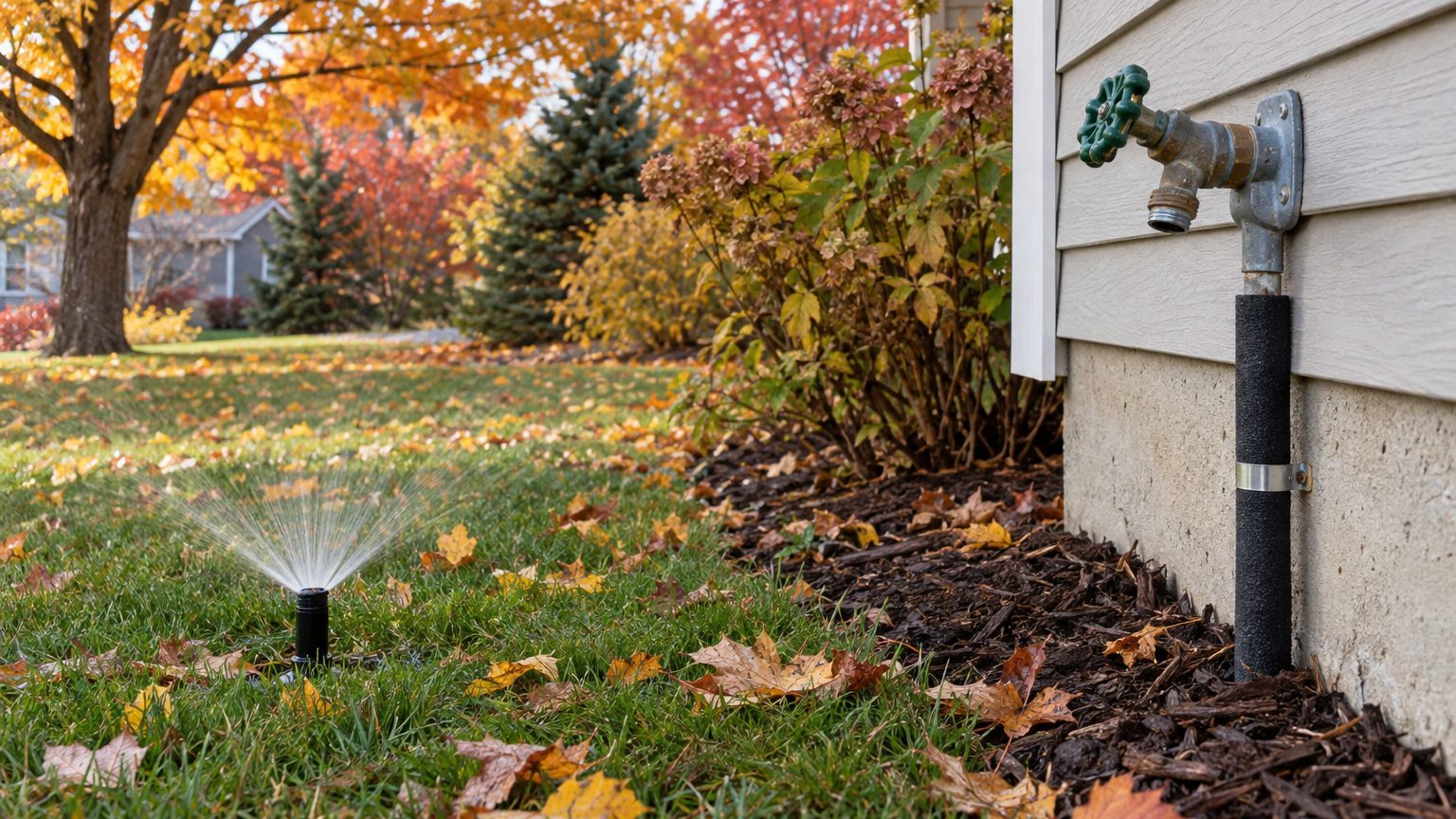

Michigan winters leave no room for skipping this chore. Sprinkler lines, valves and outdoor taps all need to be emptied before fall’s first hard freeze, and the right week moves earlier the farther north you live. Below: the calendar window, the three ways to empty a sprinkler system, how to shut down hoses and spigots using nothing but valves, and the spring damage that comes from waiting a week too long.
When to do it in Michigan
Finish the job before the first fall frost arrives, which the MSU Extension Michigan Garden Calendar puts at October 6 to October 21 for zone 6a. The rule is before the first hard freeze, not after the first light one, because a light frost is only the warning shot.
Why the frost window is a deadline, not a target
Frost dates are averages, and a first frost that whitens the grass rarely does anything to a buried pipe. The trouble comes next. A warm, sunny stretch often follows that first frost, everyone relaxes, and then one clear night drops well below freezing. The parts that suffer first are the ones sitting in open air: the above-ground backflow preventer, exposed valves, the spigot on the back of the house. Soil insulates buried pipe for a while longer, but not the fittings that stick out of it.
Michigan’s cold is not marginal, either. NOAA’s NCEI Climate Normals for 1991-2020 put the mean daily minimum of the coldest month at 19.2°F at the Detroit reference station. That is the average overnight low, so plenty of nights run colder. Nothing about a winter like that lets you skip the work. Any water left in a line, a valve body or a faucet barrel has time to freeze solid, and a full drain or blowout is the normal, sensible routine here.
Draining early costs almost nothing. By the time frost is in the forecast, lawns and beds have stopped asking for much water, so a system shut down a little ahead of schedule rarely leaves anything thirsty.
Shifting the date for your part of the state
The USDA Plant Hardiness Zone Map (2023 edition, built on 1991-2020 normals) spreads Michigan from 4a to 6b, so no single date fits everyone. The October 6 to October 21 range belongs to zone 6a, the Detroit-area baseline. Farther north and at higher elevation, the first frost comes earlier, which means the draining should come earlier too. Treat the window as the latest acceptable moment there, and watch the forecast for the first night that looks close to freezing.
Other fall jobs run on their own clocks. Lawn care, for example, follows a different schedule, covered in Winterizing a Lawn, and the regional timing for other seasonal tasks sits in the Michigan guides.
Sprinkler lines: drain or blow out
Water expands as it turns to ice, and a pipe wall or valve body has nowhere to give. Rigid PVC splits lengthwise, fittings crack at the joints, and the plastic housings of valves and the brass and plastic parts of a backflow preventer can fail as well. The nasty part is that nothing shows until spring, when the system is pressurized again and water sprays out of a crack that formed months earlier.
Three ways to empty a system
Manual drain, automatic drain and compressed-air blowout do the same job with different levels of thoroughness. A quick comparison:
| Method | How it works | Catch |
|---|---|---|
| Manual drain | You shut the water supply and open drain valves at low points so gravity empties the pipes | Works only if the system was built with those valves and slopes, and you can find them all |
| Automatic drain | Small valves open on their own when line pressure drops and let water out | Can leave water in low spots and does nothing for the backflow preventer |
| Compressed-air blowout | Air pushed through each zone forces water out of the pipes and sprinkler heads | Needs a compressor with enough volume and careful pressure control |
Which one Michigan calls for
With winter lows averaging 19.2°F in the coldest month at the Detroit reference station (NOAA NCEI, 1991-2020), gravity alone is a gamble. Blow out every zone with compressed air before the first hard freeze, even if the system has manual or automatic drains. Those drains do their job on the main lines but rarely catch every trapped pocket.
The method matters as much as the tool. Shut off the water supply to the irrigation system first, then attach the compressor at the blowout port and work one zone at a time, starting with the zone farthest from the compressor. Run each zone only until the heads spit a fine mist, then move on. Sprinkler heads spinning dry for too long can overheat and wear. Stay within the pressure limit the system’s manufacturer sets, wear eye protection, and never stand over a pipe or head while air is flowing. Leave the drain valves open afterward and set the backflow preventer’s handles halfway so nothing pools inside. Put the controller in rain or off mode instead of unplugging it, so the schedule survives.
When a professional is the sensible choice
Hire out the blowout if you can’t tell what kind of system you own, if there’s no map of the zones, or if the only compressor you can get is a small one that runs out of air halfway through the yard. A pro makes sense, too, when the system has a pump or an unusual setup, and when a wrong pressure setting would cost more than the service call. Book the visit so it lands before the October 6 to October 21 window opens, not inside it.
Outdoor faucets and hoses
This job asks for nothing but a few turns of a valve and about ten minutes per tap. Do it the same day as the sprinklers, or just before, so both jobs are finished ahead of the frost window.
- Disconnect every hose, splitter, timer and sprayer from every outdoor tap, front, back and garage side.
- Close the interior shutoff valve that feeds each outside tap, usually found in a basement, crawl space or utility room.
- Open the outside tap all the way so trapped water runs out, and open the small bleeder cap on the interior valve if it has one to drain the last of it.
- Leave the outside tap open for the winter and put the bleeder cap back on loosely.
Drain each hose as you go, coil it, and store it indoors or in a shed. A hose left full of water and attached to a tap does the most harm, and one left out on the lawn will crack.
Frost-free faucets fool people. The valve seat sits deep inside the heated part of the wall, and the long barrel is meant to tilt slightly downward so water runs out when the tap closes. Leave a hose attached and the water can’t drain, so the barrel stays full, freezes and splits. The damage stays hidden inside the wall until spring, when you turn the tap on and water sprays behind the drywall. The Frost-Free Outdoor Taps page covers how these fixtures are built, and Winterizing Outdoor Faucets Before the First Freeze goes deeper on the routine.
Disconnect the hose and close the interior valve before the first-frost window of October 6 to October 21. That is the entire decision. Anything beyond turning valves belongs to a plumber: no interior shutoff, a tap that drips after closing, a valve that won’t turn, a pipe that looks damaged. Don’t force or cut anything, just call for a repair before winter.
What goes wrong here
Michigan’s failures tend to cluster around one weakness: good intentions scheduled for a week that never arrives.
The early cold snap is the classic. A warm, dry October lulls people into waiting, then a single hard night lands before anyone drains. The spring evidence is a system that loses pressure, a head that geysers, a zone that stays soggy or a cracked backflow preventer. Prevention is dull but effective: pick a day before the October 6 to October 21 range starts, write it down, and treat the date like a dentist appointment. If the cold arrives first anyway, a late blowout still beats none.
The forgotten hose comes second. It sits behind the shed or in a garage-side tap nobody thinks about, and the spring sign is water dripping or spraying inside the wall or ceiling the first time the tap is opened. Walk the whole property with a mental count of every spigot before the window opens, and check the ones you rarely use. If a pipe has already frozen or you suspect one has, the Frozen Pipes page explains what to look for.
The flooded valve box is subtler. In-ground boxes hold the zone valves, and a box that fills with water or debris can freeze the valves inside it. The spring sign is a zone that won’t shut off, a valve that leaks at the seam or a wet patch that returns after a dry week. A blowout clears the valves themselves, and keeping the box lid on, clear of soil and leaves, stops most of the trouble. Where the box sits in a low spot that stays wet, a professional can tell whether the drainage needs fixing.
Put the three next to each other and the pattern is plain. Each one comes from a small job left undone, and each one is easy to avoid by acting before the window opens rather than during it.
Common questions
Can I wait until November to winterize?
Waiting past the first-frost window is a bet on the weather. The window of October 6 to October 21 for zone 6a marks when frost typically first arrives, and a hard freeze can follow quickly. Farther north the first frost comes earlier still. Draining early costs nothing, while a late job risks splits you won’t see until spring.
Do automatic drain valves replace a blowout?
Not in Michigan, where the coldest-month mean minimum reaches 19.2°F at the Detroit reference station (NOAA NCEI, 1991-2020). Automatic drains can leave water in low spots and do nothing for the backflow preventer, so compressed air remains the safer finish.
Should I turn the sprinklers back on if a warm spell follows?
No. Once the system is drained, keep it that way until spring, because refilling means draining again and a warm spell can end overnight. If newly planted trees or shrubs need water, carry it in a can or use a hose only on days above freezing, then disconnect and drain the hose right afterward.
How do I know if a pipe split over the winter?
Open each outside tap slowly in spring after reopening the interior valve, and stay near the inside face of the wall for the first minute. A drip, a hiss or a wet spot on the ceiling or wall means the pipe split. Shut the interior valve again and call a plumber instead of trying to fix it yourself. For the sprinkler side, turn each zone on one at a time and look for geysers, weak spray or a zone that stays wet.