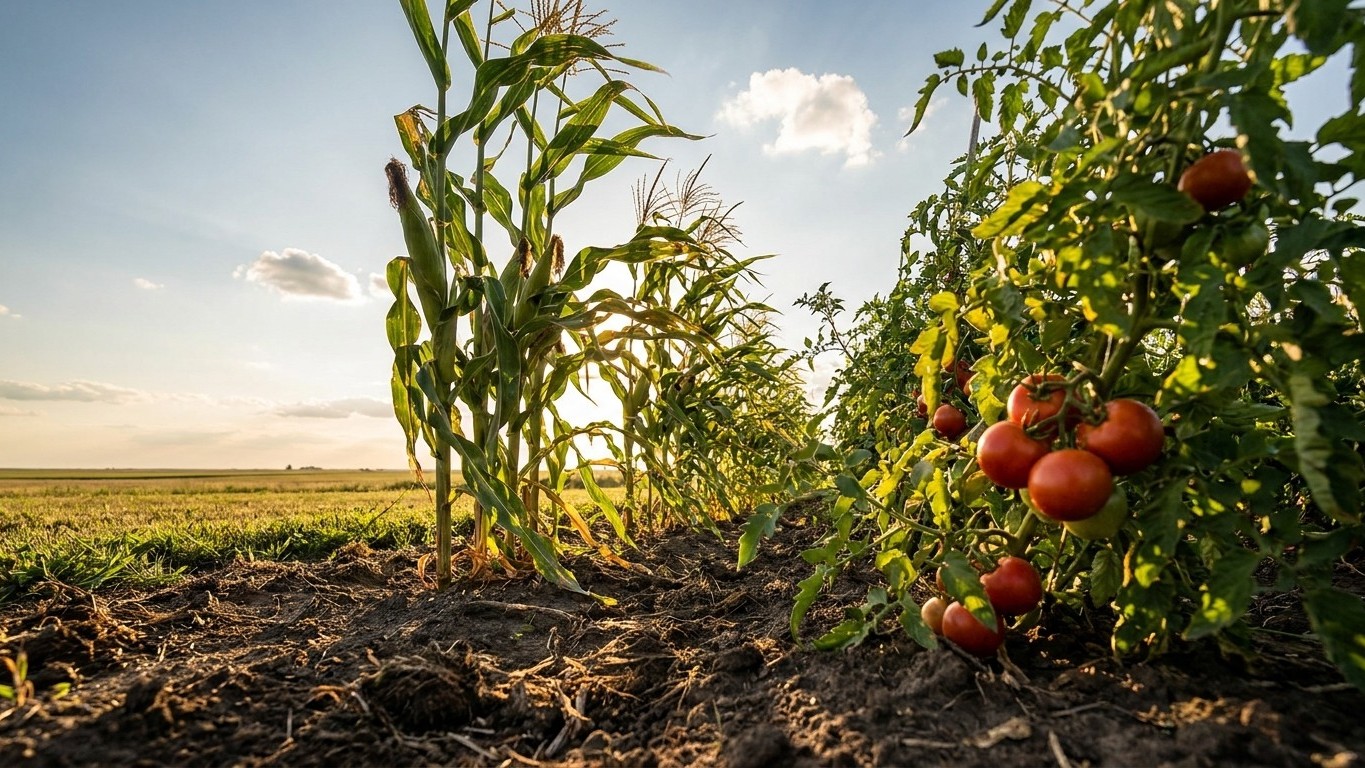

Sweet corn in Alaska is ready 60 to 90 days after planting, and planting waits for soil at 60 F, not for the last frost. In Anchorage that soil warmth arrives well after the freeze danger passes, which leaves a shorter window than the seed packet assumes. Once the ears are ready, the picking window is only a week or so, and sugar starts draining out of the kernels the moment you snap them off the stalk.
The short answer
Soil first, then the calendar
Anchorage’s last spring frost falls between May 3 and May 12, going by NOAA NCEI climate normals for the Anchorage station (the 30 to 70 percent freeze-probability band). Do not plant on that date. Soil at 60 F, the threshold Utah State University Extension gives for sweet corn, comes well after the frost date, and the data here publishes no calendar date for it. Your thermometer is the authority. Clemson Cooperative Extension says to plant no earlier than when the soil at the 4-inch depth is at least 50 F, and to “wait to plant extra-sweet varieties until soil temperatures reach 65 °F.” Those two numbers are not interchangeable. A supersweet seed sown into 50 F ground tends to rot rather than sprout, which is why a gardener can succeed one year and fail the next after changing varieties.
On the other end sits the first fall frost, between September 22 and October 1. Between the two frosts, Anchorage gets about 143 frost-free days. That is generous for Alaska. The Interior and the north have far shorter seasons, and anything here built on Anchorage numbers needs trimming as you go north. Sixty to ninety days from planting has to fit inside whatever is left after the soil catches up, and the next section works through whether it does. Long summer daylight helps the plants make up some ground, but it does not warm the soil.
Picking week and the fade
A second clock starts later. The usual guidance is that ears are ready 17 to 24 days after the silks first emerge. The first clock (60 to 90 days from planting) tells you whether a variety fits your season. The second tells you which week to pick. Do not merge them. To confirm, look for three signs together: silks dry and brown, husks still moist and green, and milky juice when you puncture a kernel. One sign alone misleads.
After picking, the fade begins. Clemson Extension puts it this way: “Sweet corn loses sugar from the kernel rapidly at high temperatures… Sweet corn can be stored under optimal conditions for about five days, but will lose sweetness with each day of storage.” Note that “about five days” is a ceiling under ideal conditions, not a promise. The type matters too: standard su corn loses sugar fastest, se holds it longer, and sh2 holds it longest. Heat is the accelerator, and an average Anchorage year has 0.0 days at 90 F or above. That is a small advantage, not permission to leave a bag of ears on the counter.
Does a late variety fit here?
The arithmetic is simple, but the conclusion depends on one number this page cannot supply: the date your soil reaches 60 F. Start from about 143 frost-free days. Subtract the weeks you wait for warm soil. What remains must cover the days to maturity, with a cushion before the first fall frost, which can arrive as early as September 22.
A 60-day variety
An early variety fits comfortably. Take the full 143 frost-free days and subtract 60, and you have 83 days of slack. Even a long wait for warm soil leaves room, and so does a slow, cool stretch in July. A planting that goes in late can still reach picking before the frost window opens. This is the variety to build an Alaska plan around, particularly in a first year. It also leaves room to sow a few weeks later if a cold snap kills seedlings.
If you grow it in a spot with the sun and shelter a garden bed provides, the early type gives you a margin that a later type cannot. The timing of sowing is its own question, and soil temperature, not the calendar, should drive it.
A 90-day variety
Here the answer is no, at least not as a plan. On paper, 143 minus 90 leaves about 53 days. But that slack has to absorb the entire wait for 60 F soil, which is not published here, and the days-to-maturity printed on a packet are counted from planting under ordinary growing conditions. A cool Alaska summer can stretch them. Anchorage sees 0.0 days at 90 F in an average year, so the heat that pushes corn along is thin. Two weeks of slow growth in June and an early September frost, and the ears are not ready.
Outside Anchorage the verdict is firmer. The Interior and the north have much shorter seasons than 143 days, so a 90-day type simply does not fit. Even in Anchorage, treat a late variety as a gamble you can afford to lose, not as the main crop. If you want to try one anyway, plant it in the warmest bed you have, only once the soil is ready for it, and keep a cover on hand for a frost at the end.
What goes wrong here
Most failed corn patches in Alaska trace to one of three causes. Two come from the climate. The third has nothing to do with it.
- Soil sown too cold. Seeds that go in on the last-frost date, or any date picked off a calendar, sit in ground that is still below the thresholds. Ordinary sweet corn needs at least 50 F at 4 inches deep, and extra-sweet types need 65 F. Cold, wet seed rots or sprouts patchily. The remedy is to measure at depth and wait. Reading the surface will send you out too early, because the top inch warms first. Warming the bed ahead of time with plastic is a reasonable help, but it does not change the thresholds.
- A variety too late for the season. A 90-day type planted after a slow spring may meet the first frost with half-filled ears. Choose by days to maturity first and flavor second. The early end of the 60 to 90 range is the safer end here, and the further north you garden, the more that holds. For the whole picture, see Growing Sweet Corn in Alaska.
- Sweetness lost to cross-pollination. This one is not climate. Utah State University Extension warns that sweetness is lost when su, se and sh2 types tassel at the same time. The source gives no separation distance, so no figure appears here. The problem is timing: pollen from one type landing on another’s silks. The remedy is to grow a single type, or to keep the plantings separate and arranged so they do not tassel together. Plant in blocks of three or more rows, not one long single row, so the pollen has a chance to reach the silks.
Pests are a separate list of trouble, covered in What Eats Corn in Alaska, and When.
Common questions
Is the last frost date the day to plant sweet corn?
No. In Anchorage the last spring frost falls between May 3 and May 12, but soil at 60 F comes well after it. Plant by soil temperature measured 4 inches down, not by the frost date.
How do I know an ear is ready to pick?
Look for three signs together: dry brown silks, husks that are still moist and green, and milky juice when you puncture a kernel. Ears are usually ready 17 to 24 days after the silks first emerge, but that is a guide for which week to check, not a substitute for the three signs.
How long does picked sweet corn stay sweet?
Clemson Extension says it can be stored under optimal conditions for about five days, but will lose sweetness with each day. That is a maximum, not a promise. Standard su loses sugar fastest, se holds it longer, and sh2 holds it longest.
Can I grow a 90-day sweet corn in Alaska?
Only as a gamble, and only near Anchorage. About 143 frost-free days sound like enough, but the wait for warm soil and a cool summer eat the cushion. In the Interior and the north, where the season is far shorter, it does not fit.