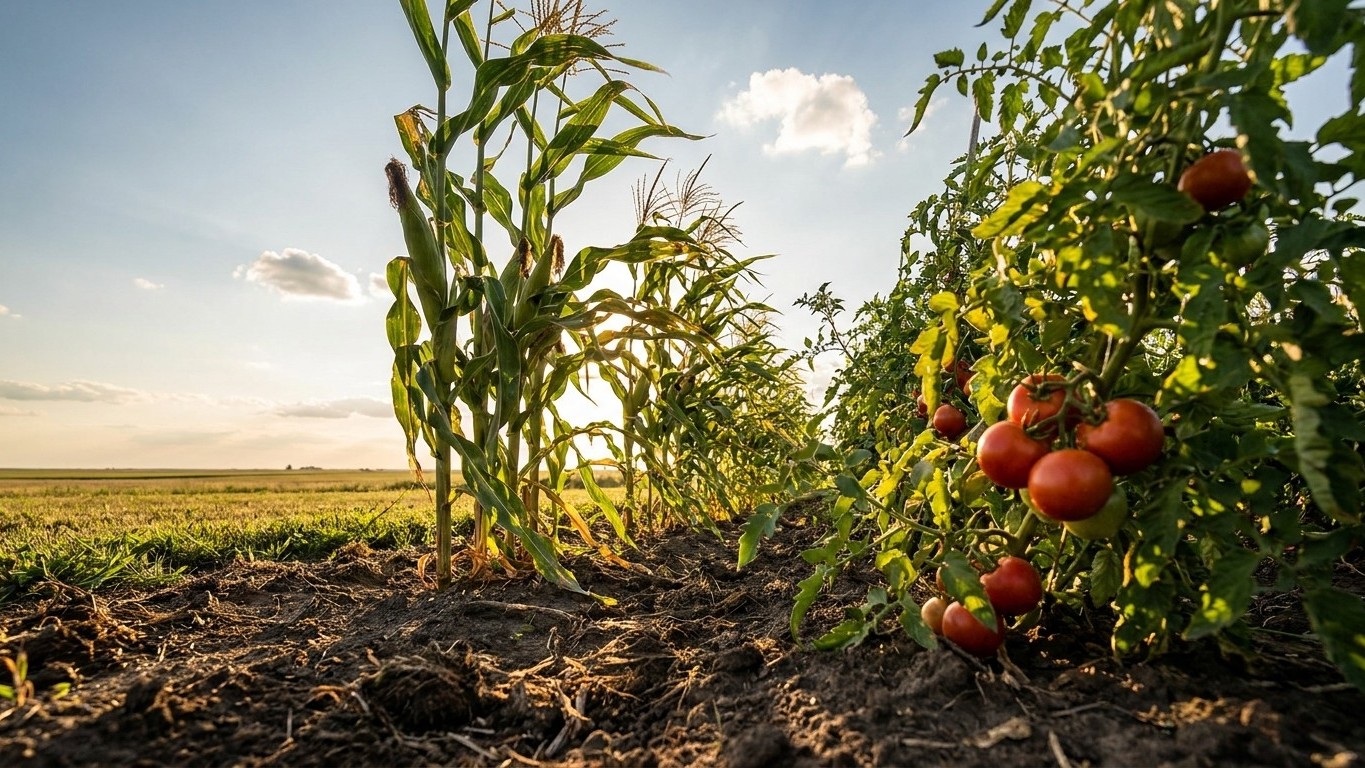

Two clocks decide when sweet corn is ready, and they answer different questions. The first, 60 to 90 days from planting, tells you whether a crop fits the season at all. The second, 17 to 24 days from the moment silks emerge, tells you which week to pick. After picking, a third clock starts: sugar leaves the kernel, and Arizona heat speeds it up.
The short answer
Soil warms after the frost, not with it
Soil at 60 F arrives well after the last frost. The two are different days, and treating them as one sends seed into the ground too early. In the low desert the frost half of that sentence barely applies anyway. NOAA’s climate normals for Phoenix show a 32F reading in only 6 of 30 springs and list the frost-free season as 365 days. The rare cold snap that does reach 32F falls between late December and mid January. A frost-based planting calendar for low-desert Arizona would be fiction, so soil temperature is the instruction.
Utah State University Extension says sweet corn needs soil above 60 F and 60 to 90 days from planting. Clemson Extension splits the threshold by type: “Do not plant before the soil temperature at the 4-inch depth is at least 50 ºF. Wait to plant extra-sweet varieties until soil temperatures reach 65 °F.” The 4-inch depth is what makes the number usable, because a surface reading runs warmer than the zone where the seed sits. The 60 F figure falls between Clemson’s two, so if you are sowing extra-sweet (sh2) corn, wait for the higher one. A supersweet seed sown at 50 F rots instead of sprouting. That is why a gardener can succeed one year and fail the next after changing varieties, with the same bed and the same watering.
When does the soil here cross those lines? The verified figures carry no calendar date for it, and a date would be a different claim from a temperature. A soil thermometer pushed 4 inches down gives a better answer than any chart. For sowing windows by region, see When to Sow Sweet Corn in Arizona.
Does 60 to 90 days fit before autumn?
In the low desert, autumn sets no frost deadline, because there is no reliable fall freeze. The deadline is heat. Phoenix averages 168.9 days a year at 90F or more, roughly five and a half months’ worth, and summer heat stops fruit set for months. So the 60 to 90 days has to be counted forward from sowing and must finish ahead of the heat that stops kernels from forming.
The high country plays by different rules. Flagstaff and the area around it freeze hard, so there the first fall frost does cap the season. The facts published here carry no frost dates for those elevations, so check local records before counting days. Either way, the planting clock only tells you whether a crop fits. The week to pick comes from the silk clock, covered below.
Does a late variety fit here?
A 60-day variety
Sixty days is two months from sowing to harvest. If the soil crosses its threshold with at least two months to spare before the heat that stops fruit set, the crop fits. It also fits with room to spare, because it asks the least of the season. In the low desert it spends the fewest weeks growing toward summer. In the high country it needs the shortest frost-free stretch after the soil warms.
A shorter crop has a second advantage. Fewer weeks in the ground means fewer weeks exposed to whatever eats corn in Arizona, a calendar covered in What Eats Corn in Arizona, and When. If you are choosing one variety for a first planting, the early one is the safer bet.
A 90-day variety
Ninety days is three months, a full 30 days longer than the early type. In the low desert that month comes straight out of the margin before summer heat. With no frost to set the deadline, heat is the deadline, and every extra day of growing runs deeper into the weeks when fruit set fails. The arithmetic works against it. A 90-day variety sown the moment the soil is warm enough has the thinnest margin of any choice, and I would not plant it in the low desert.
The high country is a different question, and the honest answer is that the verified figures cannot settle it. A 90-day corn needs 90 days between sowing and the first hard freeze, and no fall frost date for those elevations is published here. If your local record shows fewer than 90 days after the soil reaches 60 F, the late variety does not fit there either. For the broader picture, Growing Sweet Corn in Arizona covers the crop from seed to ear.
What goes wrong here
Three failures account for most disappointing corn in this state. Two come from the climate. The third has nothing to do with it.
- Soil sown too cold. Seed that goes in before the 4-inch soil temperature reaches 50 F for ordinary corn, or 65 F for extra-sweet types, tends to rot instead of germinating. The remedy is a thermometer, not a date. Keep in mind that the two thresholds are not interchangeable. A bed that is ready for ordinary sweet corn may still be too cold for an sh2 type, and a rare winter snap down to 32F can catch a seedling that went in early.
- A variety too late for the season. A 90-day type sown in spring runs a month deeper into the heat that stops fruit set. The remedy is to count forward from the day the soil reaches its threshold and choose a variety whose days to maturity finish before that heat. At higher elevations, compare the count against your local first fall frost instead.
- Sweetness lost because two types tasselled together. This one is not about climate. Sweetness is lost when su, se and sh2 types tassel at the same time, because their pollen crosses and the kernels go starchy. No isolation distance is published here, so none is given. The remedy is timing. Plant one type per planting, stagger plantings so that different types do not shed pollen in the same week, and sow in blocks of three or more rows instead of a single long row. Blocks are a shape of garden, not a date.
Common questions
How do I know an ear is ready to pick?
Use three signs together: dry brown silks, husks that are still moist and green, and milky juice when you puncture a kernel. One sign alone misleads. The silk clock tells you when to start checking. Ears are typically ready 17 to 24 days after the silks first emerge, so mark that day on a calendar.
How fast does picked corn lose its sweetness?
Clemson Extension puts it this way: “Sweet corn loses sugar from the kernel rapidly at high temperatures… Sweet corn can be stored under optimal conditions for about five days, but will lose sweetness with each day of storage.” The five days is a maximum under optimal conditions, not a promise, and Arizona kitchens are rarely optimal. The type matters too. The su type loses sugar fastest, se holds it longer, and sh2 holds it longest. That is the practical reason to choose one over another, and the reason the old advice about running from the garden to the pot is still sound.
Can I use the last frost date to time planting?
Not in the low desert. Frost shows up in only 6 of 30 Phoenix springs, so the date tells you almost nothing. The soil temperature at 4 inches does, and it lags the last frost. Wait for 50 F for ordinary sweet corn and 65 F for extra-sweet types.
Does the high country follow the same rules?
The soil and day counts do. The 60 F soil floor and the 60 to 90 days from planting apply anywhere. What changes is the end of the season. Flagstaff and the high country freeze hard, so a first fall frost can cut the crop off. This page holds no frost dates for those elevations, so use a local record.