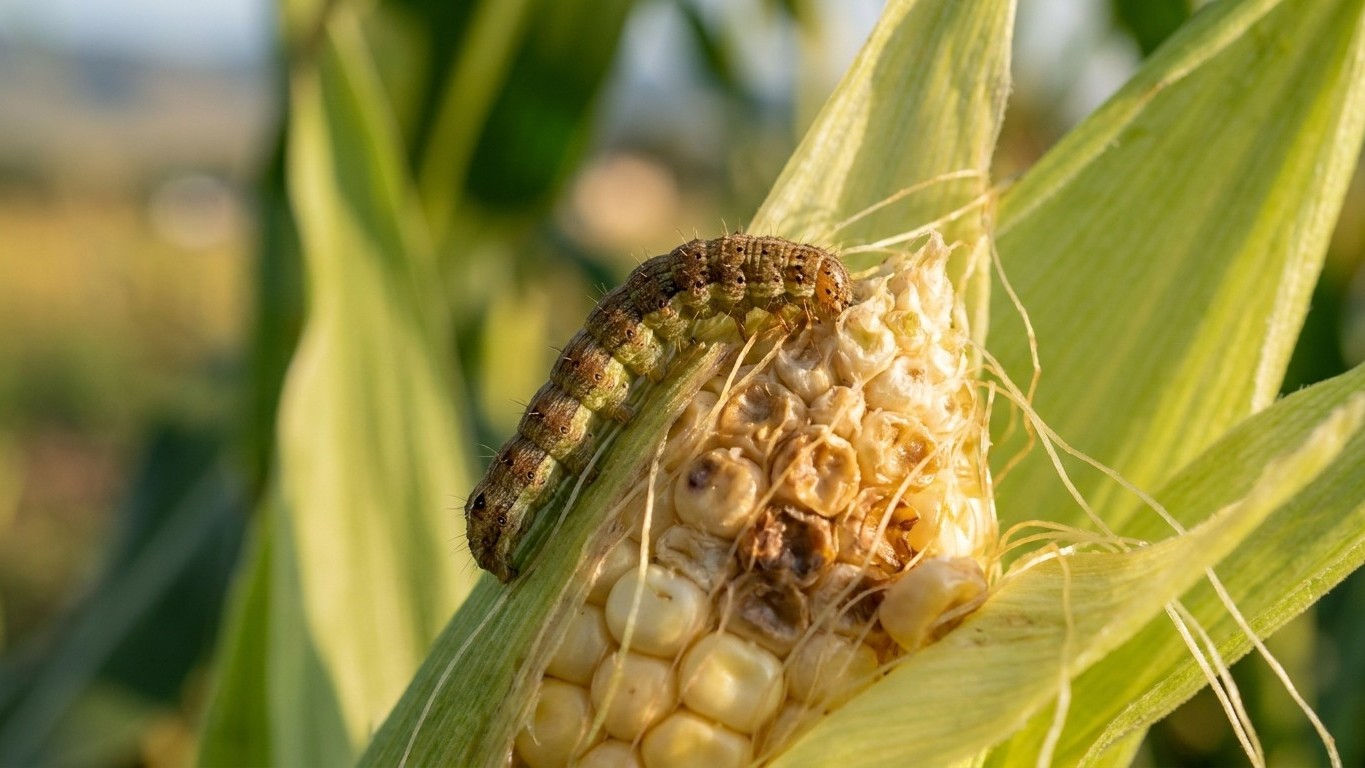

University of Arizona Cooperative Extension documents ten garden pests active on vegetable crops in the state, but only about half of them have any business on a corn plant. The rest target squash, tomatoes, beets, or ripening fruit. Knowing which pest actually targets corn, and which stage of the plant it hits first, matters more than knowing every bug that shows up in a backyard.
Which pests attack corn in Arizona

University of Arizona Cooperative Extension lists ten pests for home gardens across the state: aphids, beet leafhopper (vector of curly top virus), false chinch bug (Nysius raphanus), grasshoppers, green fruit beetle (Cotinis mutabilis), spider mites, squash bug (Anasa tristis), thrips, tomato hornworm (Manduca quinquemaculata), and whiteflies.
Five of those have no real reason to be on a corn plant. The beet leafhopper spreads curly top virus into broadleaf crops like beets, tomatoes, and peppers; corn is a grass and isn’t a target for that virus. The false chinch bug swarms on mustards and dying weeds, not on standing grain crops. The green fruit beetle, sometimes called the fig beetle, goes after soft, ripening fruit like figs and grapes, not fibrous corn ears. The squash bug is a cucurbit specialist, tied to squash and pumpkin vines. The tomato hornworm feeds on nightshades: tomato, pepper, eggplant, and their weedy relatives. None of the five belong on a corn damage checklist.
That leaves five pests that do feed on corn in Arizona gardens: aphids, grasshoppers, spider mites, thrips, and whiteflies. All five are generalists that move onto corn once it’s growing nearby, rather than pests that specialize in corn the way the squash bug specializes in squash. The single most common mistake is treating for a pest based on what’s damaging the tomatoes or squash a few feet away, instead of confirming the insect is actually on the corn leaves or silks. A yard can carry a heavy hornworm problem on the tomatoes and a clean stand of corn at the same time.
The five that matter share one trait: they’re sap-feeders or chewers that thrive on stressed, heat-loaded plants, which describes most Arizona corn for a large part of the year.
When each one shows up, and what it does first
Arizona’s low desert has no dependable frost to anchor a calendar around, so the planting clock for sweet corn runs on soil temperature instead: seed goes in once soil sits above 60°F, and the crop needs somewhere between 60 and 90 days from that planting date to reach maturity. Pest activity tracks the plant’s growth stages that follow, not a fixed month.
Aphids are usually the first sign of trouble, showing up on new growth not long after seedlings establish, well before tasseling. Look for clusters on the underside of young leaves and a sticky film on the foliage below them.
Thrips move in around the same early window, working inside the whorl of young leaves and later on the silks. Their damage looks like a silvery streaking with tiny black specks scattered across the leaf surface.
Grasshoppers build steadily as the season goes on, chewing ragged notches in from the leaf margins. They tend to become more visible once nearby weeds and wild grasses dry out and the insects move onto whatever stays green, including a corn planting.
Spider mites and whiteflies are the two to watch once the heat really sets in. Arizona’s reference station averages 168.9 days a year at 90°F or hotter, and that stretch of heat load is exactly when spider mites multiply fastest: fine stippling on the upper leaf surface, followed by bronzing, especially on dusty plants that haven’t been rinsed. Whiteflies build up on the underside of the canopy around the same time, fluttering up in a small cloud when a leaf is disturbed.
None of this timing lines up with named months the way a frost-based calendar would in a colder state. It follows the plant: new growth draws aphids and thrips, dry weeds push grasshoppers over, and the long run of 90-degree-plus days drives the mite and whitefly buildup.
Telling the damage apart from everything else
Corn in Arizona deals with heat stress, alkaline-soil nutrient lockup, and irrigation gaps at the same time it deals with insects, and several of those look alike at a glance. The detail that separates a pest problem from a growing problem is almost always something you can check within a minute or two, not a guess based on the season.
| What you see | Possible cause | What tells them apart |
|---|---|---|
| Fine stippling on upper leaves, then bronzing | Spider mites, or drought stress | Check the underside for fine webbing, or tap a leaf over white paper and watch for tiny moving specks |
| Sticky, shiny leaves with a black sooty film | Aphids or whiteflies | Honeydew and sooty mold together aren’t produced by any common nutrient or water problem in corn |
| Ragged, torn leaf margins | Grasshoppers, or wind and blown sand | Insect chewing leaves an irregular bite pattern and sometimes visible frass; mechanical damage tends to shred randomly with no droppings |
| Silvery streaks on leaves or silks with tiny black flecks | Thrips, or nitrogen deficiency | Deficiency yellows evenly from the leaf tip inward; thrips leave a rough, silvery texture you can feel with a fingertip |
| Yellowing between the leaf veins, veins staying green | Iron or nitrogen deficiency, common in Arizona’s alkaline soils | No insects are present, and the pattern follows the veins rather than showing up as scattered spots or holes |
None of this replaces a look from someone trained to confirm it. If a symptom doesn’t match one of these pairs cleanly, that’s the moment to bring a sample or a photo to a local extension office rather than treat for a guess.
What actually works here, and what is a waste of time
Because Arizona’s corn calendar runs on soil temperature and heat load rather than frost dates, the timing of a fix matters more than the fix itself. Row covers over young seedlings keep aphids and thrips off the plant during that early vulnerable stage, but they need to come off before tasseling, since corn is wind-pollinated and a cover left on through pollen shed can reduce the ear fill.
Rinsing dust off leaves with a hose during the long run of 90-plus-degree days does more against spider mites than most gardeners expect, since dust buildup is part of what lets mite populations explode in the first place. Regular walk-throughs, checking leaf undersides every few days rather than waiting for visible damage, catch aphids and thrips while numbers are still low enough to matter.
What doesn’t work is a calendar-based treatment applied on a fixed date because that’s when a gardening guide from a different climate says to spray. Arizona’s growing season isn’t set by a frost date the way most of the country’s is; it’s set by soil temperature at planting and by a summer heat load intense enough to shut down fruit set for months. A treatment timed to a month name instead of a plant stage or a temperature threshold will often land too early or far too late.
For anything beyond covers, rinsing, and inspection, whatever is registered for use on corn in Arizona is a question for University of Arizona Cooperative Extension, not a generic product label written for a cooler, wetter state.
Where to check this for your own county
Everything above comes from University of Arizona Cooperative Extension, and it describes what’s documented across the state, not what’s necessarily present in a specific yard. Pest presence shifts sharply within Arizona itself, and that’s the detail worth acting on before assuming any of the five pests above is the one causing a specific problem.
The low desert around Phoenix runs on a nearly frost-free calendar, with a freeze reaching the ground in only a handful of recent springs. The high country around Flagstaff is a different climate entirely, with hard freezes that shape an entirely different pest and planting calendar. A pest active on low-desert corn in one part of the growing season may barely register at higher elevation, and vice versa.
The most useful next step is a call or visit to the county office of University of Arizona Cooperative Extension, where staff can confirm an insect ID against a sample or photo and speak to what’s actually active in that specific county, rather than what’s documented statewide. A statewide list tells you what’s possible. A county office tells you what’s actually there.
Common questions
Do all five corn pests show up on every planting?
No. The five documented feeders (aphids, grasshoppers, spider mites, thrips, whiteflies) are generalists, and any given planting might see two or three of them rather than all five. Local conditions, nearby plantings, and the specific season all affect which ones actually show up.
Is a squash bug on corn something to worry about?
A squash bug seen near corn is more likely wandering from a nearby squash or pumpkin planting than actually feeding on the corn itself, since it’s a cucurbit specialist. Worth confirming with a county extension office rather than treating the corn for it.
Why do spider mites get worse in the middle of summer?
Spider mite populations track heat load closely, and Arizona’s reference station averages 168.9 days a year at 90°F or hotter. That extended hot, dry stretch is exactly the condition mites multiply fastest in, especially on dusty, water-stressed leaves.
Does frost ever affect Arizona corn pests?
In the low desert, rarely: a freeze reaches the ground in only a minority of recent springs, and the frost-free season runs close to year-round there. In the high country around Flagstaff, hard freezes do occur and shape a very different pest and planting calendar.