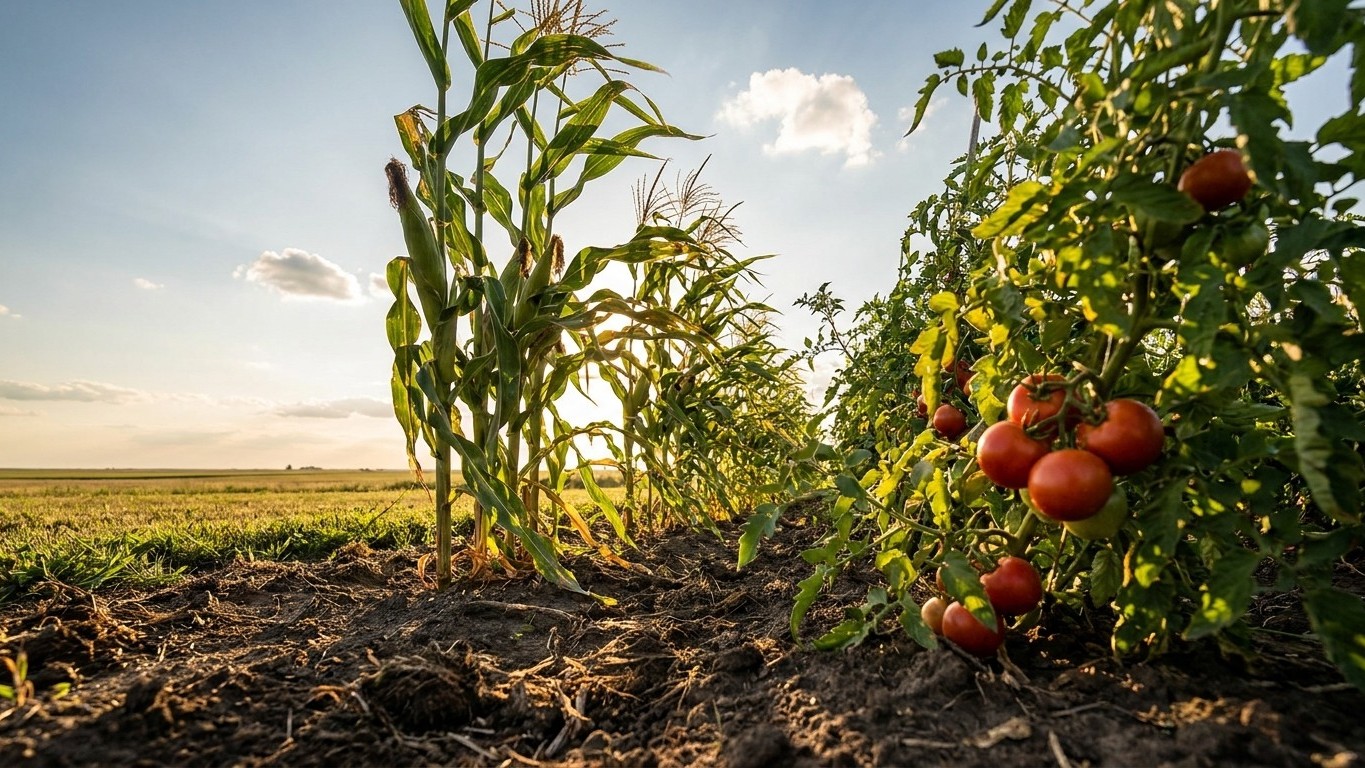

Sweet corn in Iowa is ready roughly 60 to 90 days after planting, and planting waits for warm soil, not for the last frost. Once the ears are ripe, the clock runs fast. The picking window lasts days, and sugar starts draining from the kernels as soon as the ear leaves the stalk. What follows are the soil and frost numbers that set the start, whether a late variety fits before fall, and the mistakes that cost Iowa gardeners their sweetness.
The short answer
Soil warms after the frost does
Soil at 60 F comes well after the last frost. NOAA’s climate normals put the last spring freeze at the airport station between April 12 and April 24, using the 30 to 70 percent probability band. Utah State University Extension says sweet corn needs soil above 60 F. A frost-free day and a warm seedbed are different events, and the second one trails the first. This page publishes no date for when Iowa soil reaches 60 F, because a date would be a guess. A thermometer will tell you.
Take the reading at the right depth. Clemson Extension’s instruction is specific: “Do not plant before the soil temperature at the 4-inch depth is at least 50 ºF. Wait to plant extra-sweet varieties until soil temperatures reach 65 °F.” A surface reading runs warmer than the seed zone and will send you out too early. The two thresholds are not interchangeable. Ordinary sweet corn tolerates the lower one, while extra-sweet seed sown into 50 F ground tends to rot rather than sprout. That is why a gardener can do fine one year and lose a whole row the next after switching varieties. For sowing windows built on these readings, see When to Sow Sweet Corn in Iowa.
Do 60 to 90 days fit before fall?
Yes, with room to spare for most plantings. The same NOAA normals put the first fall freeze between October 14 and October 25, which leaves roughly six months of frost-free ground. One caution applies to every date here. Iowa State Extension county figures run about 4 days later in spring and about 10 days earlier in fall than the airport station, so the airport numbers are the optimistic end. Trim the season by about two weeks if you want the cautious version. A 60-day crop uses about a third of the stretch and a 90-day crop about half, and the soil wait eats into the front of it.
Two clocks, two questions
The 60 to 90 days counted from planting tell you whether a variety fits the season. They do not tell you which week to pick. That is a second clock, and it starts at silk emergence: ears are generally ready 17 to 24 days after the silks first appear. Keep the two apart. One decides what to buy in spring, the other what to do in July or August.
Confirm ripeness with three signs together, never one alone: dry brown silks, husks that are still moist and green, and milky juice when you puncture a kernel. Clear juice means early, and doughy paste means late.
After picking, the fade begins. Clemson Extension puts it this way: “Sweet corn loses sugar from the kernel rapidly at high temperatures… Sweet corn can be stored under optimal conditions for about five days, but will lose sweetness with each day of storage.” Read “about five days” as a ceiling under ideal conditions, not a promise. It also gives the real reason behind the old advice to run from the garden to the pot. Sugar leaves the kernel, and heat speeds that up. In Des Moines, NOAA’s reference station averages 18.4 days a year at 90 F or higher, so a warm kitchen counter is not a neutral place to park an armload of ears. The type of corn matters too. Standard su types lose sugar fastest, se types hold it longer, and sh2 holds it longest. If you cannot pick and eat on the same day, that is the practical reason to grow sh2.
Does a late variety fit here?
A 60-day variety
It fits easily. Against roughly six months of frost-free ground at the airport station, 60 days is about a third of the window, and even the shortened county version leaves a wide margin. The real constraint is at the front, not the back. The soil has to reach the threshold for your type before the seed goes in, and the 4-inch reading is the only authority. Once soil is ready, a 60-day variety leaves room to adjust. A cold snap that stalls the first planting does not push the harvest toward frost, and a gardener who loses a stand to cold ground can replant without running out of season. No variety is named here, because the university sources behind these numbers name none. Check the days to maturity on the seed packet and treat it as a count from planting day.
A 90-day variety
It fits too, with less slack. Ninety days is about half the frost-free stretch on the airport numbers, and a bit more than half if you use the county figures that start later and end about 10 days earlier. Planted when the soil is ready, it finishes comfortably ahead of fall. What does not fit is a 90-day variety sown late as a follow-up planting. Count 90 days backward from the October 14 to October 25 band, treat the earlier end as the deadline, and subtract more if you use the county figures. Anything sown after that point is gambling against frost with ears still filling. A late type also faces the extra-sweet soil requirement of 65 F, which arrives later than the 50 F that ordinary corn tolerates. So a late extra-sweet variety is the one that must go in at the first honest reading, not after a delay.
What goes wrong here
Iowa’s season is generous, so most failures come from timing and neighbors rather than from the climate itself. Three show up again and again:
- Seed sown into cold soil. A mild spell after the last frost tempts people to plant, but frost-free is not the same as warm. Seed that sits in cold ground rots, and extra-sweet seed is the least forgiving. The remedy is a thermometer at the 4-inch depth: 50 F as the floor for ordinary sweet corn, 65 F for extra-sweet, with Utah State’s general rule of soil above 60 F in between. If you are unsure which type you bought, wait for the higher number. Rows lost to cold ground are also easier prey for the pests described in What Eats Corn in Iowa, and When.
- A variety too late for the season. A 90-day type that goes in late runs into the October 14 to October 25 frost band, and earlier by county figures. Frost ends the crop before the kernels fill. The remedy is to count days backward from the early end of the frost band before buying seed, and to reserve the longest variety for the first planting. Put the 60-day type in the later sowing.
- Sweetness lost to cross-pollination. This one has nothing to do with climate. If su, se and sh2 types tassel at the same time, the sweetness is lost. The source gives no separation distance, so none is offered here. The condition is timing: the types must not tassel together. Grow one type per garden, or time separate plantings so their tassels open at different times. Plant in blocks of three or more rows rather than one long single row, because that shape matters for pollination. A garden that grew sweet corn happily one year can go starchy the next simply because a different packet tasselled alongside it.
Together these three cover most disappointing harvests. For the wider picture of the crop, start with Growing Sweet Corn in Iowa.
Common questions
Is the last frost date the day to plant sweet corn in Iowa?
No. NOAA’s normals put the last freeze at the airport station between April 12 and April 24, but soil warms later. Plant by soil temperature at the 4-inch depth, not by the calendar. Ordinary sweet corn needs at least 50 F, extra-sweet needs 65 F, and Utah State Extension’s general rule is soil above 60 F.
How do I know an ear is ripe?
Look for three signs together: dry brown silks, husks still moist and green, and milky juice when you puncture a kernel. Count from silk emergence as a guide, since ears are usually ready 17 to 24 days after silks first appear. That count is separate from the 60 to 90 days from planting, which only says whether a variety fits the season.
Can I plant two kinds of sweet corn in the same garden?
Only if they do not tassel at the same time. Mixed su, se and sh2 types that tassel together lose their sweetness. No separation distance is published in the source used here, so this page gives none. Time the plantings apart or choose one type, and plant in blocks of three or more rows.
How long does picked sweet corn stay sweet?
Less time than most people expect. Clemson Extension says it can be stored under optimal conditions for about five days, “but will lose sweetness with each day of storage.” Heat speeds the sugar loss. Among the genetic types, su fades fastest, se holds longer, and sh2 holds longest, so an sh2 ear picked on a 90 F day is still the safer bet for a slow dinner plan.