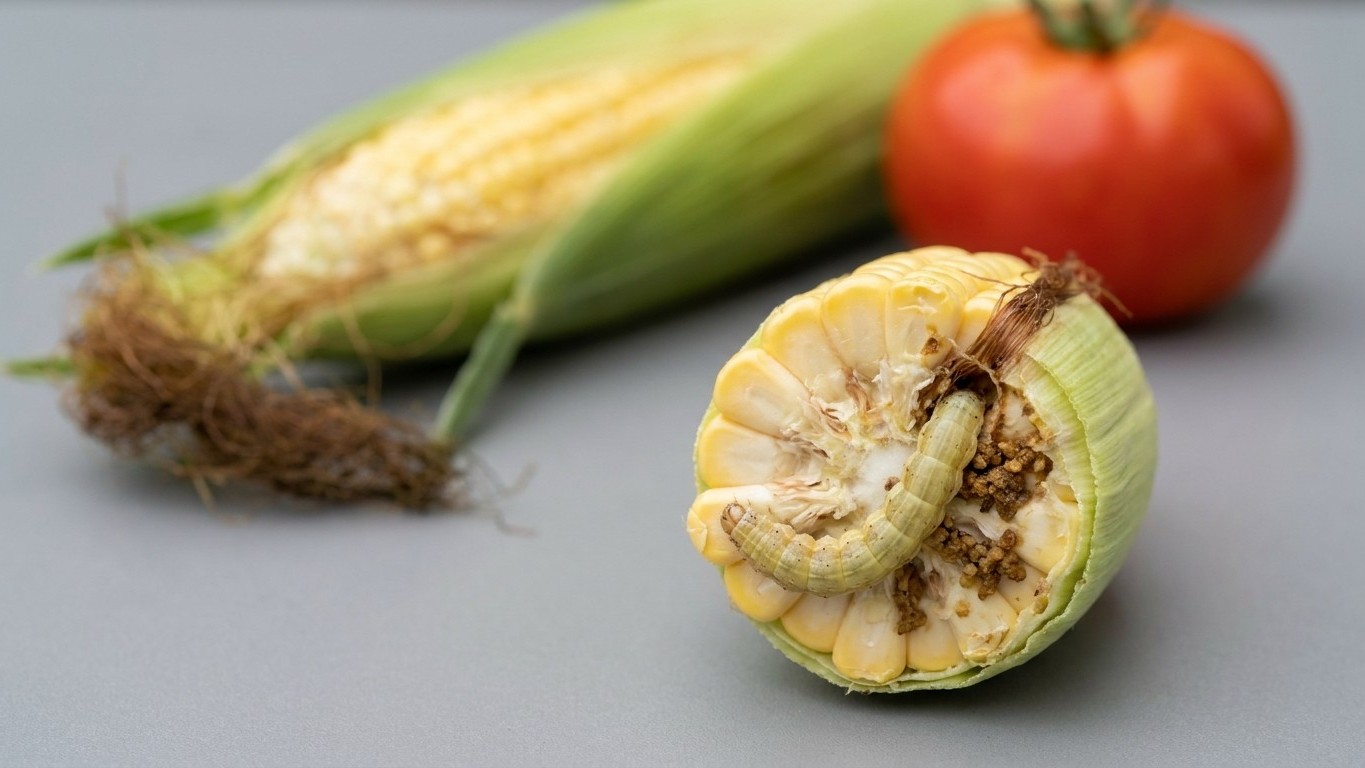

Iowa State University Extension tracks nine insect species commonly reported in home gardens and landscapes across the state, and only four of them are documented as corn feeders. The rest go after other plants entirely. Corn damage here follows the frost-free calendar: stalk borers move in shortly after seedlings emerge, grasshoppers build through the hottest stretch of summer, and beetles show up right around silk emergence, when a few days of feeding can cost a whole ear its pollination.
Which pests attack corn in Iowa
Iowa State University Extension documents nine species for home gardens and landscapes in this territory: common stalk borer, grasshoppers, iris borer (Macronoctua onusta), Japanese beetle (Popillia japonica), lily leaf beetle, spotted cucumber beetle, squash bug, squash vine borer, and striped cucumber beetle. Of those nine, only four are documented as feeding on corn: common stalk borer, grasshoppers, Japanese beetle, and spotted cucumber beetle.
The other five have nothing to do with a corn planting, and mixing them up wastes time chasing the wrong insect. Iris borer tunnels inside iris rhizomes and never touches a corn plant. Lily leaf beetle feeds exclusively on lily foliage. Squash bug pierces squash and pumpkin vines to suck sap, not corn tissue. Squash vine borer tunnels into squash stems at the base, a habit that has no equivalent in a cornstalk. Striped cucumber beetle sticks to cucurbit-family leaves and blossoms, cucumbers, squash, melons, and rarely bothers with corn at all.
What the four corn feeders actually do
Common stalk borer larvae tunnel inside the stalk itself, working from the outside in after hatching in nearby grassy cover. Grasshoppers are generalist chewers, working leaf tissue from the edges inward, and they get worse in dry years when their egg survival improves. Japanese beetle adults cluster on silks and clip them short, which interferes with pollination more than it damages the plant directly. Spotted cucumber beetle adults feed on young seedling leaves early in the season, then move to silks and exposed kernel tips later on.
None of this means a given garden will see all four. Extension documentation covers what has been reported across the state, not what shows up on any one property in a given season.
When each one shows up, and what it does first
Timing here tracks the frost-free window more reliably than a calendar month, since planting dates shift from one part of the state to another. The last spring frost typically falls between April 12 and April 24, and stalk borer activity follows a few weeks behind that, once moths that overwintered in grassy field margins lay eggs and larvae move from weeds into nearby corn stalks. The first sign is not a chewed leaf but a wilted or bent whorl, sometimes with a small entry hole visible near the base of the stalk.
Grasshoppers build their numbers gradually through the warm months, and their feeding pressure tends to peak during the hottest stretch of the season. Des Moines averages 18.4 days a year at 90 degrees or above, and that stretch of heat is also when grasshopper populations are largest and hungriest, chewing ragged notches along leaf edges, often worse near field borders and dry grass strips than in the middle of a bed.
Japanese beetle adults tend to appear in the weeks leading up to silk emergence, and their first visible damage is silk itself: short, brown, ragged stubs at the tip of the ear before pollination has finished. Spotted cucumber beetle shows up earlier, on young seedling leaves as small ragged holes, then reappears later at the ear tip, leaving small round feeding marks on exposed kernels once husks pull back slightly.
The first fall frost, which arrives between October 14 and October 25 here, closes out activity for all four, though stalk borer and grasshopper populations usually taper off well before then as host plants dry down.
Telling the damage apart from everything else
A wilted stalk, a ragged leaf, or a chewed kernel tip does not automatically mean an insect is responsible. Drought stress, hail, nutrient shortages, and normal ripening all leave marks that get mistaken for pest feeding, and the fix for each is completely different.
| Symptom | Likely cause | What tells them apart |
|---|---|---|
| Wilted or bent whorl on a young plant | Stalk borer tunnel, or drought stress | Split the stalk near the soil line; a tunnel with frass and a larva inside points to the borer, while uniform wilting across an entire row without any tunnel points to dry soil |
| Ragged, chewed leaf edges | Grasshopper feeding, or hail damage | Grasshopper feeding leaves irregular bite marks and scattered frass on individual leaves; hail shreds leaf tissue evenly across a whole section of the planting in a single event |
| Short, brown, ragged silks before pollination | Japanese beetle feeding | Clipped silks appear while the plant is still actively pollinating, not after |
| Brown, dry silks with the husk still green | Normal ripening, not damage | This is expected late-season change, not a pest sign |
| Small round holes in exposed kernels | Spotted cucumber beetle feeding, or bird and raccoon damage | Beetle holes are small and scattered across a kernel surface; wildlife strips whole sections of kernels or pulls husks back entirely |
The ripeness test itself relies on three signs together, not one: dry brown silks, a husk that is still moist and green, and milky juice from a punctured kernel. A single dry silk with no other change is not a sign of trouble, it is just an ear getting close to ready. When a symptom does not match any row in that table cleanly, that is the moment to bring a sample, not a description, to a local expert.
What actually works here, and what is a waste of time
On a season this short, timing beats product almost every time. A lightweight physical barrier over seedlings, put in place at planting and left on until the first true leaves appear, keeps early-season feeders like spotted cucumber beetle off young plants when they are most vulnerable. That cover has to come off before tasseling, since corn depends on wind, not insects, to move pollen, and a cover left on too long blocks the plant’s own pollination.
Hand-picking works surprisingly well against Japanese beetle, since the adults are sluggish in cool morning hours and drop easily into a container when disturbed rather than fly off. It costs nothing and does not risk overreacting to a small, localized problem.
What wastes time is treating a planting before any sign of feeding shows up. Stalk borer larvae are already inside the stalk by the time a wilted whorl is visible, which means the decision that matters happened weeks earlier, at egg-laying, not at the moment symptoms appear. Clearing old cornstalks and mowing grassy field margins each fall removes the overwintering sites stalk borer moths rely on, and that single fall clean-up decides more for next season than anything applied mid-summer.
Broad, scheduled treatments applied without a confirmed pest also tend to disappoint, since they hit the calendar rather than the actual population on a given property, and Extension guidance in this state is built around checking first, not spraying on a fixed date.
Where to check this for your own county
Everything above describes what Iowa State University Extension documents at the state level, and state-level documentation is a starting point, not a guarantee about any single yard. Pest pressure shifts inside the state itself, driven by local weather in a given year, nearby grassy cover, and what got planted the season before on the same ground.
The next move is a call or a visit to the extension office in your own county, not a broader search for a generic answer. County offices track what is actually showing up locally in a given season and can confirm a specific insect from a sample or a photo, something no state-wide list can do.
If a symptom does not match anything described here, or matches more than one row in the table above, that is exactly the kind of case a county office handles well. Bring a sample of the damage itself, whether that is a section of stalk, a chewed leaf, or an affected ear, since a photo alone often leaves out the detail that settles the question.
Common questions
Do all four documented pests show up in every Iowa garden?
No. The list reflects what Iowa State University Extension has documented across the state, not what is present on any one property. A given yard might see one of the four, several, or none in a given year.
Can a fall clean-up really replace a treatment?
For common stalk borer, removing old stalks and grassy margins where moths lay eggs addresses the problem at its source, before larvae ever reach a stalk the following season, which matters more than treating after damage is already visible.
Why does silk damage matter more than leaf damage?
Leaf feeding from grasshoppers or beetles rarely threatens the whole plant, but silk clipped short by Japanese beetle before pollination finishes can reduce how many kernels actually develop on the ear.
Is a chewed kernel always a pest?
Not necessarily. Small, scattered round holes point to spotted cucumber beetle, while whole sections of kernels missing or husks pulled back point to birds or raccoons, a completely different problem with a different fix.