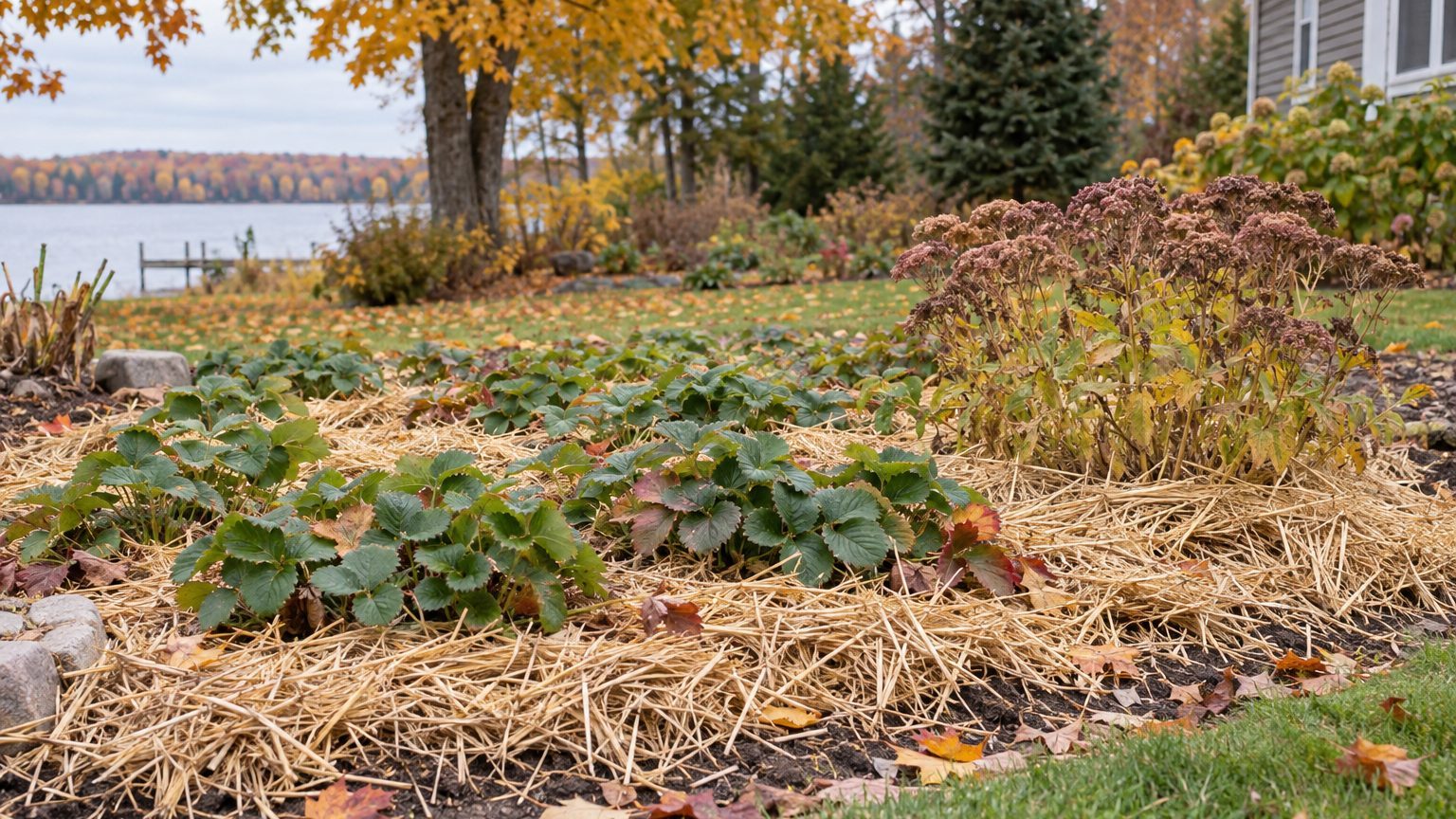

In Kansas, winter mulch goes on after the ground starts to freeze, not before. At Wichita, the first 32°F freeze arrives between October 23 and November 2, so the job belongs in the weeks after that window, once repeated hard nights have stiffened the soil surface. Strawberries get a loose blanket of clean straw. Borderline perennials get a ring of mulch around the crown. Everything comes back off in spring as growth resumes. Mulching too early is the most common mistake.
When to put winter mulch down in Kansas
Wait for the freeze, not the first frost
Winter mulch does not keep plants warm. Its job is to keep frozen soil frozen. A Kansas winter rarely stays cold in one steady stretch. NOAA’s 1991-2020 Climate Normals put the mean daily minimum of the coldest month at 22.5°F at Wichita, so the ground does freeze here. But warm afternoons in January and February regularly thaw the surface, and the next night freezes it again. That cycle is what pushes shallow crowns up out of the ground.
Mulch applied too early works against you. Soil that is still warm stays warm and damp under a blanket, crowns soften, and mice and voles find a sheltered place to move in. The first frost is not the signal either. A light frost kills tender growth, but strawberries and perennials are still hardening off, and they need those cold nights to go fully dormant.
NOAA’s normals (the 32°F freeze probabilities, 30 to 70 percent band) place the first fall freeze at Wichita between October 23 and November 2. That is the starting line, not the mulching date. Let the October 23 to November 2 window pass, then mulch once the soil surface is still stiff in the morning after several hard nights. In most years that means the weeks after the window closes. A trowel is the best test: if the top layer of soil is crusty and firm after a cold night, you are there.
Adjust for your own garden
Those dates come from an airport weather station. Suburban and rural gardens usually see the first fall frost earlier than the airport does, often by one to two weeks, and more at higher elevation. The colder part of Kansas, farther north and higher up, gets its freeze sooner, so fall jobs like mulching start earlier there too. Check your own county’s dates in First and Last Frost Dates in Kansas and then watch the soil, which is the real trigger.
Hardiness zones add another layer. The USDA Plant Hardiness Zone Map (2023 edition, built on 1991-2020 normals) runs from 5b to 7a across the state, based on the average annual extreme minimum temperature. Wichita is the reference city here, and a garden in another part of Kansas can sit in a different zone. Look yours up before deciding which plants are borderline.
Is winter mulch needed at all? For strawberries and anything planted this year, yes. For established, tough perennials in a well-drained bed, often not. The sections below sort out who gets covered.
Strawberries
A strawberry plant carries next year’s crop in its crown, the short, woody stem sitting right at the soil line. That is the exposed part. When the soil freezes, thaws, and freezes again, it heaves, and the crown and its roots can lift out of the ground. Bare crowns also take the full force of dry winter wind and temperature swings. Plants that look fine in December can be dead or weak by April, and the damage often goes unnoticed until the berries fail to show up. Details on varieties, spacing, and care through the growing season are in Growing Strawberries.
The material matters. Clean straw is the standard choice because it is light, airy, and drains well. Look for straw rather than hay, which is full of seed heads and will seed your bed with weeds. Whole leaves are a poor substitute, because they pack down into a wet mat that holds water against the crowns. Pine needles and shredded leaves work if straw is not available, but they should be loose, not packed.
Depth is where people overdo it. NC State Extension’s guidance for general beds says: “A 2-inch to 3-inch layer of mulch suppresses most annual weed seeds and makes it easy to hand-pull any that do germinate.” That figure is written for weed control, not strawberries specifically, but it gives the right order of magnitude for a winter layer. Straw springs back and looks deeper than it is, so spread it loosely and resist the urge to pile on more. Deep, dense mulch is how crowns rot.
Timing follows the same rule as everything else. Wait until the first-frost window has passed and the ground is starting to freeze, then cover the rows. The plants should have gone dormant by then, with the leaves flattened and darkened by cold nights.
Spring matters just as much. Straw left on too long smothers the new growth and holds in cold, wet conditions. Pull the straw off the crowns as soon as new growth shows, usually pale yellow leaves under the straw, then rake it into the aisles. It will keep weeds down and keep the berries clean once fruit sets. Leave it close at hand, though. If a hard frost threatens while the plants are blooming, flip a layer back over them for the night. Because Kansas springs swing so much, check your county’s last frost date in the Kansas guides before you put the rake away.
Perennials and borderline plants
Most established perennials in a Kansas bed do fine without winter protection. Mulch helps three groups: plants in their first winter, plants with shallow roots that heave easily, and plants rated close to the limit of your zone. Newly planted perennials have not yet anchored themselves, so one freeze-thaw cycle can pop them out of the soil. Shallow-rooted plants such as coral bells and garden mums are common victims. Anything marginal for your zone benefits from help too.
The word “borderline” depends on where you garden. The USDA 2023 map runs from 5b to 7a across Kansas, and the coldest-month minimum at Wichita is 22.5°F (NOAA Climate Normals, 1991-2020). A plant rated for your zone is generally fine. One rated only for slightly milder conditions is a gamble in a cold winter, and mulch can improve the odds without guaranteeing anything. Look up your own spot on the map rather than assuming the state’s range applies to you.
Shape matters as much as depth. The goal is a ring around the plant, not a pile on top of it. Mulch heaped against the crown holds moisture against the stems and invites rot and voles. Pull it back a little so a gap surrounds the crown, and keep the layer within the range NC State Extension gives. Their handbook says to “provide a 3-inch layer of mulch to reduce water loss and maintain uniform soil moisture and temperature around roots” for trees. The same handbook’s weed-control figure is 2 to 3 inches. Both are ceilings, not targets to beat. Use a 2-inch to 3-inch ring around the crown, never a mound over it. For more on getting the shape right, see Mulching Without Killing the Plant.
Shredded leaves, straw, and shredded bark all work. Whole leaves tend to mat, so run them over with a mower first. Evergreen perennials need extra care because their foliage should not be buried. Mulch the soil around them and keep it off the leaves.
Herbs are a special case. Some perennial herbs shrug off Kansas winters, others need real protection, and a few will not make it at all. That sorting is covered in Getting Perennial Herbs Through the Winter. In spring, uncover the perennials gradually as new growth appears, a little at a time, rather than all at once.
What goes wrong
Most mulch failures come down to four mistakes, and each one leaves a recognizable mark.
| Problem | What it looks like | What prevents it |
|---|---|---|
| Mulching too early | Soft, dark crowns in late winter; plants that never go fully dormant | Wait for the first-frost window to pass and for the soil surface to stay frozen |
| Matted, soggy mulch | A slick, wet layer that smells sour; rotting at the crown | Use loose straw or shredded leaves, and fluff the layer instead of packing it |
| Voles nesting | Tunnels under the mulch; gnawed crowns and roots | Keep the layer thin, pull it back from crowns, and mulch late |
| Forgetting to uncover | Pale, stretched growth; slow or smothered plants in spring | Peek under the mulch on mild days and pull it back when growth starts |
Early mulch is the root of the first three problems. Warm soil under a thick blanket is exactly what voles and fungi like. They need shelter and moisture, and an early covering provides both. Waiting for a hard freeze removes most of the appeal.
Matting is a material problem. Whole leaves and wet, fine-textured mulch pack tight and hold water against plant tissue. If you can press a handful into a dense wad, it is too compact. Straw and shredded leaves fluff back up.
The spring mistake is the quietest. Plants under mulch keep growing even when you cannot see them, and growth in the dark comes out pale and weak. Lift a corner of the mulch on a mild day in late winter to check. If you see yellow or white new growth, start pulling it back, and keep the material close in case a frost returns.
Common questions
Can I mulch strawberries right after the first frost?
No. The first frost is not the signal. At Wichita, NOAA’s 1991-2020 normals put the first 32°F freeze between October 23 and November 2, and mulch belongs in the weeks after that, once the soil surface stays frozen in the morning. Gardens in the colder north or at higher elevation reach that point sooner than the airport figures suggest.
Do established perennials need winter mulch in Kansas?
Often not. The ground does freeze, with a coldest-month minimum of 22.5°F at Wichita, but hardy perennials in well-drained soil usually cope. New plantings, shallow-rooted plants, and anything near the edge of its hardiness zone are the ones worth covering.
How deep should winter mulch be?
NC State Extension says: “A 2-inch to 3-inch layer of mulch suppresses most annual weed seeds and makes it easy to hand-pull any that do germinate.” For trees it recommends a 3-inch layer. More is not better, and it should never touch the crown or stem.
When should I take winter mulch off?
Pull it back when new growth starts, not on a fixed date. Rake straw into the aisles and keep it nearby for frost nights. Check your county’s last spring frost date, because a thawed bed can still take a hard hit if the cover is gone too soon.