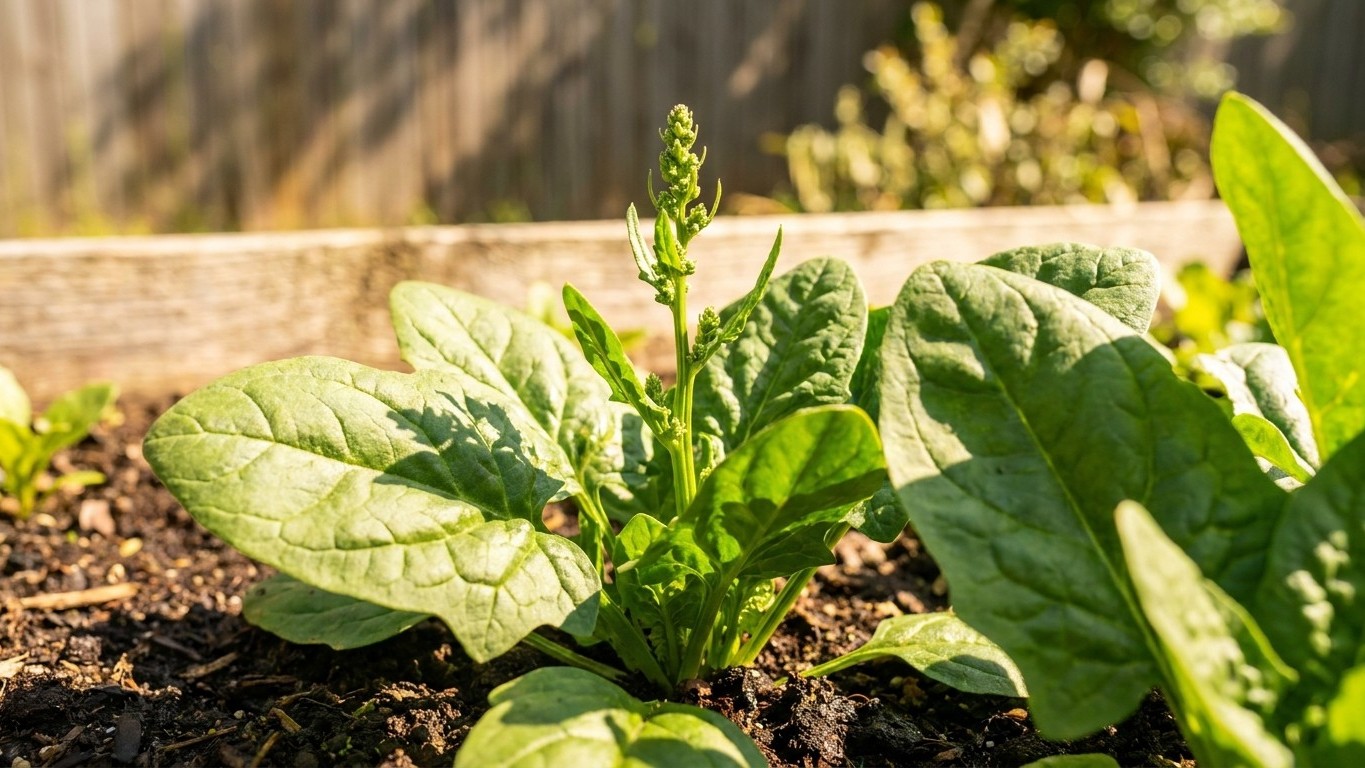

Cut spinach as soon as the leaves are big enough to eat and before the center starts rising into a seed stalk. In Nebraska, that leaves a spring crop squeezed between a late-March-to-early-April sowing and the first run of warm, long days. The fall crop depends on soil cooling enough for seed to germinate. After the cut, the best case is under two weeks, and only at 32°F. In a refrigerator door, expect yellowing within days.
The short answer
Nebraska’s longest day delivers 14 h 59 of daylight at the reference city, Omaha, where the climate normals behind these numbers were recorded. That figure matters because spinach flowers in response to long days as well as warmth. Day length alone can push it toward a seed stalk. A cool June does not buy extra weeks, because the plant is responding to the light, not just the thermometer.
So the limit here is both day length and heat, working together. Day length sets a ceiling that no weather can lift. Heat narrows the window further. Utah State University Extension says spinach grows best where temperatures do not exceed 75 F, and that one number does double duty: it is the point where growth stops being good and the point where leaves turn bitter. Omaha averages 28.1 days a year at 90 F or higher. That is a station average, not a forecast, but it tells you summers here are not the mild kind.
What to look for when cutting
Spring sowing goes in two to three weeks before the last frost, which falls between April 12 and April 23 at the reference city. The source publishes no days-to-maturity for spinach, so there is no honest harvest date to hand you. Go by the plants instead. Start cutting once the leaves are a usable size, and keep cutting until the center begins to lengthen. Once it does, harvest everything. Will Spinach Bolt Early in Nebraska? covers how to spot that moment.
How long it keeps after the cut
UC Davis Postharvest lists the optimum at 0°C (32°F) with 95 to 98 percent relative humidity, and states that spinach “will not maintain good quality for more than 2 weeks.” Read that as a ceiling, not a plan. Wilting, yellowing and decay increase after 10 to 14 days, and faster at 5 to 10°C (41 to 50°F). That second range is about what a refrigerator door holds. The coldest spot in most home fridges is the back of the bottom shelf, so that is where the bag goes. The full figures are on the UC Davis spinach fact sheet.
How long the spring window really is
The opening is easy to calculate. The closing is the part nobody can print on a calendar. Here is the sequence, using the reference-city frost dates as the starting point:
- Find your last spring frost date. At the reference city it falls between April 12 and April 23. Suburban and rural gardens often see it one to two weeks later, so check your own county rather than trusting the airport number.
- Count back two to three weeks. For the reference city that puts sowing between roughly March 22 and April 9, a stretch about two and a half weeks wide. A yard with a later frost shifts the whole stretch later.
- Start cutting when the leaves are a usable size. No days-to-maturity is published for spinach, so judge by the plant, not a number on a seed packet.
- Watch for daytime highs settling above 75 F. Growth falls off and the flavor turns bitter, even before any seed stalk shows.
- Pull the crop when the center starts to rise. Past that point you are growing seed, not salad.
The arithmetic is simple: usable weeks equal the date highs settle above 75 F minus the date you sowed. The sowing date you control. The other date comes from your own forecast, and the figures behind this page do not pin it to a day. What they do show is a sowing window of about two and a half weeks, with an end date set by the weather.
Why the end of the window is the hard part
Two clocks run at once. Heat is uneven, so a warm afternoon in April does not end the season, but a week of them does. Day length only climbs, from about 12 hours at the March equinox toward 14 h 59 at the June solstice. Every week you spend harvesting, the light pressure toward flowering rises.
That asymmetry has a practical consequence. Sowing on the early edge of the window is the only lever that adds harvest weeks, because the closing date will not move for you. A sowing a few days late loses those days from the end, not the beginning. A second sowing a week or so after the first can spread the harvest, but only if it still fits before highs settle above 75 F. Anything sown after that is working against both clocks.
The autumn crop, and when the soil lets you sow
Fall spinach faces a kinder day length (the days are shrinking after the solstice) but two other obstacles. One comes at the start of the season and one at the end. The fall crop is easy to ruin on both sides.
Obstacle one: soil too warm to germinate
Utah State University Extension says seed germination is reduced above 80 F soil. The block on a fall sowing is warmth, not cold. Soil holds heat long after the air feels pleasant, and with 28.1 days a year at 90 F or higher at the reference station, an August seedbed can easily sit above 80 F. Seed sown then may sprout poorly or not at all.
The calendar cannot tell you when the window opens. A soil thermometer can. Check the seedbed a few inches down in the morning, and sow when it reads below 80 F. Watering the row, sowing late in the day and shading the bed can help in a warm spell. In a hot region the window opens when the soil falls, whatever date the seed packet suggests.
Obstacle two: the frost that ends the season
The first fall frost at the reference city comes between October 15 and October 26. Suburban and rural gardens often get it one to two weeks earlier, so shift every date below earlier if that describes your yard. The only timing rule the source gives is to plant 50 to 75 days before the date you want to harvest.
Counting back from a harvest date of October 15 gives sowing between about August 1 and August 26. Counting from October 26 gives about August 12 to September 6. Early August is the stretch most likely to run into soil above 80 F, so in practice the workable sowing dates sit toward the later part of those ranges. Sowing late also means a crop with fewer days before frost, and the source publishes no figure for how much growth you will have by then. A yard whose frost comes a week earlier slides everything a week earlier, and the warm-soil problem gets harder to avoid.
Fall plantings meet a different set of leaf-eaters than spring ones. What Eats Spinach in Nebraska, and When breaks that down by season.
Common questions
Can I still cut spinach after it bolts?
You can, but expect a poor result. The source lists 75 F as both the growth ceiling and the bitterness threshold, and a plant that is bolting in warm weather is past it. The best move is to cut the whole plant just before the stalk rises, not to wait and see.
How long will cut spinach keep in the refrigerator?
UC Davis says it will not maintain good quality for more than 2 weeks, and that figure applies at 32°F and 95 to 98 percent humidity. At the 41 to 50°F typical of a fridge door, it yellows faster. Keep it at the back of the bottom shelf and plan to eat it well inside the two-week ceiling.
Are the frost dates here right for my yard?
They describe the reference city, Omaha, from NOAA NCEI climate normals, with a last spring frost of April 12 to April 23 and a first fall frost of October 15 to October 26. A yard outside the city often sees the last frost later and the first frost earlier, commonly by one to two weeks. Check your own county before you count back from any of these dates.
Which variety should I plant?
Utah State University Extension names four: Bloomsdale, Melody, Teton and Olympia. It gives no data about any of them, so no comparison of bolt resistance or maturity is available here. Whichever you choose, the timing rules above still apply. The overall season is laid out in Growing Spinach in Nebraska.