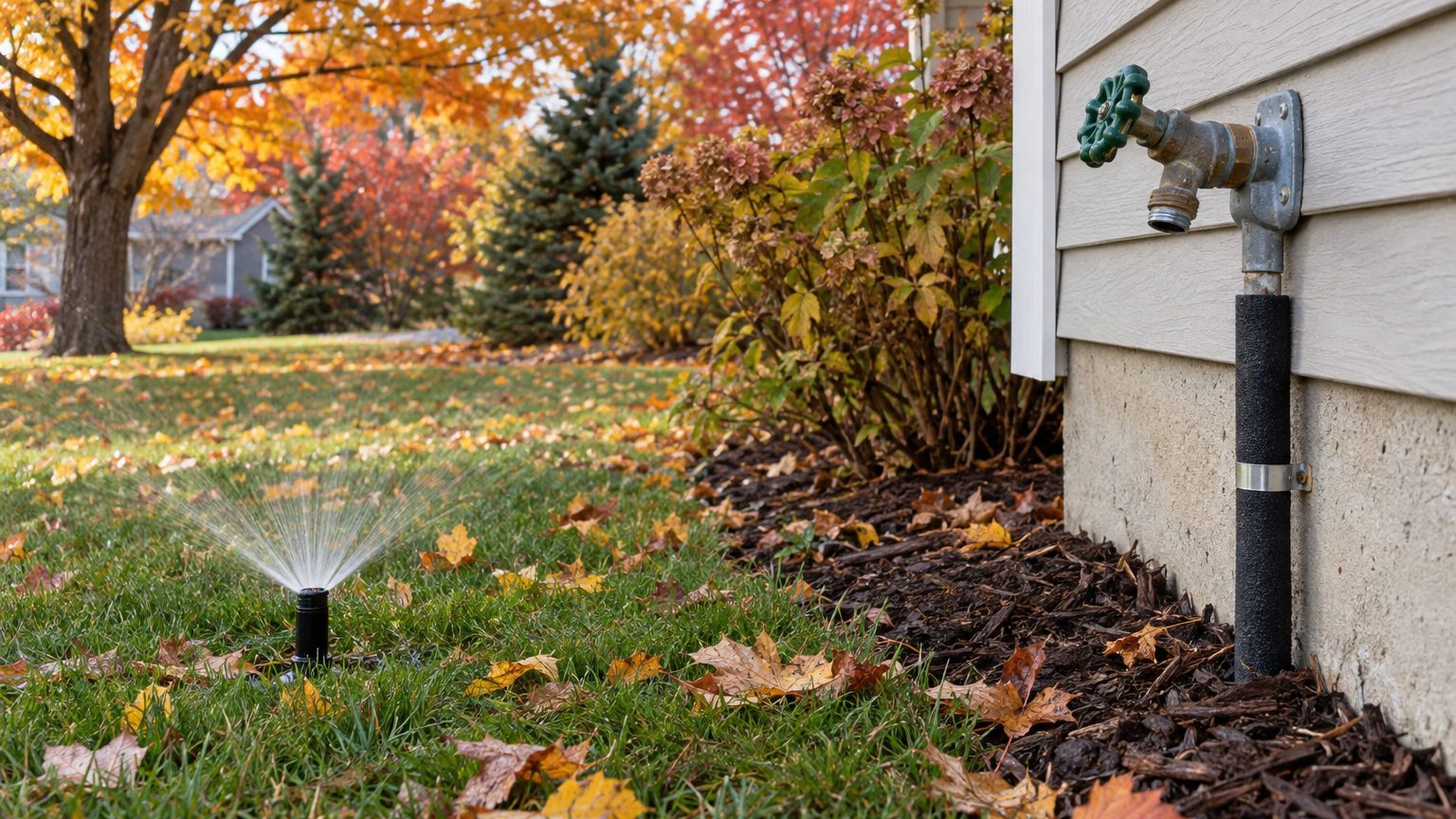

In Illinois, sprinklers and outdoor faucets get shut down in October, before the first frost of the fall and well ahead of the first deep freeze. A full shutdown is not optional here. Winter lows sit far below freezing, and any line or faucet still holding water in January will split. How much margin you get depends on how far north you live, whether you’re in town or out in the country, and how soon the first cold snap shows up.
When to do it in Illinois
Winterize sprinklers and outdoor faucets before the first fall frost, which at Chicago’s reference station falls between October 24 and November 3. The rule is before the first hard freeze, not after the first light one.
Those dates come from the NOAA NCEI 1991-2020 Climate Normals for an airport weather station in Chicago. They mark the band where the odds of a 32°F night run from 30 to 70 percent. That is a band, not a deadline. At the early edge the chance of a freeze is already real, and in some years the cold simply arrives sooner. Suburban and rural yards usually see their first fall frost one to two weeks earlier than the airport does. The farther north you go, toward the Wisconsin line, the earlier your own date moves, and fall chores move with it. Treat the Chicago figures as a reference point for one city, not a guarantee for the whole state, and check your county’s frost dates with your local National Weather Service office or University of Illinois Extension.
Why a light frost is not the finish line
A light frost whitens the grass and blackens the basil leaves. It rarely hurts anything buried. What does the damage is the hard freeze that follows, the kind that stays cold long enough to freeze the top layer of soil and everything sitting in it: water in a valve box, in an above-ground backflow preventer, in the barrel of an outdoor faucet.
The two events tend to come close together. A homeowner who waits for the first light frost to start draining is already working against the clock, and the first hard freeze doesn’t send a warning. Think of the first light frost as the signal that you’re late, not the signal to begin.
Why Illinois can’t skip the blowout
Some mild-winter states can get away with a quick drain and a prayer. Illinois isn’t one of them. The mean daily minimum in the coldest month at the Chicago station is 18.8°F (NOAA NCEI Climate Normals, 1991-2020). That is the average low for every night of that month, so plenty of nights run colder, and water left in a line has weeks to freeze solid.
The USDA Plant Hardiness Zone Map (2023 edition) places Illinois across zones 5a to 7b, and the southern end of the state is milder than Chicago. That moves the timing later, since southern Illinois gets its first freeze after Chicago does. It doesn’t remove the job. Zones describe the average annual extreme minimum, and a pipe doesn’t care about averages, only about the one night that goes wrong.
While the hoses are coming off, October is also the month to put Winterizing a Lawn on the same list. For other seasonal timing around the state, browse the Illinois guides.
Sprinkler lines: drain or blow out
Water expands as it turns to ice, and a sealed pipe has nowhere to let it go. The pressure goes into the weakest point: a fitting, a valve body, the brass housing of a backflow preventer, the swing joint under a head. Nothing looks wrong in December. The split sits there quietly until spring, when you turn the system on and water finds the crack. With a coldest-month average low of 18.8°F at the Chicago station, water trapped in any of those parts will freeze, not maybe but routinely.
Lines are rarely level, either. Water settles in low spots, in the bowl of a pop-up head, in the valve manifold, in any section that tilts uphill. Those are exactly the places that crack.
Three ways to empty a system
Every method aims at the same result, an empty system, but they differ in how reliably they get there.
| Method | How it works | Where it falls short | Fit for Illinois |
|---|---|---|---|
| Manual drain | You open drain valves at the low points and let gravity do the work | Leaves water in heads, flat runs and any section that doesn’t slope toward a drain | Fine as a supplement, rarely enough alone |
| Automatic drain | Valves open on their own when line pressure drops | Can stick open or shut with grit, and doesn’t empty the backflow device or uphill runs | A backup, not a plan |
| Compressed-air blowout | Air pushed through each valve zone forces water out of pipes and heads | Wrong pressure or sloppy technique can damage heads and fittings | The standard for a climate this cold |
Illinois calls for the blowout. Even a system with drain valves usually keeps some water in heads and in sections the drains can’t reach, and the winters here give that water months to freeze. Think of the drain valves as a first pass and the compressed air as the part that counts.
When a professional is the sensible choice
Blowing out a system looks simple, and that is the trap. Air moving through a line can spin a rotor head far faster than it was built to turn, and a bad connection at the compressor can turn into a flying hazard. Too much pressure in a system built for water can burst the very fittings you’re trying to protect. Each valve zone gets its air in turn, a short run at a time, with eye protection on and nobody standing over a head.
Hire a pro if you don’t own a compressor sized for the job, if you can’t locate your irrigation shutoff or low-point drains, if the system includes a pump or a backflow device you can’t identify, or if you’ve found cracked parts in past springs. Whatever route you choose, book the blowout for before the October 24 to November 3 frost window if you’re near Chicago, and earlier if you’re farther north or in open country. An appointment is only worth something if it lands ahead of the freeze.
Whichever way you go, shut the irrigation supply first and set the controller so it can’t run zones while the lines are empty.
Outdoor faucets and hoses
Hoses come first. Disconnect every one, along with splitters, sprayers, timers and hose-end shutoffs, and store them. A hose left on a spigot is the single most common reason an otherwise careful shutdown fails, because it keeps the faucet from draining and holds a length of water against the pipe.
The shutdown, step by step
The job takes a few minutes per faucet and involves nothing but turning valves:
- Remove and store every hose and attachment.
- Find the interior shutoff valve for that faucet, usually in a basement, crawl space or utility room, and close it fully.
- Open the outside faucet and leave it open all winter so whatever water remains can drain out.
The order matters: close the interior valve first, then open the outside tap. Reverse it and you’ve drained nothing, because the line stays fed. If you can’t find the interior valve, or it won’t turn, stop. Forcing a stuck valve, cutting into a line or adding a new shutoff is plumber’s work. The full sequence, with the common variations, is in Winterizing Outdoor Faucets Before the First Freeze.
Why a frost-free faucet still fails with a hose attached
A frost-free faucet isn’t magic. It has a long stem that puts the actual valve seat deep inside the heated side of the wall, so the part that holds water is protected. When you shut it off, the water left in the barrel is meant to run out through the spout, helped by a slight downward tilt in the pipe.
Attach a hose and that exit is blocked. Even a hose that looks empty holds a little water at the faucet end, and a closed nozzle or hose-end shutoff keeps the barrel from draining at all. The trapped water freezes, and it freezes where you can’t see it. The first sign is usually a spray inside the wall or a wet ceiling in spring. More on how these fixtures work, and how to tell which one you own, in Frost-Free Outdoor Taps.
If a frost-free tap drips after you shut it off, or if it seems to tilt upward instead of down, don’t try to adjust it. That is a plumber’s call.
What goes wrong here
The early cold snap
The most likely failure is also the dullest: someone intended to do it next weekend. The Chicago band of October 24 to November 3 is a probability range, and suburban and rural yards often get their first frost one to two weeks sooner. A homeowner who plans around the average date can get caught by an early hard freeze with the system still full.
In spring, it looks like a geyser from a cracked line when you first turn the system on, a patch of lawn that stays soggy, a zone that won’t build pressure, or a head that sprays weakly. The fix for next year is to schedule the job before the range begins, not for the week the forecast turns. If cold is already in the forecast and you haven’t started, do the faucets first (a few minutes each) and then the lines.
The forgotten hose and the flooded valve box
The forgotten hose is usually the one behind the shrubs, on the garage side, or coiled on a reel nobody has touched since August. Its signature is quiet damage inside the wall. In spring, a cracked faucet barrel shows up as a drip or spray from the interior pipe when you open the valve, or as a stain on the basement ceiling. Open the interior valve slowly, look at the pipe and surrounding wall before you attach anything, and if water is coming where it shouldn’t, close the valve again and call a plumber. For a line that has already frozen, start with what to do about Frozen Pipes and leave repairs to a professional. The prevention is a checklist: walk the whole property before the October 24 to November 3 range begins and count every faucet.
The valve box is the quieter one. Control valves sit in a buried box, and when water collects in it and freezes, the valves and their fittings crack. The spring sign is a box full of water, a valve that leaks constantly or a zone that runs when it shouldn’t. Keep lids on and debris out, make sure the valves are included in the blowout, and treat standing water in a box as a warning that something is leaking or draining poorly.
Common questions
Is a light frost enough to ruin sprinkler lines?
Usually not by itself. A light frost is a warning, and the damage comes from the hard freeze that follows, which can arrive soon after. Above-ground parts such as the backflow preventer and the barrels of outdoor faucets are the most exposed. Finish the work before the first frost range, not in response to it.
Can I wait until November in Illinois?
In the Chicago area, the first-frost band runs from October 24 to November 3, so waiting into November is a gamble that most years lose by the end of the band. Farther north and out in the country, the first frost tends to come earlier still. In southern Illinois it comes later than Chicago, but check your own county’s dates before assuming you have the extra time.
Do I still need to winterize a frost-free faucet?
Yes, at least by taking the hose off. A frost-free faucet only protects itself when it can drain, and a hose, or even a closed nozzle, stops that. Close the interior valve and leave the outside tap open as you would with any outdoor faucet.
Where do I find my own first-frost dates?
Your county’s local National Weather Service office and University of Illinois Extension both publish local frost information. The Chicago figures come from an airport station, and suburban and rural yards often see their first fall frost one to two weeks earlier, so use your local date, not the airport’s.