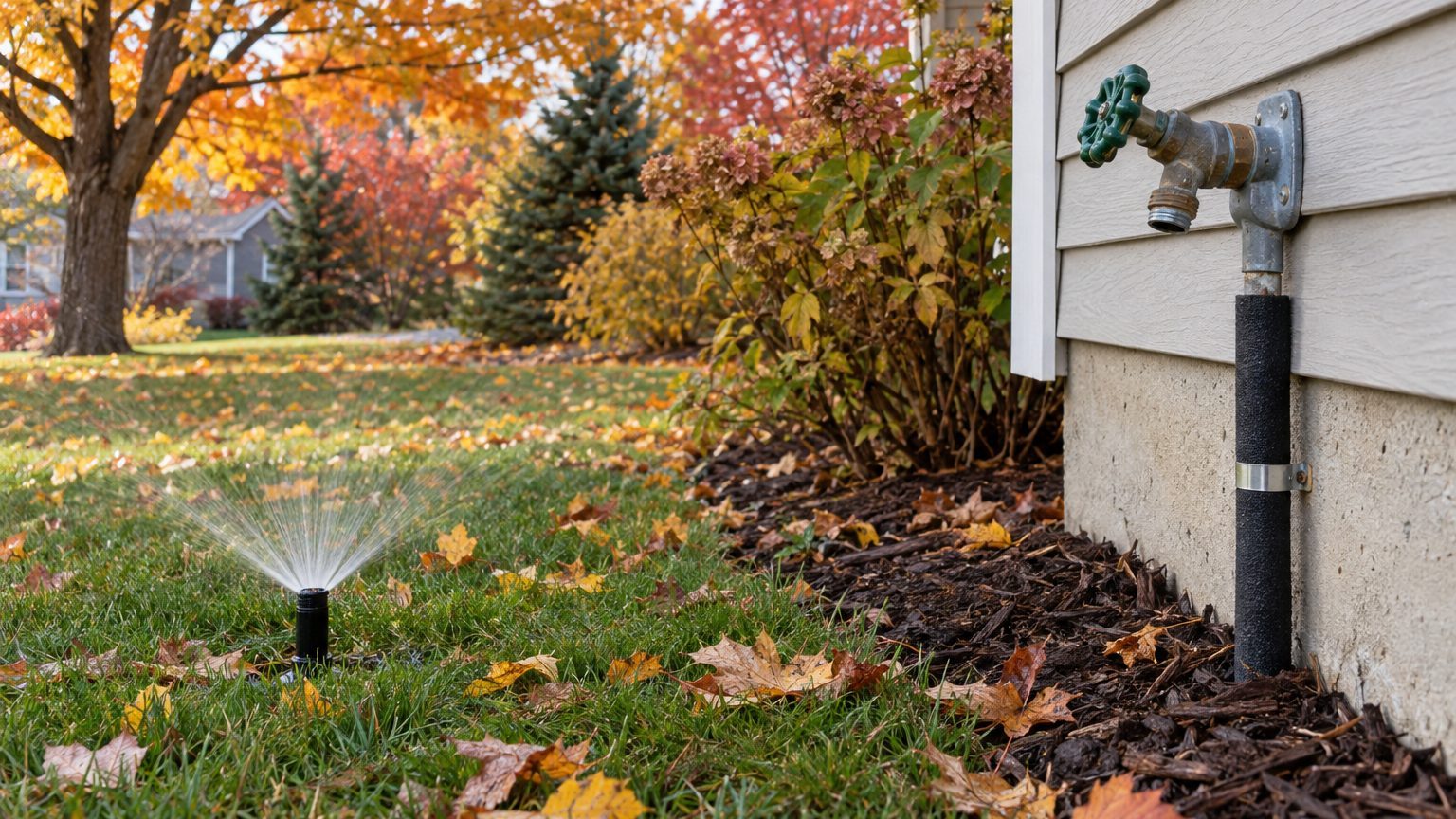

A sprinkler system left full going into a Wisconsin winter is a bet against the thermometer, and the thermometer wins. The safe approach is to drain the lines and shut down the outdoor faucets in the weeks before the first hard freeze. For Milwaukee, NOAA’s 1991-2020 Climate Normals put the first 32°F freeze between October 17 and October 29. The north and the inland south get there sooner, so their work starts earlier.
When to do it in Wisconsin
Plan to finish in the weeks leading up to the first fall frost, which NOAA’s 1991-2020 Climate Normals place between October 17 and October 29 at the Milwaukee station (the range comes from the band where 32°F freeze probabilities run 30 to 70 percent). The rule is to get it done before the first hard freeze, not after the first light one.
Here is the date to write on the calendar: have everything drained ahead of the October 17 to October 29 freeze window at Milwaukee, and earlier in the north and inland.
A full blowout is not optional here. In a mild climate you can sometimes get away with covering a backflow device and hoping. Wisconsin is not that climate. NOAA’s normals for Milwaukee give the mean daily minimum of the coldest month as 17.2°F, which means a typical winter night in the deepest cold sits well below freezing. Water left in a pipe or valve will freeze, and it will do so more than once before spring. USDA’s 2023 Plant Hardiness Zone Map, which is built on the average annual extreme minimum temperature, places Wisconsin in zones 3b to 6a, so conditions differ across the state, but nowhere in that range is the winter gentle enough to skip the job.
Why a light frost is the alarm, not the deadline
The first light frost is the warning shot. It often kills the tomato vines, glazes the windshield, and tells you the calendar has turned. Pipes tend to survive it, because one cold night does not always freeze water that is sitting in warmer soil or in a building wall. A hard freeze, the kind that holds below 32°F for hours and keeps going the next night, is what splits plastic fittings and cracks brass. Aim to be done before that, and treat the first light frost as the signal that you have run out of slack.
The lead time matters because the 30 to 70 percent band is not a promise. In some years the first freeze arrives before October 17. In others it holds off past October 29. A window built on average dates only helps if you finish at the early edge of it.
How the date shifts across the state
Milwaukee is the reference point, and the state is large. Lake Michigan delays the first fall freeze at the lakeshore. Inland southern Wisconsin typically freezes in early October, and the north freezes far earlier. Fall tasks move earlier as you go north and inland, never later. More local detail lives in the Wisconsin guides.
| Area | First fall freeze compared with Milwaukee’s window | What it means for the job |
|---|---|---|
| Lake Michigan shoreline | Delayed by the lake | Slightly more room, but still plan to finish inside the Milwaukee window |
| Inland southern Wisconsin | Typically early October, ahead of the Milwaukee window | Start earlier than a lakeshore neighbor would |
| Northern Wisconsin | Far earlier than the Milwaukee window | Drain and blow out well ahead of it, and do not wait for a late-October date |
The same logic applies to other fall chores. A lawn that needs its last treatments follows a calendar tied to the same frost dates, covered in Winterizing a Lawn. For sprinklers and faucets, though, the plumbing deadline comes first, because a split pipe costs more than a thin patch of grass.
Sprinkler lines: drain or blow out
Water expands when it freezes. Inside a closed space like a pipe, a valve body, or a backflow preventer, that expansion has nowhere to go, so the ice pushes outward until something gives. Plastic pipe splits along its length. Fittings crack at the joints. Valve bodies and the brass or plastic parts inside them fracture. The damage is often invisible until spring, when you turn the system on and water starts bubbling up in the lawn.
The backflow preventer deserves special mention. It usually sits above ground near the house, where it is exposed to the air, and it holds water in a chamber that cannot drain on its own. It is often the first thing to fail.
Three ways to empty a system
Manual drain relies on drain valves installed at the low points of the system. You open each one, let gravity pull the water out, and close them again in spring. It costs nothing but time, and it works only if the system was installed with sloped pipe and enough drains to reach every low spot. Water in a pocket that is not at a drain stays put.
Automatic drain valves open on their own when line pressure drops after you shut off the supply, letting the water run out of the line. They are convenient, but they only clear the water that can flow to them, and a valve that sticks or clogs with debris will leave water behind with no warning.
Compressed-air blowout pushes the water out of every zone, one at a time, using an air compressor connected to the system. It reaches the pockets that gravity misses, which is why it is the method most often used in cold regions. The air has to be used carefully, because too much pressure can damage heads and fittings, and the person doing it should stay clear of the sprinkler heads and wear eye protection.
Which one Wisconsin calls for
With a coldest-month minimum of 17.2°F in Milwaukee and colder conditions farther north, a compressed-air blowout is the sensible default. Manual and automatic drains can be part of the process, but leaving them to do all the work is a risk when the winter is this cold. If your system came with drain valves, use them after the blowout, not instead of it.
Write this down: choose a compressed-air blowout, finished ahead of the October 17 to October 29 freeze window. If you are in the north or inland, move that earlier.
A professional is the sensible choice in a few situations. If you do not own a compressor of the right size, renting one and guessing at the settings is how heads get blown off. If the system has many zones, a backflow preventer you cannot confidently shut down, or you are not sure where the shutoffs are, the cost of a service visit is small next to the cost of a split mainline. Call before the window opens rather than during it, so you are not trying to schedule a visit with a freeze in the forecast.
Before anyone connects air, the water supply to the system must be off, and the shutoff is usually the same valve you will turn again in spring. If you are not certain which valve that is, that alone is a reason to hire someone to do the work once and show you the layout.
Outdoor faucets and hoses
This job takes ten minutes and involves nothing but turning valves. Start by disconnecting every hose, including the short ones, splitters, and any timer or attachment screwed onto the spigot. Drain the hoses and store them. Then find the interior shutoff valve for that faucet, which is usually in a basement, crawl space, or utility area, and close it. Last, go outside and open the faucet fully so the water in the line can drain out. Leave it open for the winter.
If the faucet drips or runs after you have closed the interior valve, stop there. That means the valve is not sealing, and fixing it is plumber’s work. The same goes for anything that involves cutting, soldering, replacing a valve, or opening a wall. Turning valves is the whole job for an owner.
The deadline to remember is this: disconnect every hose when the first light frost shows up in the forecast, and no later than the October 17 to October 29 window at Milwaukee, sooner in the north.
Why a frost-free faucet still fails with a hose on
A frost-free faucet is built with a long stem so the valve seat sits inside the heated part of the wall, not at the cold outer end. When you shut it off, the water in the barrel is supposed to drain out through the spout. That design depends on the barrel emptying. If a hose is attached, even one with the nozzle open, water is trapped in the barrel, and the barrel is sitting in the cold part of the wall. That water freezes, the ice splits the barrel or pushes on the stem, and you will not know until spring, when the faucet is turned on and water sprays inside the wall.
The faucet also has to be tilted slightly downward to drain. If it was installed level or tilted up, water stays in the barrel regardless of what you do. That is a plumber’s fix, not a weekend one. More on how these faucets work and what to check is in Frost-Free Outdoor Taps, and the full fall routine is laid out in Winterizing Outdoor Faucets Before the First Freeze.
Older, non-frost-free spigots depend even more on the interior shutoff. The valve is at the outside end of the pipe, so if the line is full, there is no safe spot for the ice to form. Closing the interior valve and opening the outside tap is the only protection they have.
What goes wrong here
The most common failure is the early cold snap. The first freeze does not wait for the average date, and because the 30 to 70 percent band means a freeze can arrive before October 17, a system that was scheduled for late October can be hit first. The damage shows up in spring as a wet patch in the lawn that will not dry out, a geyser from a sprinkler head or a pipe joint, or water running at the backflow preventer when the system is turned on. The fix is to treat the early edge of the range as the real deadline, and, if a hard freeze is forecast before you have finished, to shut off the water supply to the system and open any drain valves as a stopgap until the blowout can happen.
The forgotten hose is the second. One hose left on one spigot is enough. It looks fine all winter. In spring, when the faucet is opened, water sprays from the wall behind it, sometimes inside the house, sometimes behind a finished surface where it runs unseen for days. Prevent it with a habit: make hoses come off the same weekend the sprinklers are drained, and check each spigot once more after the first hard freeze is in the forecast. Where a pipe has already frozen or you suspect one, the steps for thawing and what not to do are covered in Frozen Pipes.
The third is the valve box that floods. Sprinkler valves usually sit in a buried box with a lid. If the box fills with water from groundwater, a leaking valve, or runoff, and the winter freezes it, the valves inside can crack. In spring this looks like a zone that will not shut off, a valve that leaks constantly, or a box full of water that never drains. Keeping the lid in place, clearing debris from the box in fall, and making sure the blowout reaches every zone all help. If a box holds standing water, have it looked at by an irrigation professional before winter, not after.
Common questions
Is it too late if the first frost has already happened?
Not necessarily. A light frost does not always freeze water in the pipes, so you may still have time. Do the work as soon as you can, and do not wait for a warm spell to feel safe. If a hard freeze is in the forecast and you have not finished, shut off the water to the system and open the drains to buy time.
Do I still need a blowout if my system has automatic drain valves?
In Wisconsin, yes, for most systems. Automatic drains only clear the water that can reach them by gravity, and a stuck or clogged valve fails silently. A blowout removes the water that the drains miss. Having both is better than relying on either one alone.
Should I leave the outside faucet open all winter?
Yes, after the hose is off and the interior shutoff is closed. An open faucet lets any remaining water drain out and gives the line room for any moisture that condenses. A closed outside faucet can hold a small amount of water at the end of the pipe, which is enough to cause damage.
When can I turn everything back on in spring?
Wait until the risk of hard freezes has passed, which comes later in the north and earlier along the southern part of the state. Reconnect hoses, open the interior valve slowly, and check each faucet and each sprinkler zone for leaks before you trust the system for the season. If you hear water running inside a wall, shut the interior valve and call a plumber.