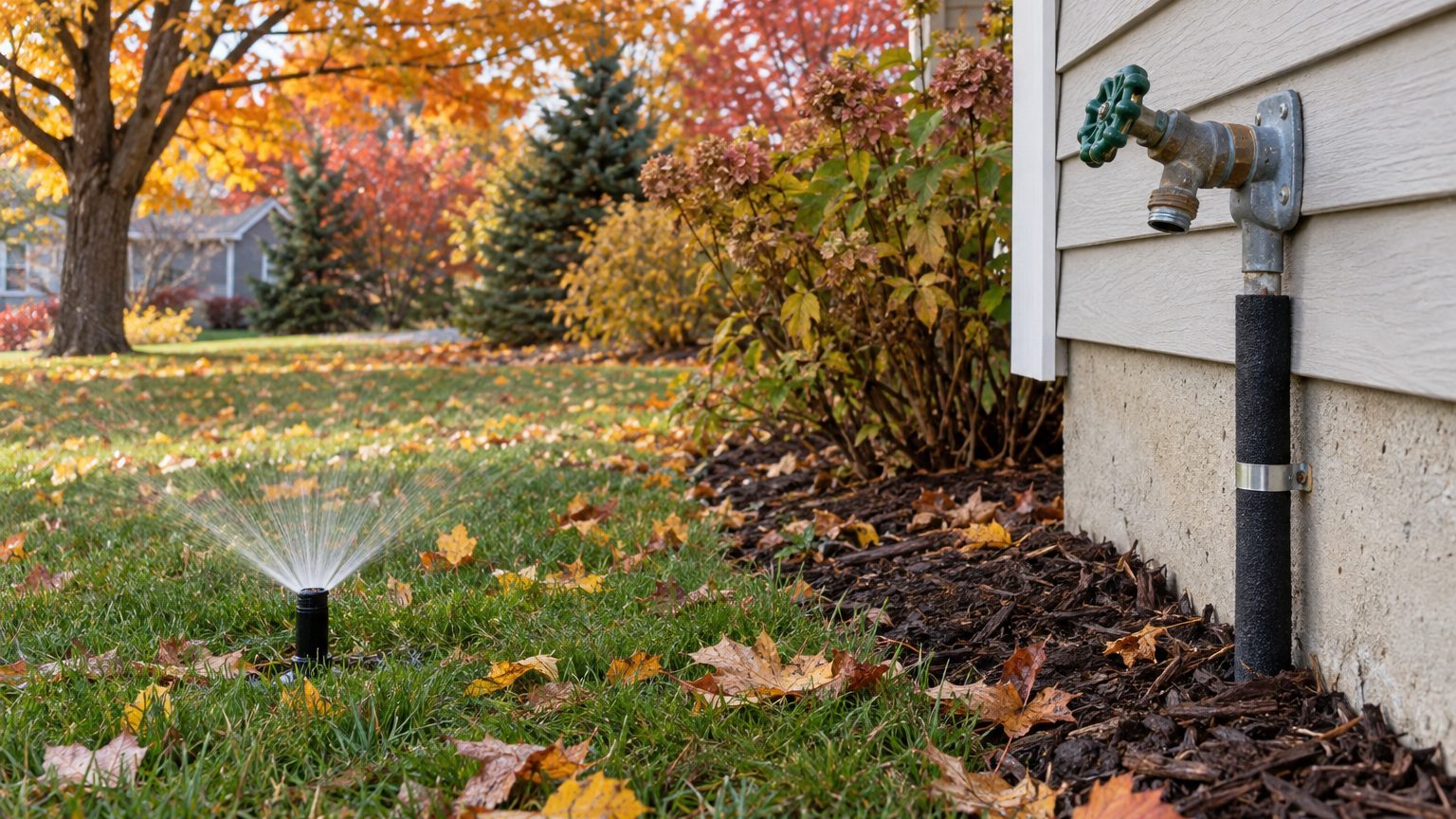

Delaware’s first fall frost arrives between October 26 and November 7 at the Wilmington airport weather station, according to NOAA’s 1991-2020 Climate Normals. That range is your calendar anchor for shutting down an irrigation system and the outside taps. Get both done in the weeks before it opens, and earlier if you live inland or farther north, where cold shows up sooner. Skip the job and one hard freeze can split a valve, a backflow assembly or a pipe inside a wall.
When to do it in Delaware
Aim to finish winterizing before the first hard freeze, not after the first light one, which in practice means working in the weeks leading up to October 26 to November 7. That range comes from NOAA NCEI’s 1991-2020 Climate Normals for the Wilmington airport station, based on the 30 to 70 percent probability band of a 32°F freeze. Write it on the calendar as a deadline, not a suggestion: have everything drained before the October 26 to November 7 window opens.
Don’t read the range as a statewide promise, because it describes one airport. Suburban and rural properties often see the first fall frost one to two weeks earlier than the reference station, and the colder parts of the state, meaning farther north and inland, get it earlier still. A house in open country north of the city can be hit while the airport is still above freezing. Check your own county’s frost data before you pick a weekend.
A light frost is a warning, a hard freeze is the deadline
A light frost is a night that dips a degree or two under 32°F and thaws by mid-morning. It will blacken tomato vines. It rarely does damage to plumbing. A hard freeze is the night temperatures stay below freezing for hours, long enough to turn standing water in a pipe into ice. The first light frost tells you the clock is running. The hard freeze is the moment the work should already be behind you.
The trouble is that nobody knows in September which night will be the hard one. Early cold snaps happen, and a forecast that looks mild on Tuesday can turn on Friday. The sensible approach is to pick a dry weekend in the stretch before the range, and not wait for the forecast to force your hand.
Why skipping it is a bad bet here
In colder-winter territories the question is how early to start. In places with mild winters, the question is whether a full shutdown is needed at all. Delaware is not mild enough to skip it. NOAA’s normals put the mean daily minimum of the coldest month at 25.6°F at the Wilmington reference station, so typical January nights fall well below freezing, not just the rare bad one. The USDA Plant Hardiness Zone Map 2023 lists the state as 7a to 8a, a range built on the average annual extreme minimum, which tells you that some parts of the state run colder than others.
So the full job applies: drain or blow out the sprinkler lines, disconnect hoses and drain the outside taps, and deal with any exposed backflow device. Buried pipe gets some protection from the soil. Valves, risers, sprinkler heads and anything above ground get none.
| Location | First fall frost timing |
|---|---|
| Wilmington airport station (reference) | October 26 to November 7 |
| Suburban and rural properties | Often one to two weeks earlier than the reference range |
| Farther north and inland | Earlier still; check your county |
Sprinkler lines: drain or blow out
Why water in the lines is the problem
Water expands as it freezes, and pipe does not give. Whatever is trapped in a sprinkler line, a valve body or a backflow assembly pushes outward on its container until something yields. PVC cracks along its length. Fittings pop apart. Brass valve bodies split. The ice itself often does little harm while it is solid, so the damage tends to hide until the thaw, and you find out in spring when the system pressurizes and a geyser shows up in the lawn.
Irrigation systems are especially exposed because they are made of long runs of thin-walled pipe laid across open ground, with a handful of above-ground parts (the backflow preventer, the shutoff, the risers) sitting in the cold air. Those parts freeze first.
Three ways to clear a system
A manual drain means closing the supply to the system and opening drain valves at the low points of the lines so the water runs out by gravity. It works on systems that were installed with those valves and with lines that slope toward them. It is slow, it depends on every low point being found, and pockets can hold water on flat or rolling yards.
Automatic drain valves open on their own when line pressure drops after the system is shut off, letting the water seep out at each low spot. They are convenient, but they can stick open or closed from grit and age, and they only help if the pipe slopes to them. Treat them as backup, not as a plan.
A compressed-air blowout pushes the water out with air. You shut off the supply, connect a compressor to the blowout port, and run the zones one at a time in short cycles until the heads stop spitting water and only mist comes out. It is the thorough option, because the air reaches parts of the system gravity does not. It also has rules worth respecting. Stay within the pressure rating of the pipe and heads, never stand over a head or valve while it is under air, wear eye protection, and don’t run a zone dry for long, since sprinkler heads rely on water to cool their moving parts.
Which one this climate calls for
With January minimums averaging 25.6°F at the reference station, Delaware winters are cold enough that I would not trust gravity alone. For most systems, a compressed-air blowout, done in the weeks before the October 26 to November 7 frost window, is the right call, with manual or automatic drains as a supplement. Drain the backflow assembly and the supply line to it separately, following the maker’s instructions, and set the controller to its off or rain mode so it doesn’t try to run a dry system.
A professional makes sense in several situations. If you own no compressor, or one too small to move air through a large system, hiring someone is cheaper than a half-done job. The same goes for systems with many zones, with a pump, or with a backflow device that needs periodic testing, and for anyone who simply isn’t sure where the low points and shutoffs are. A mistake with compressed air can hurt you, and one missed zone can cost you a spring repair. The air pressure itself is not a place to guess.
Outdoor faucets and hoses
Outside taps are simpler than sprinklers, and the job takes about as long as a cup of coffee. The sequence is the same in nearly every house. First, disconnect every hose, splitter and timer from every outdoor faucet, including the one behind the shrubs. Second, find the interior shutoff valve for that faucet, usually in a basement, crawl space or utility closet, and close it. Third, go outside and open the faucet fully so the water in the line can run out, and leave it open for the winter. If the interior valve has a small drain valve or cap, open it over a bucket to let the last of the water out. That is all turning valves and nothing else. Anything beyond that, such as cutting, soldering or replacing a tap, is plumber work. The longer walkthrough is in Winterizing Outdoor Faucets Before the First Freeze.
The decision to write down is simple: disconnect every hose before the first hard freeze, which in Delaware means before the October 26 to November 7 range at the Wilmington reference station, and earlier for suburban and rural homes. Do it the same weekend as the sprinklers so that one trip covers both.
Why a frost-free faucet still fails with a hose on
A frost-free faucet is built so that the valve seat sits well inside the warm side of the wall, at the end of a long barrel. When you shut it off, the water in the barrel is supposed to run out through the spout, because the barrel is angled slightly downward. That design works only when the water can leave.
Leave a hose attached, and especially a hose with a nozzle or a timer on the end, and the water has nowhere to go. It sits in the barrel, close to the outside wall, where the cold can reach it. When it freezes, the barrel splits, and nothing looks wrong until spring, when the tap is turned on and water sprays inside the wall. This is why many “frost-free” failures turn out to be hose failures. More on how these fixtures work is in Frost-Free Outdoor Taps.
Check whether yours is truly frost-free. Older homes often have a standard sillcock, with the valve right at the wall, and those need the interior shutoff closed and the outside tap opened. And if a frost-free faucet sits level or tilts toward the house, it will not drain well even with the hose off. Reslopping it is a plumber’s job, not a turn of a valve.
What goes wrong here
Delaware’s winters rarely arrive on a schedule. Most failures come from a plan that was good but late, or from a step that was skipped. Three show up more than the rest.
The early cold snap
A hard freeze lands a week or two before anyone has gotten around to draining. Because the reference range runs from October 26 to November 7 and suburban and rural properties often see frost one to two weeks sooner, an early night in the 20s is not rare. In spring it looks like a wet patch that never dries, a zone with weak pressure, a head that geysers, or a hissing sound at the shutoff. The fix is to schedule the work well ahead of the range, not at its start. Keep a dated reminder for the weekend before the October 26 to November 7 window, and move it a week earlier if your property is inland or north.
The forgotten hose
One hose on one faucet, left attached because it was behind the grill or tucked behind a bush. A split barrel behind the siding is the usual result, and it often doesn’t show until the tap is opened in spring. Watch for water dripping inside the wall or ceiling, a damp basement corner under the tap, or a faucet that sprays sideways. Prevention is a walk around the whole house, counting every outdoor faucet, before you call the job done. For what a burst line looks like inside a house, see Frozen Pipes.
The flooded valve box
Irrigation valves live in plastic boxes set into the ground, and those boxes collect water, leaves and sometimes a resident frog. When the soil is wet and the box does not drain, the valves inside sit in standing water that freezes. In spring you may find a cracked valve body, a solenoid that won’t fire, or a zone that stays on. To prevent it, close the supply, open the manual drain at the valve manifold if one is provided, clear debris from the box, and make sure the lid is on and the box is not sitting in a low spot that fills after storms. Check it again after the first heavy rain of fall.
Common questions
Is it too early to winterize in early October?
It does no harm to the system, as long as you won’t need to water again. The one catch is new sod or fall seeding, which may still need irrigation until it roots. If that is your situation, wait until closer to the frost window and read Winterizing a Lawn for how lawn care and shutdown timing fit together.
Can I just turn off the controller and the water supply?
No. Closing the supply stops new water from entering, but whatever is already in the lines, valves and backflow assembly stays there and can freeze. The water has to be pushed out or drained out, not just shut off.
If I have automatic drain valves, do I still need a blowout?
Often yes. Those valves depend on slope and clean seats, and they fail quietly. With a mean coldest-month minimum of 25.6°F at the Wilmington reference station, a system that relies only on them is a gamble. The backflow device, which usually sits above ground, has to be drained separately in any case.
How do I find the right date for my county?
Start with the reference range, October 26 to November 7 at the Wilmington airport station, then move earlier if you are in the suburbs, the countryside or the northern part of the state. Property-by-property conditions differ, so add the local forecast as the final check. More Delaware-specific timing is collected in the Delaware guides. And the USDA’s 7a to 8a hardiness rating, which measures the average annual extreme minimum, tells you what plants survive, not when frost arrives, so don’t use it to schedule this job.