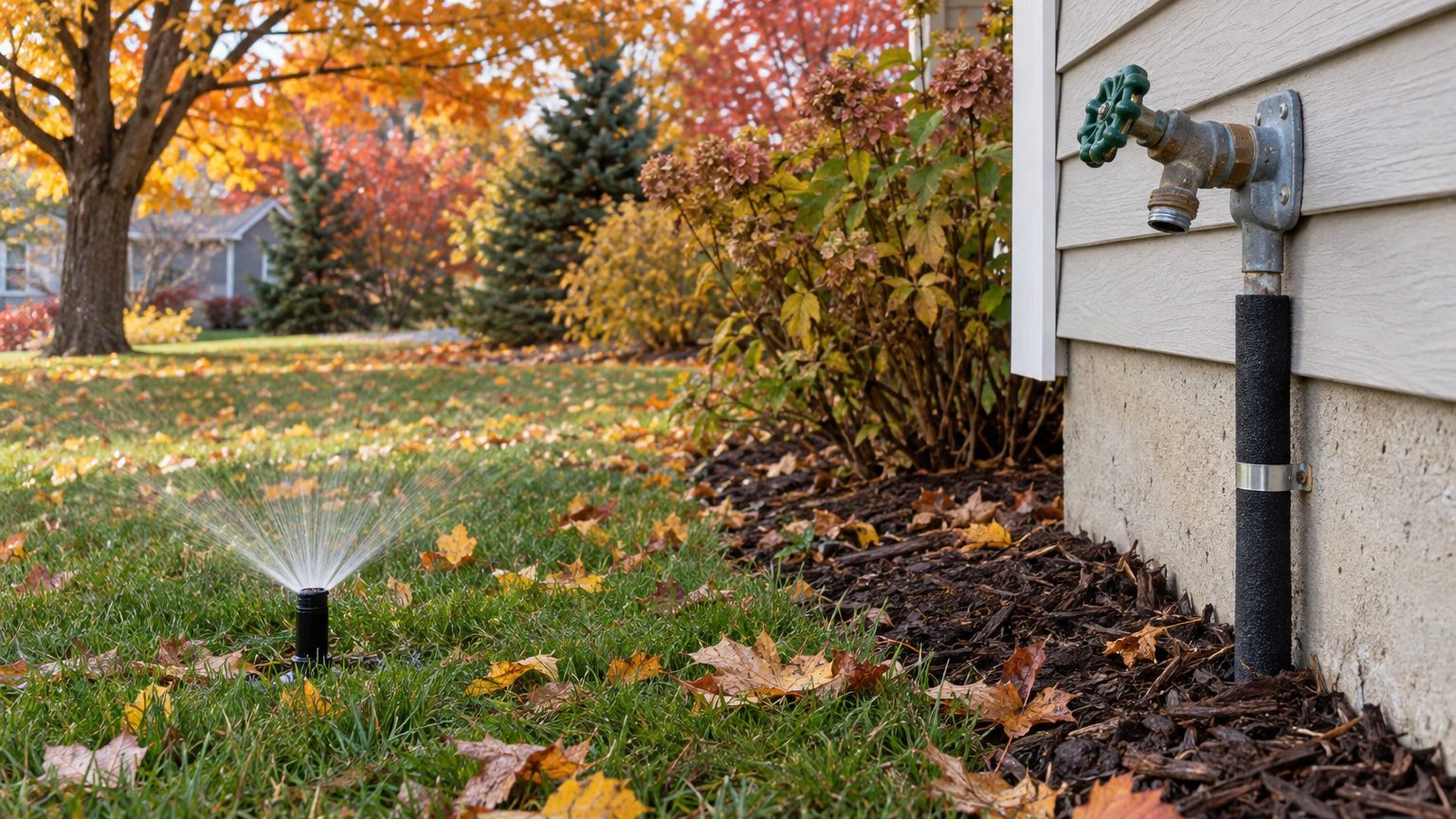

Maryland sprinkler systems and outdoor faucets should be shut down in October, ahead of the first hard freeze and well before the ground and pipes are asked to survive a real cold night. Winterize too early and you give up a few weeks of watering. Winterize too late and the bill arrives in April: a split pipe, a cracked valve, or a leak inside a wall. The dates, the methods, and the failures to expect are below.
When to do it in Maryland
Finish before the October 26 to November 5 frost window, the range NOAA’s 1991-2020 Climate Normals give for the first fall frost at the Baltimore reference station (the dates when the odds of a 32°F freeze sit between 30 and 70 percent). The rule is before the first hard freeze, not after the first light one.
Why a light frost is a warning and a hard freeze is the deadline
A light frost on a clear October morning whitens the grass and rarely touches anything underground. A hard freeze, the kind that sets in overnight and holds into the morning, reaches the parts of a system that sit above ground or close to the surface: the backflow preventer, exposed pipe, shallow valve boxes, and the hose bib on the side of the house. Because that 30 to 70 percent band is a spread of odds and not a promise, some years bring the first freeze before October 26. Watching the forecast beats trusting the calendar.
Today is October 8, 2026, so the window is open now. For most Maryland homeowners, the next few weeks are the time to book a blowout or block out a weekend.
Why Maryland is not a skip-it climate
In a region where winter lows never dropped below 32°F, a full blowout would often be unnecessary, and a quick shut-off would do. Maryland is not that place. NOAA’s Climate Normals for 1991-2020 put the mean daily minimum of the coldest month at 25.4°F in Baltimore. That is an average low, so plenty of nights run colder. Water left in a line will freeze here, and the work needs doing every year.
The state also does not share one climate. The USDA Plant Hardiness Zone Map (2023), which is built on average annual extreme minimum temperature, runs from 5b to 8a across Maryland, so the Baltimore dates are a starting point and not a statewide rule.
| Part of Maryland | First fall frost compared with Baltimore | What to do |
|---|---|---|
| Western Maryland (Garrett, Allegany) | Mountainous and colder, so frost arrives earlier | Start earlier than the Baltimore range, not after it |
| Central Maryland (Baltimore reference) | October 26 to November 5 (NOAA) | Finish before that window opens |
| Eastern Shore | Milder, so frost tends to arrive later | A little more slack, but the work is still required |
Other fall chores follow the same calendar, and the Maryland guides cover them by season.
Sprinkler lines: drain or blow out
Water expands as it turns to ice, and a closed pipe gives it nowhere to go. The pressure lands on the weakest point: a fitting, a valve body, a sprinkler head, or the backflow preventer sitting above ground. Flexible poly pipe forgives some of this. The rigid parts do not. The damage stays hidden all winter and appears when the system is switched on in spring, with a geyser where a head used to be or a zone that never builds pressure.
Three ways to clear a system
A manual drain relies on valves installed at the low points of the system. You open them, the water runs out by gravity, and you close them again. It works only if the system was built with those valves and sloped so the water can actually reach them.
An automatic drain uses valves that open by themselves when line pressure drops, letting water seep out at low spots. It is convenient, but it clears only the water that can reach those valves. Sections that sag or run level can hold water through the freeze, and a drain clogged with grit may not open at all.
A compressed-air blowout pushes the water out of each zone with air, one zone at a time, until only mist comes from the heads. It is the most thorough method because it does not depend on the slope of the pipe.
What a Maryland winter calls for
With a coldest-month average low of 25.4°F in Baltimore, the dependable choice is a blowout, with manual or automatic drains treated as backup and not as the plan. Drains alone are a gamble on every low spot working correctly. For the do-it-yourself version, shut off the water supply to the system, set the controller to rain or off mode so it does not run zones into winter, and follow the compressor and pressure limits in the manufacturer’s instructions. Wear eye protection, because heads and fittings can fail under air.
Hiring a professional is the sensible choice if you lack a compressor with enough capacity, if you are unsure how your zones are laid out, if the system has no manual drains, or if it runs from a well pump. Compressed air also has a downside: too much pressure can damage the very parts you are trying to protect. Have the lines blown out before the October 26 to November 5 range begins, and book early, because the busiest stretch comes right as the first cold nights approach.
The same weekend is a natural time for Winterizing a Lawn, since the irrigation is done for the year anyway.
Outdoor faucets and hoses
Faucets need far less than sprinklers, and every step is a turn of a valve or a hand tightening a hose. Start by unscrewing every hose, splitter, and sprayer from the spigot. Drain each hose and coil it for storage. A hose left connected holds water against the faucet, and that trapped water is how most outdoor plumbing damage begins.
The sequence
Next, find the interior shut-off valve that feeds the outdoor tap, usually in a basement, crawlspace, or utility room, and turn it to closed. Then go outside and open the tap fully so the water left in the line can drain out. Leave it open. An open tap gives any last trace of water room to expand instead of pressing against the pipe walls. The full routine, including where these valves tend to hide, is covered in Winterizing Outdoor Faucets Before the First Freeze.
Doing this before the October 26 to November 5 window that NOAA gives for the first fall frost in Baltimore keeps you ahead of an early cold night. Leave the interior valve closed and the outside tap open all winter, and reopen them in spring only after the last hard freezes are behind you.
Why a frost-free faucet still fails with a hose attached
A frost-free outdoor tap places its valve seat deep inside the heated wall, so the part that freezes is empty. That design depends on the stem draining after each use. A connected hose holds water in the barrel, the barrel cannot empty, and the water that was supposed to be gone freezes inside the wall. The failure often stays invisible until you open the tap in spring and water sprays inside the wall.
The same design needs a slight downward slope to drain at all. If a tap seems to hold water after use, that is a plumber’s problem. Rerouting, replacing, or adding a shut-off is beyond turning valves and belongs to a licensed professional. The same goes for a house with no interior shut-off for the outdoor line.
What goes wrong here
The most common failure is the early cold snap. The Baltimore frost range is a middle, not a guarantee, and a hard freeze can show up before anyone has touched a valve. The result, found in spring, is a cracked head, a split fitting, or a faucet that leaks inside the wall. The prevention is a trigger. When the forecast turns to a freeze, drain the faucets and pull the hoses that same day, even if the sprinkler blowout is still booked for later in the week. Turning off the system’s water supply buys time.
The forgotten hose runs a close second. A single hose left on one faucet at the back of the house is enough to split a frost-free tap, and the spring sign is a spray or drip inside the wall, a damp ceiling in the basement, or water pooling at the foundation after you turn the tap on. A hook or bucket by the faucet where hoses go in October is a better safeguard than memory. If you suspect a burst line behind the wall, shut the interior valve and call a plumber, and see Frozen Pipes for what to do when ice is already involved.
The valve box that floods is the quiet one. The in-ground box holding your zone valves can collect water, and a box sitting half full when a hard freeze arrives risks cracked valve bodies. In spring you will see a zone that will not shut off, a soggy patch near the box lid, or a drop in pressure across the whole system. Lift each box lid in the weeks before November and check that the water level is low and the box is draining, and have a professional deal with any box that stays full.
Common questions
Is the first light frost my signal to winterize?
It is a warning, and in Maryland you should already be working by then. A light frost seldom damages buried lines, but it means the hard freeze is close. Aim to finish before the window of October 26 to November 5 that NOAA gives for the first fall frost at Baltimore, and move earlier if you live in the mountains of Garrett or Allegany County, where frost arrives sooner.
Do I really need a blowout if Maryland winters aren’t that harsh?
Yes. The coldest-month mean daily minimum at Baltimore is 25.4°F (NOAA, 1991-2020), which is below freezing, and the Eastern Shore is milder but still sees freezes. A drained or blown-out system costs far less than replacing a cracked backflow preventer or valve.
Can I just turn off the controller and the water supply?
No. Turning off the supply and the controller stops the system from running, but the water already in the pipes and valves stays there and can freeze. The lines have to be emptied by a drain or by air.
Do frost-free faucets need anything?
They need the hose removed, and that matters more than any other step. Close the interior valve and open the outside tap as well, since it costs nothing. A frost-free faucet with a hose still attached can hold enough trapped water to split inside the wall, a failure homeowners often discover only when they turn it on in spring.