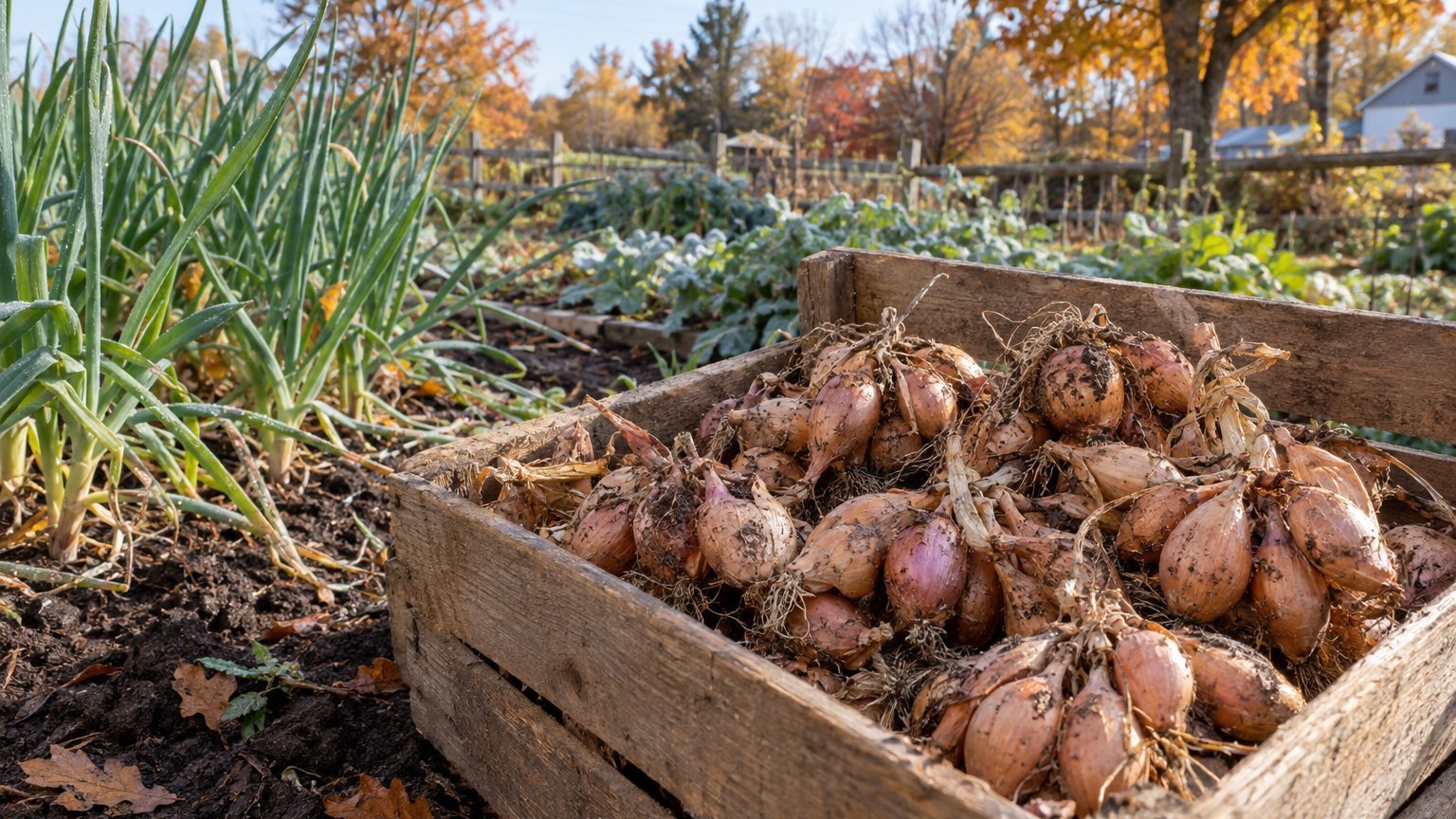

For most Florida gardeners, the best shallot is a multiplier type grown from bulbs, planted in the cool season and pulled before summer heat and rain turn the bed into a rot trap. Seed-grown shallots are the gamble. This page chooses by type, not by cultivar name, because it has no Florida trial results for individual varieties. The dates below come from north Florida.
The short answer for Florida
Choose bulb-grown multiplier shallots, plant them in the cool months, and harvest in spring. In central and south Florida, where frost is effectively absent, the whole calendar flips. Winter is the main season, and summer is the part you have to survive.
The frost numbers behind this come from Jacksonville, the reference station (NOAA NCEI 1991-2020 Climate Normals, station USW00013889). The last spring freeze falls between February 16 and March 7. The first fall freeze falls between November 26 and December 13. Both ranges are the 30-70% band of the probability of a 32°F freeze. So they mark when the odds of a freeze tip from unlikely to likely, not a date a freeze is guaranteed. Jacksonville is an inland airport site in north Florida. Never apply this window to Orlando or Miami.
Cold is not the limiting factor. The mean daily minimum of Jacksonville’s coldest month is 42.9°F, which is mild for a crop that shrugs off frost. What limits Florida shallots is the other end of the thermometer. A bulb crop needs weeks of cool, bright weather to size up before the heat arrives. Types that finish fast get that. Types that need a long, slow season do not.
| Type | North Florida | Central and south Florida |
|---|---|---|
| Bulb-grown multipliers | Best choice. Plant in fall, harvest in spring. | Best choice. Plant in the cool, dry months, harvest before the rains. |
| Seed-grown shallots | Workable, but they usually take longer from start to bulb. | A poor bet. The slow start runs into heat. |
| Grown only for green tops | Easy winter bonus. | The most forgiving use, since there is no bulb to cure. |
Bulb-grown multipliers win because one bulb splits into a cluster, and the cluster can size up quickly. Seed-grown types start from nothing and have to build both leaf and bulb in the same cool window. The full picture, from soil to harvest, is in Growing Shallots in Florida. Specific planting dates are in When to Plant Shallots in Florida.
What will not work here
Spring planting fails first. Catalogs and garden books written for northern states say to plant as soon as the soil can be worked. In Jacksonville, that advice puts bulbs in the ground around the very weeks when the last freeze is still a coin flip (February 16 to March 7). It also leaves them with only a few cool weeks before warmth takes over. Shallots set in March in central Florida have even less time. The bulbs stay small, and the tops give out early.
Slow, long-season shallots fail for the same reason. A crop that needs most of a northern summer’s worth of gradual growth does not get it here. Florida’s cool season is short, and it ends abruptly. Seed-grown shallots are the usual casualty. They can work in the north of the state with an early start, but they leave no margin.
Humidity defeats close spacing. Florida’s wet season runs through the summer, and a crowded bed of shallot clusters stays damp at the base long after a storm has passed. Damp bulbs, warm air and poor circulation add up to fungal rot. Give each cluster real room, plant in a raised or well-drained bed, and keep mulch from piling against the necks.
Weekly deep watering is the wrong rhythm on sandy soil. Much of Florida’s ground drains quickly and holds few nutrients, so water and fertilizer both move past the roots. Shallots have shallow roots, and they do better with light, frequent watering during the dry cool months, then a taper as the tops begin to fall. Overhead soaking late in the season invites rot. Sandy soil also favors root-knot nematodes, microscopic worms that stunt roots. Rotating beds and adding organic matter helps.
Curing and storage are the quiet failure. A northern gardener can pull shallots, dry them in a shed for a few weeks, and store them in a cool cellar through winter. In Florida, harvest often falls into rising heat and humidity, and bulbs that do not dry properly rot in storage. Plan to cure them in shade with strong airflow and to use the biggest, softest-necked bulbs first. Save the best-cured ones as next season’s planting stock.
The last mistake is geographic. Using Jacksonville’s frost dates in Tampa or Fort Lauderdale produces nonsense, because those places do not have a meaningful last frost date to count from. Down there, the question is not “when does the freeze end?” but “when does the heat begin?”
What changes across Florida
The USDA Plant Hardiness Zone Map (2023, built on 1991-2020 normals) puts Florida in zones 8b through 11b. That is seven half-zone steps, from the Panhandle and north Florida down to the Keys. USDA zones are based on a single variable, the average annual extreme minimum temperature. So the range tells you how cold the coldest night gets, not how long the cool season lasts or how brutal the summer is. For shallots, that second question matters more.
There is no single answer for the state. In the north, a true winter means shallots planted in fall will sit through a few freezes. Bulbs are hardy and will take that, though young tops can burn in a hard one. A light mulch is usually enough. The Jacksonville dates on this page are a fair guide there, and the main risk is planting too late.
In central Florida, freezes are occasional and the calendar starts to turn. The cool, dry months are the season, and the planting window moves toward early and mid-fall. In south Florida, frost is effectively absent. Shallots there are a winter crop, grown for about as long as the weather stays mild, and they are far more likely to end up as green tops than as cured bulbs.
Altitude is no help in Florida. The state’s highest point is only about 345 feet, so there is no mountain garden to lean on. What shifts your timing is latitude, distance from the coast, and the pocket of your own yard. Inland sites swing colder and hotter than coastal ones.
Which part of that spread you fall into is something to look up, not guess. Check the USDA Plant Hardiness Zone Map for your location. Then use the zone only as a cold-tolerance clue, and let your own first and last freeze records decide the dates.
Where to check this for your own county
Your county’s UF/IFAS Extension office is the next stop. Florida’s cooperative extension runs through county offices, and each one sits closer to your soil and weather than any state-level page can.
Look for two things. The first is a local planting calendar for vegetables, often broken into north, central and south Florida. Find the entry for onions or shallots. If shallots are not listed, onions and garlic entries still show the cool-season window your county works with. The second is any list of varieties trialled or recommended in your county. Those lists, built from local growing results, are worth more than any national catalog’s claims of “adaptable to all regions.” If a county agent or Master Gardener volunteer is available, ask what has worked locally, and ask about nematodes and soil testing as well.
A county recommendation beats a state one. This page is the state one. It rests on one reference station in north Florida and on broad zone data, and it cannot see your soil, your coastline, or the way your neighborhood trades heat at night. Treat it as a starting frame and let your county office override it.
Checking this against your own garden
Your own observations outrank every date here. Three are worth watching, and none needs equipment beyond your hands and eyes.
First, soil warmth by feel. Push your fingers a few inches into the bed in the morning. If the soil feels cool, you are still in the shallot window. If it already feels neutral or warm like a sunlit pot, you are late. Compare a sunny bed against one shaded by a fence or tree. A real difference tells you which spot buys you extra weeks.
Second, the first green shoots after planting, and the first leaves that follow. Quick, even emergence means the bed drains well and the temperature is right. Slow or patchy emergence points to cold, wet pockets or poor drainage. Count the weeks from planting to a full set of leaves in your own yard. Next year, that number is a better schedule than anything printed here.
Third, the first flower stalk. A shallot that sends up a seed stalk is telling you something about stress, often swings between cool and warm weather. If stalks show up early and in a particular corner, that corner runs warmer or swings harder than the rest. Pull those bulbs for the kitchen rather than storage, and put the next planting in the steadier part of the yard.
Common questions
Can I grow shallots in Miami or Orlando?
Yes, but on a different calendar. Central and south Florida are effectively frost-free, so the main season runs through winter and summer is the hard part. Plant in the cool, dry months and harvest before the heavy rains. Do not use the Jacksonville freeze dates.
Should I start shallots from seed or from bulbs?
Start from bulbs. A bulb division already holds stored energy and can size up fast inside a short cool season. Seed-grown shallots are possible in north Florida but need more time and leave less room for error.
Will a freeze kill my shallots?
Mature and established shallots usually tolerate cold well, and Jacksonville’s coldest-month mean minimum is 42.9°F. The risk is to very young tops in a hard freeze, which a light mulch or a cover cloth on the coldest nights can soften. This page does not have record-low data, so check local forecasts.
How should I store shallots in Florida’s humidity?
Cure them in shade with a steady flow of air until the necks are dry and papery. Then store them in a cool, ventilated spot, such as a mesh bag hung indoors in an air-conditioned room. Check them often and use any that soften first. Humidity is the enemy, and in Jacksonville three of the last thirty falls brought no freeze at all, so do not count on cold weather to help.