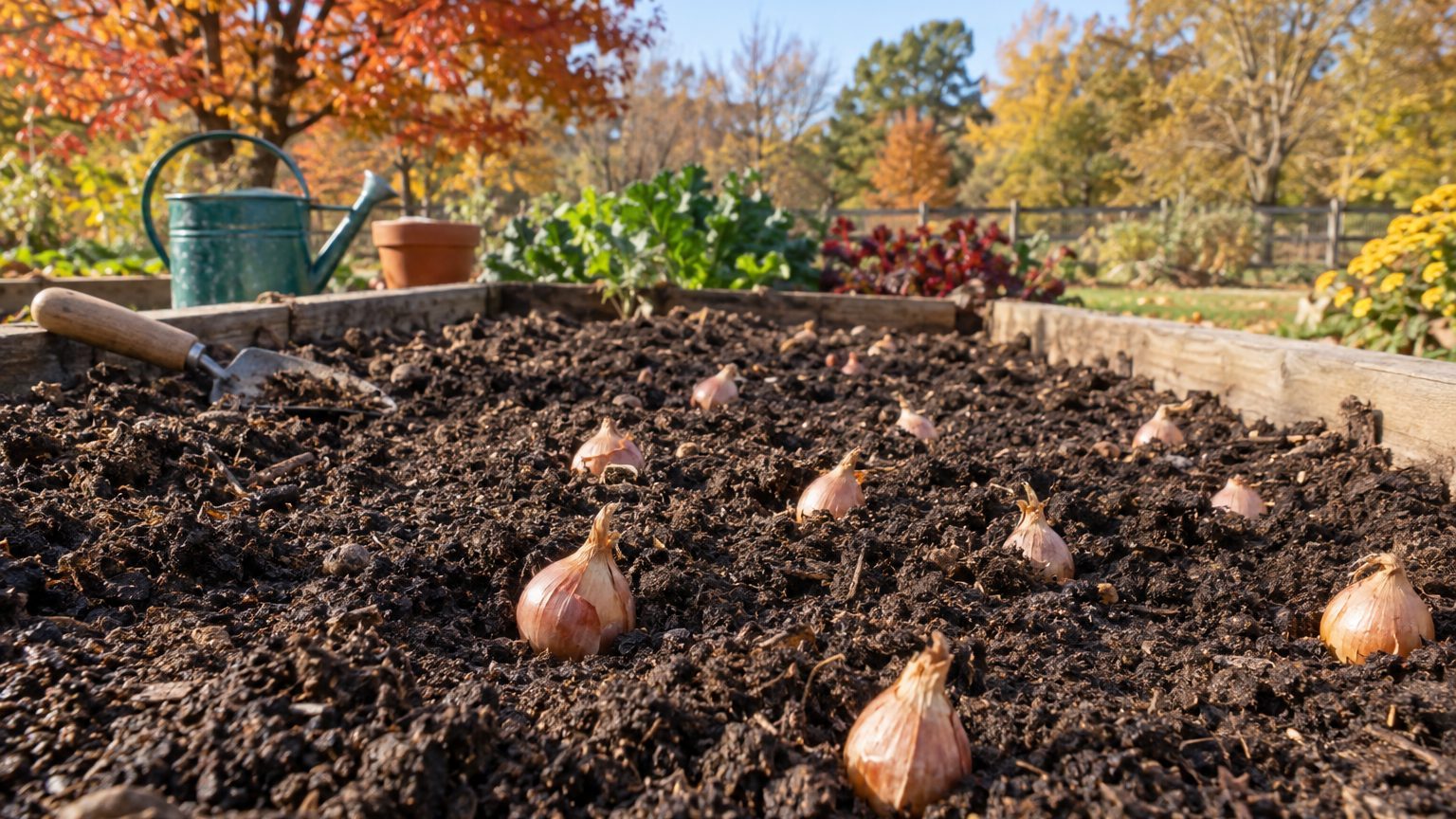

Shallots go into Manitoba ground at one of two times: early spring, as soon as the soil can be worked, or fall, after the average first frost of September 22 and before the ground locks up. Spring is the lower-risk default. Fall planting buys an early crop but has to survive a coldest-month night that averages -21.4 °C.
The short answer for Manitoba
Two dates anchor the calendar. At the Winnipeg Richardson airport station, Environment and Climate Change Canada’s 1981-2010 normals put the last spring frost on average on May 23 and the first fall frost on average on September 22. Both are mean dates, not guarantees. They describe a probability: in one year out of two, the last frost falls later than May 23. Treat each as the midpoint of a window.
Between the two averages sit roughly 122 days. That figure is plain arithmetic on two midpoints, so a real season can be shorter or longer by weeks.
Reading the two dates
Shallots tolerate light frost, so May 23 is not a “wait until then” date. Spring sets can go in as soon as the soil is workable, which in most years comes before that average. This page does not have a verified date for when Manitoba soil becomes workable, so that part is yours to judge (see the last section). For fall, the window opens after September 22 and closes when the ground freezes hard. A freeze-up date is another figure this page does not carry.
| Planting | Anchor | What you are betting on |
|---|---|---|
| Spring | Workable soil, ahead of the May 23 average last frost | A full run of growing weeks before summer bulbing |
| Fall | After the September 22 average first frost | Roots without top growth, then a mulched winter |
Which one to choose
Spring suits most beginners because the whole cycle happens in one season you can watch. Fall suits gardeners willing to mulch and accept some winter loss. Variety matters as much as timing, and The Best Shallots to Grow in Manitoba covers which types fit a season this length.
What will not work here
Waiting for May 23 and calling it safe. Since the frost falls later than that date in half of all years, a gardener who treats it as a deadline is guessing. Worse, shallots do not need the wait, and every week of cool spring you skip is a week of leaf growth you give up.
Planting too early in fall fails in a different way. A set that sprouts tops before freeze-up spends its reserves on leaves that winter kills. The goal in fall is roots only, which is why the September 22 average marks where the window opens, not where it is wide open. Even then, a stretch of warm October can push growth, so a thick mulch of straw or shredded leaves matters more here than in milder places.
Bare, unmulched fall beds struggle against the cold itself. The mean daily minimum of the coldest month at the Winnipeg reference station is -21.4 °C. That is an average night, not a record low, so some winters go well below it. Mulch also helps against freeze and thaw heaving, which can push sets out of heavy clay soil and expose them.
The slowest varieties do not fit a window of about 122 days between mean frosts. A shallot that needs a long, hot summer to size up will stall when the season ends early, and you will harvest small, soft bulbs that store poorly. Choose types bred for short seasons and plant them at the first workable moment.
Soggy spring ground is the other trap. Heavy clay, common across the Red River Valley, holds meltwater, and sets planted into saturated soil can rot before they root. A cold, wet April is a reason to wait a week, not a reason to plant on a calendar date. A raised bed or ridged row drains faster and often solves it.
Finally, remember how old the numbers are. These are 1981-2010 normals, while the US figures elsewhere on this site cover 1991-2020. Do not set the two side by side as if they were the same period.
What changes across Manitoba
The frost dates above come from one Winnipeg station, and a province is not one climate. Northern and upland districts run weeks behind it. A gardener there should expect a later spring start, an earlier fall deadline, a shorter gap between the two, and a stronger case for early-maturing varieties and heavy mulch.
The hardiness figure for the reference city is 3b, on Canada’s plant hardiness system (1991-2020 normals, from Natural Resources Canada). That is one city’s zone, not the province’s. Manitoba does not have a single answer, and this page does not hold the full spread of zones across the province. Your own place on the map may differ from Winnipeg’s, so look it up at Canada’s Plant Hardiness Site instead of assuming.
Do not translate the number into a US one. The Canadian system uses seven climate variables, the USDA system uses one, and NRCan says there are no simple conversions between them. Its own example is that Canadian zone 4a overlaps nine USDA zones, from 3a to 7a. A “3b” on this page is a Canadian 3b only.
For a general overview of the crop before narrowing down your location, Growing Shallots in Manitoba covers soil, spacing and harvest.
Where to check this for your own county
A county recommendation beats a state or provincial one, and this page is the provincial one. Manitoba is a wide place, and the person who has watched shallots in your area for years knows more than a single airport station.
Start with Manitoba Agriculture. Look for two things. The first is a local planting calendar for shallots or for the onion family generally, ideally one tied to your region or rural municipality. The second is a list of varieties trialled near you, because a variety that does well in one part of the province may stall in another.
This page does not carry a shallot-specific calendar from that source, so do not read anything here as one. If you cannot find a shallot page, onion and garlic guidance is the closest cousin. Keep in mind that garlic is planted in fall and onions in spring, which tells you the same two windows apply.
When a local source and this page disagree, trust the local source. When local advice is silent, use the frost dates here as a rough guide and then verify them against what your own garden does.
Checking this against your own garden
Your observations outrank every date above. Three are worth watching, and none needs equipment.
Soil warmth by feel. Grab a handful from the bed. If it crumbles and does not smear or hold a wet ball, and your bare hand does not ache after a minute in it, the soil is ready for spring sets. Cold and sticky means wait. A bed that reaches this stage a week or more before a neighbor’s tells you about your slope, drainage or shelter.
The first flush of male flowers. Willow and aspen catkins open when spring is truly moving. Note the date you first see them in your yard or nearby. If they come early, your spot warms ahead of the average. If they are late, you are a district behind, and your shallots should be too.
The first true leaves. Watch chives, lilac or the first weeds. When their leaves unfold, root growth underground is usually well underway. In fall, the same logic works in reverse: green shoots on a fall planting before freeze-up mean it went in too early.
Write the dates down for a couple of seasons. After two or three years you will have a calendar more accurate than any normal.
Common questions
Can I plant shallots before May 23?
Yes, once the soil can be worked. May 23 is an average last frost date, and shallots tolerate light frost, so there is no reason to wait for it. Avoid soil that is frozen or waterlogged.
Is fall or spring better in Manitoba?
Spring is the lower-risk choice for most gardeners. Fall works if you wait until after the September 22 average first frost, plant before freeze-up, and mulch well.
Is Manitoba’s zone 3b the same as USDA 3b?
No. The 3b here is from the Canadian hardiness system and does not convert to a USDA zone. NRCan notes there are no simple conversions between the two systems.
How cold does it get for fall-planted shallots?
At the Winnipeg reference station, the mean daily minimum in the coldest month is -21.4 °C (-6.6 °F). That is an average, not a record low, and colder nights do occur in some winters.