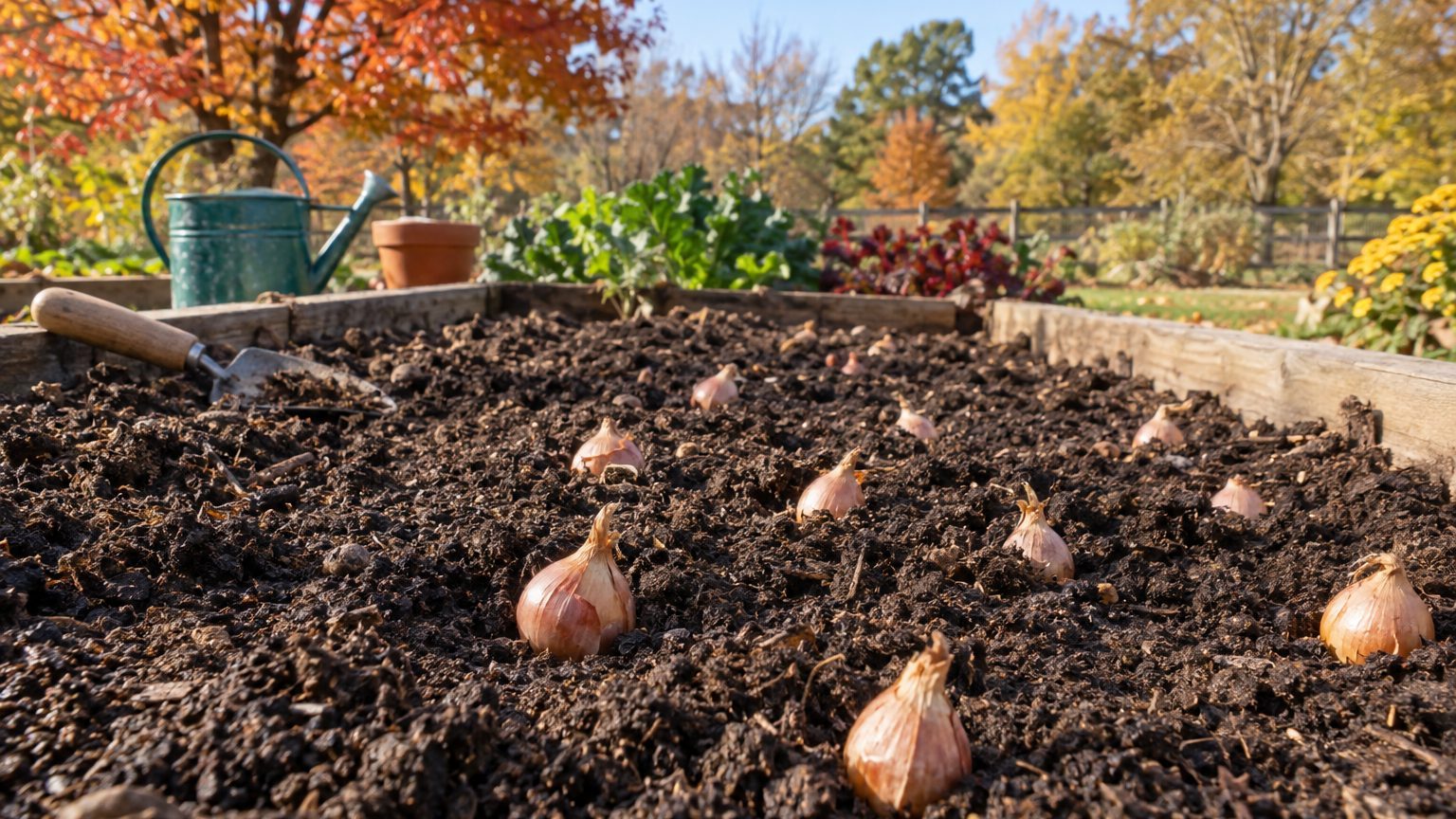

Plant shallots in New Jersey in late fall for a summer harvest, or in early spring as soon as the soil is workable. Fall planting often gives bigger bulbs, and spring is the fallback when autumn gets away from you. The dates anchoring both windows come from Newark airport, though, and a garden in Sussex or Hunterdon County runs on a different clock.
The short answer for New Jersey
At the Newark reference station, the last spring frost falls between March 29 and April 6, and the first fall frost between November 4 and November 16. Fall-planted shallots go in around the second band, and spring planting opens once the soil can be worked, which usually lands near the first. For the full growing picture, start with Growing Shallots in New Jersey.
Those dates are a probability of a 32°F freeze, not a promise. NOAA’s 1991-2020 Climate Normals give the band where the odds of a freeze sit between 30 and 70 percent. A freeze after April 6 becomes less likely, but nobody has ruled it out. Shallots shrug off that kind of surprise better than tomatoes would, which is part of why they suit this calendar.
| Reference figure (Newark) | Value | What it tells a shallot grower |
|---|---|---|
| Last spring frost | March 29 to April 6 | Spring planting can begin around here, once the soil is workable |
| First fall frost | November 4 to November 16 | The marker for fall planting |
| Coldest month, mean daily minimum | 25.5°F | Typical winter nights, not record lows |
The reasoning behind the two windows is about roots and daylight. A fall-planted clove needs time to root before the ground stiffens, but not so much time that it throws up a tall tuft of leaves. Planted in spring, it has to build roots and leaves quickly, and bulbs begin to swell as days lengthen, whether the plant is ready or not. The earlier it starts, the more leaf it has to feed the bulb.
Winter cold is not the obstacle here. The coldest month at Newark averages a daily minimum of 25.5°F. That is the average low, not the record low, but it is a figure an established clove with a layer of mulch can live with.
One adjustment matters before you pick a date. Those figures come from an airport weather station. Suburban and rural gardens typically see the last spring frost later and the first fall frost earlier, often by one to two weeks, and more at elevation. Treat the Newark dates as the reference city, not a statewide guarantee.
What will not work here
Copying the airport’s fall date into a rural garden is the most common slip. If your first frost arrives one to two weeks ahead of Newark’s, a November 10 planting date means cloves going into ground that has already been cold for a while. Roots grow slowly in cold soil, and a clove that has not anchored itself can heave out of the ground in a freeze-and-thaw cycle. In an earlier-frost spot, plant earlier, not on the Newark schedule.
Planting too early fails in the opposite direction. The first fall frost does not arrive at Newark until the first half of November, which means the soil stays mild deep into autumn. Cloves pushed in while the ground is still summer-warm will sprout leaves that winter then burns back. The plant survives, usually, but it has spent reserves it needed for the bulb.
Waiting until May is a quieter failure. The spring window opens around the end of March and early April, and the gap between that and summer heat is not wide. New Jersey summers are hot and humid, and shallots planted late have less time to size up before the heat forces them to wrap up. The result is small bulbs that look like what a well-timed planting would have called seed stock.
The season itself is not the problem. From the last spring frost band to the first fall one, Newark’s frost-free stretch runs about seven months, which is plenty for a crop that finishes in early to midsummer. What defeats a New Jersey shallot patch is humidity and wet foliage. Cloves planted shoulder to shoulder, with leaves that never dry after a rain or an overhead watering, invite fungal disease in muggy July weather. A spacing of about 6 inches between cloves, and watering at the soil line, buys airflow.
Variety choice follows the same logic. Types that need a long, dry curing period struggle in a damp summer, and the ones that store best are not always the ones that finish earliest. The trade-offs are laid out in The Best Shallots to Grow in New Jersey.
What changes across New Jersey
New Jersey covers hardiness zones 6a to 7b on the USDA Plant Hardiness Zone Map (2023 edition, built on 1991-2020 normals). That is four half-zone steps within one small state, so there is no single answer. The system rests on one variable, the average annual extreme minimum temperature, and says nothing about summer humidity or the date of your last frost.
Newark sits somewhere in the middle of that spread, which is why its dates make a reasonable reference and a poor universal. Roughly, the shifts run like this:
- North and higher ground: expect a later spring thaw and an earlier fall frost. Move fall planting earlier, mulch more heavily after the ground cools, and start spring planting later than the Newark dates suggest.
- Central areas near the reference city: the dates above are a fair starting point, still with a week or two of cushion for suburban and rural spots.
- South and the shore: milder winters make fall planting more forgiving, but heat arrives sooner, so spring plantings have less time to size up.
Those are directions of adjustment, not dates, and they are not a statement of which zone you are in. Look yourself up on the USDA Plant Hardiness Zone Map by ZIP code. Your own spot, hilltop or river valley, may differ from the town average, and that difference can be worth more than the two-week shift above.
Where to check this for your own county
The best source for your county is Rutgers New Jersey Agricultural Experiment Station, the state’s land-grant extension service. Find the Rutgers Cooperative Extension office for your county and look for two things: the local planting calendar for vegetables, and any varieties that have been trialled in your county’s soil and weather.
Shallots may not get their own line in every calendar. If yours does not, check the entries for garlic and onions, the closest relatives, whose planting and harvest timing tracks shallots closely. Ask the county office, too, for the typical frost dates in your town rather than the nearest airport, and about soil testing, since shallots dislike soggy ground and a test will show whether your pH needs attention.
A county recommendation beats a state one, plainly. This page is the state one, built from a single reference station and a statewide hardiness range. The extension office has people who have watched local gardens through bad springs and wet summers, and that experience is not on any weather chart.
Checking this against your own garden
Your own observation outranks every date above. Three things are worth watching.
Soil by feel. Grab a handful from a few inches down and squeeze it. If it crumbles when you poke it, it is ready to plant. If it stays in a sticky ball or leaves mud on your hand, wait. A bed that crumbles earlier than your neighbor’s is draining well and warming early, which tells you your spring window opens sooner.
First green shoots. Note the day your shallot leaves first push through in spring, or when fall-planted cloves send up their first leaves. Mark it on the calendar and compare year to year. A patch that greens up two weeks behind a friend’s across town has a cooler microclimate, and you should shift your dates accordingly.
A shrub as a clock. Forsythia blooms early in spring, and its timing in your yard says more about your local warmth than a weather station fifteen miles away. Write down when it flowers. After a few years, you will have a calendar tuned to your own ground.
Common questions
Can I plant shallots in spring in New Jersey?
Yes. Plant as soon as the soil is workable, which tends to fall near the Newark last-frost band of March 29 to April 6. Spring-planted shallots usually yield smaller bulbs than fall-planted ones, because they have less time to build roots and leaves.
Will winter kill fall-planted shallots?
Newark’s coldest month averages a daily minimum of 25.5°F, which established cloves with mulch handle well. That is an average low, not a record, so a colder pocket in northern New Jersey may need a thicker mulch layer.
How late is too late to plant in fall?
This page has no ground-freeze date, so it cannot give you one. The practical limit is when the soil is too hard to work. The first-frost band of November 4 to November 16 at Newark is the nearest marker, and rural gardens reach it one to two weeks sooner.
Should I use the Newark dates in northern New Jersey?
Use them as a starting point only. Northern and higher gardens usually see later springs and earlier fall frosts, so plant in fall earlier and wait longer in spring. Your county’s Rutgers extension office can give you dates for your area.