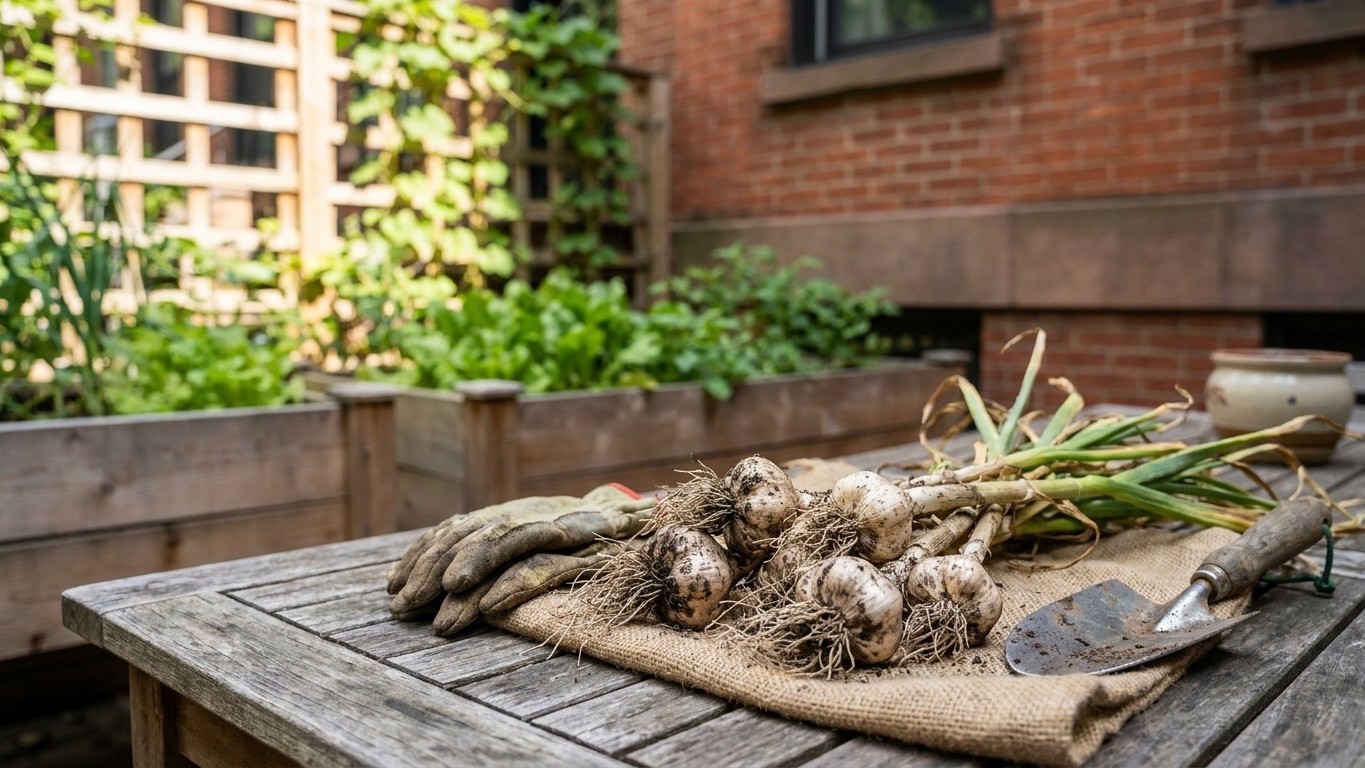

Garlic in Illinois gets eaten in two seasons. In fall, voles, mice and soil insects go after cloves that haven’t rooted yet. In spring and early summer, thrips and maggots feed on leaves and young bulbs, and a microscopic nematode can ruin a bed from the inside. Winter is quieter, though voles keep working under mulch. The crop goes in during autumn and comes out the following summer, so the first fall frost is a handy anchor for the whole pest calendar.
The short answer for Illinois
The first fall freeze at the reference airport station arrives between October 24 and November 3, based on the 30-70% probability band for 32F in the NOAA NCEI 1991-2020 Climate Normals. Garlic goes into the ground around that window, and almost every pest worth worrying about shows up on one side of it or the other.
Two cautions come with that figure. A frost date is a midpoint, not a safe date: in one year out of two, the freeze lands later. And an airport is a warm place. Suburban and rural gardens usually see the first fall frost one to two weeks earlier than the airport does, so your own bed may be ahead of the reference city.
Laid against that window, the threats sort themselves out:
- Before and at planting: wireworms in ground that was recently sod, and bulb and stem nematodes riding in on infested seed garlic.
- Fall into winter: voles and mice, which tunnel under fresh mulch and eat cloves.
- Spring: maggots feeding on shoots and cloves, especially in cool, wet weather.
- Late spring into early summer: onion thrips scraping the leaves, and bulb mites working on damaged bulbs.
Illinois has no pest of its own that skips the calendar, so the fix is timing rather than any single spray or trap. Knowing where the frost falls in your garden tells you when the rodent season starts and how long the roots have to establish before the ground locks up.
Working it out for your own garden
A state is not one climate. The reference figure describes one airport, and Illinois stretches a long way north to south. Redoing the arithmetic for your own ground takes about two minutes.
Step one: move the frost date to your yard
Start with the reference window, October 24 to November 3. If your garden is suburban or rural, subtract one to two weeks. Taking a week off gives October 17 to October 27. Taking two weeks off gives October 10 to October 20. Across both cases, your own first freeze could plausibly fall anywhere from about October 10 to October 27. That is simple subtraction on the one-to-two-week adjustment, not a published figure for any county, and it still describes a midpoint. Half of all years will run later, and some will run earlier.
Large water and local relief push the number around further. A lakeshore garden may sit later than an inland one a few miles away, and a low spot where cold air pools may freeze before the hilltop does. The When to Plant Garlic in Illinois: Counting Back From the First Frost page works through how that date turns into a planting window.
Step two: lay the pests on your calendar
Once you have your date, mark three checkpoints. The first falls a few weeks before planting: dig a test spot and look for slender, hard, yellow-brown wireworms, and check whether the bed was grass last year. The second falls at planting: inspect every clove for soft spots, brown staining or a crusty base, and discard anything suspect. The third falls when you mulch. Hold off until the soil has cooled, because a thick blanket laid early gives voles a warm place to move in.
The frost date also tells you how much rooting time you have. Cloves need to put out roots before the ground freezes hard, and a clove that is still unrooted in December is easier for a vole to dig up and harder for the plant to recover from. Because frost falls later in half of all years, you can’t treat the date as a deadline you beat by a day or two. Plan around the early end of your adjusted range and let the later years be a bonus.
Pests that appear in spring run on a different clock, set by warming soil and leaf growth rather than by frost. Maggot flies are most active in cool, damp weather, while thrips build up as the weather turns warm and dry. The practical effect is that you scout in April and May, then watch the leaf tips in June until the bulbs are lifted.
What changes across Illinois
The same bed in two parts of the state is dealing with different weather. This is direction, not published dates. The only dated figure on this page is the reference window, and county-level numbers belong to the extension service.
| Part of Illinois | Frost timing vs. reference | Why | What it means for pests |
|---|---|---|---|
| Northern counties along the Wisconsin line | Earlier | Higher latitude and open farmland that drains cold air | Less time to root before freeze-up, so rodents find unrooted cloves |
| Chicago lakeshore and dense suburbs | Later | Lake Michigan holds heat into fall and cities trap it | Longer warm autumn keeps soil insects active |
| Central prairie farmland | Near the reference window | Flat, open ground with little moderation | Fields in corn and soybean rotation put wireworms and maggots near the garden |
| Southern Illinois | Later | Lower latitude and milder falls | Pests stay active later and may survive mild winters better |
| Northwest hills and Shawnee Hills | Varies by site | Valleys collect cold air while ridges stay milder | Frost pockets can leave cloves unrooted |
Illinois is mostly flat, so elevation matters less here than in Appalachian states. Relief matters in the northwest corner and in the Shawnee Hills of the south, where the cold-air pockets in the table do their work. A garden on a ridge and one in the hollow below can disagree by several days. Gardeners in eastern counties who want a second opinion can compare notes with the Indiana pages, When to Plant Garlic in Indiana: Counting Back From the First Frost and Garlic Varieties That Suit Indiana Winters, since the climates blend across the state line.
For a broader tour of the crop, Growing Garlic in Illinois covers soil, feeding and harvest, which all affect how much damage a given pest can do.
The mistakes this climate punishes
Illinois winters swing. A cold snap in December can be followed by a thaw in January and another freeze in February, and late winter is full of freeze-thaw cycles. That pattern turns several ordinary mistakes into lost crops.
Planting too late to root is the first. A clove that goes in just before the ground freezes has no anchor, and repeated freezing and thawing can push it upward, exposing it to voles and cold. The same goes for planting too shallow. Shallow cloves heave more easily and sit closer to the surface where rodents forage, so follow the depth recommended by your Garlic Varieties That Suit Illinois Winters page and your county extension rather than guessing.
Mulching too early invites trouble in the other direction. Straw or shredded leaves laid over warm soil create shelter for mice and voles weeks before the ground freezes, and they will tunnel through it and sample the cloves. Wait until the surface has cooled, then mulch.
Planting into recent sod is a quieter error. Wireworms live in grass roots for years, and a new bed cut from a lawn or hayfield starts out with a resident population. The same goes for ground freshly amended with undecomposed manure or green residue, which draws maggot flies in spring.
Then there is seed stock. Bulb and stem nematodes can come in on infested cloves and can persist in soil for years once established, so garlic or onions planted in the same spot again compounds the problem. Buy certified seed garlic when you can, and don’t replant cloves from a bulb that showed swelling, distorted growth or soft tissue. Rotating beds helps, as does skipping the compost pile for any plant that looked sick.
One pest to ask about is the allium leafminer, a newer arrival that has been spreading across the Northeast and Midwest. Whether it has reached your county is a question for extension, and I haven’t seen a confirmed local figure to quote here.
Checking this against your county
University of Illinois Extension has county offices staffed by horticulture educators and Master Gardeners who can give you local frost data and tell you which pests are active near you this year. Bring a photo of the damage, or a sample in a sealed bag, if you suspect nematodes or mites. They can identify it and suggest controls that match the label and your situation. Treat the airport window here as a starting point, then adjust it with their county numbers.
Common questions
Do deer and rabbits eat garlic in Illinois?
They usually leave it alone, which is one reason people tuck garlic around the edges of beds. Voles and mice are the animals that cause the real losses, because they tunnel under mulch and eat cloves through winter.
What causes silvery streaks on garlic leaves in spring?
Onion thrips are the usual cause. They rasp the leaf surface and leave pale, silvery patches, and populations tend to build in warm, dry weather as spring turns to summer. Light damage rarely cuts the harvest much, but heavy infestations on small plants can.
Can I replant cloves from a bulb that had pest damage?
Not if you suspect nematodes or rot. Those problems travel with the cloves, and nematodes can survive in the soil for years. Bulbs with simple cosmetic chewing from a past season are less of a concern, but when in doubt, buy clean seed garlic and start over.
Should I wait for the first frost before planting?
No. Frost is a midpoint and comes later in half of all years, so waiting for it can leave you planting into hard ground with no time to root. Work from your own adjusted date and plant ahead of it, while the soil is still workable.