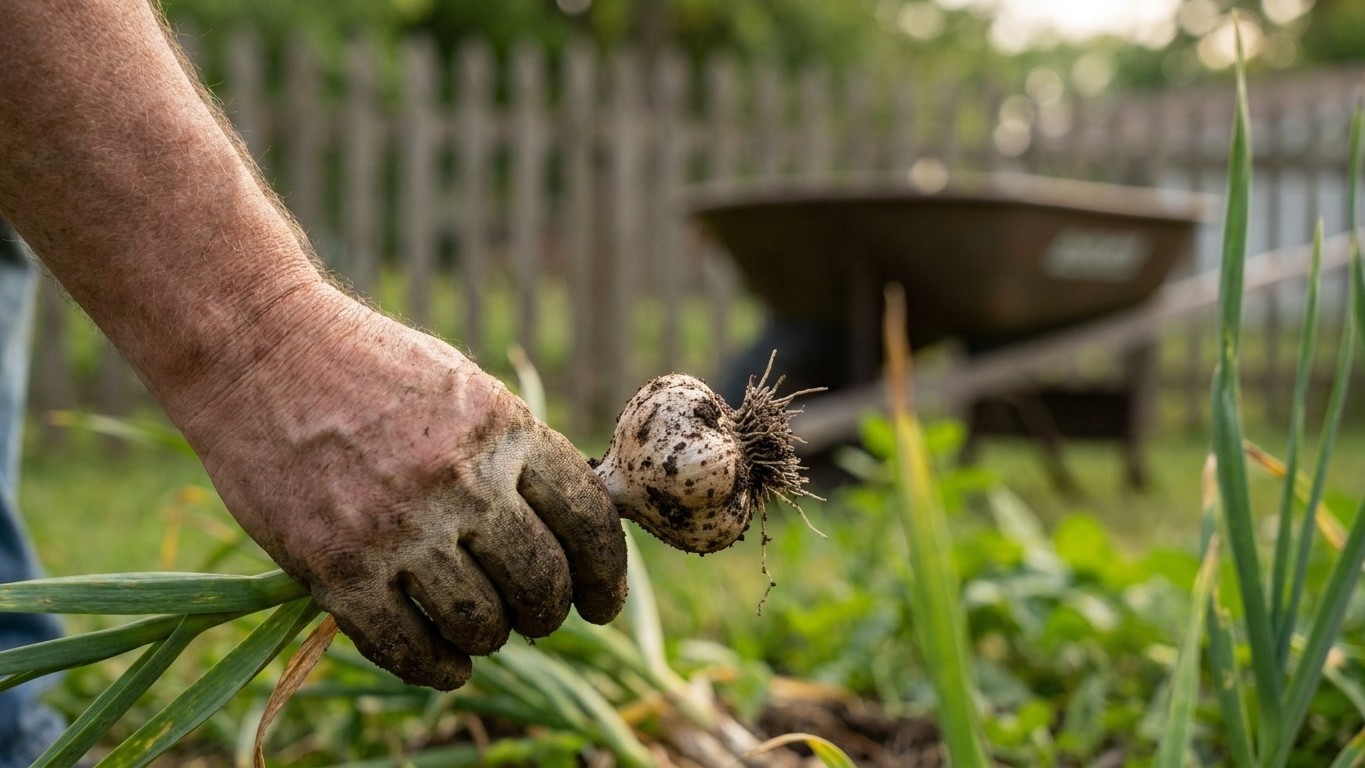

Late September in Indiana is garlic weather, whether you’re tucking in softnecks like Early Red Italian and Italian Late or hardnecks like Duganski and Ivan. That window holds regardless of cultivar, anchored to a first freeze that Indianapolis typically sees between October 21 and October 30 — though half of all years miss that range entirely. Plant early in the window rather than chasing the frost date exactly, since warm soil for rooting matters more than timing a freeze that won’t arrive on schedule anyway.
The short answer for Indiana

Set garlic cloves in the ground between late September and early October. That window holds for every cultivar on this list, softneck types like Early Red Italian and Italian Late as much as hardnecks like Duganski and Ivan. The date is anchored on the first fall freeze, and NOAA’s NCEI 1991-2020 climate normals put that freeze at the Indianapolis station between October 21 and October 30.
That range is a midpoint, not a guarantee. In roughly half of all years the actual freeze arrives after October 30, and in the other half it arrives before October 21. Planting on the early side of the late-September-to-early-October window gives cloves the longest run of warm soil to root before winter sets in, which matters more than hitting the frost date exactly.
The cold requirement
Winter cold is not the limiting factor here. Garlic needs a stretch of six to eight weeks with soil temperatures below 40°F to split its cloves into a full bulb, a threshold set out by the University of Georgia Extension in publication C854. Indianapolis logs an average of 21.8 weeks below 40°F across the growing season, close to three times what the crop requires, so softneck types such as Inchelium Red and Lorz Italian and every hardneck on the list root and vernalize without trouble across the state.
If you haven’t chosen a bed or worked the soil yet, that groundwork belongs to Growing Garlic in Indiana before you get to variety selection. That six-day-wide frost range also compresses or stretches once you move away from Indianapolis, which is what the next section works through.
Working it out for your own garden
The Indianapolis figure is a starting point, not a countywide fact. Indiana runs nearly the length of the Midwest from its Ohio River counties to the Michigan line, and elevation, a large lake, and simple latitude all move the first freeze by two weeks or more in either direction. The arithmetic that matters is the gap between your local first-freeze midpoint and the date you set cloves in the ground, not the calendar date itself.
Start with your own county’s first-freeze data rather than Indianapolis’s, then count backward three to five weeks. That gap gives roots time to establish in soil that’s still workable and above freezing, without leaving so much time that a shoot pushes above ground before winter locks in. Push the planting date too close to your local freeze and the clove sits in cold, wet soil without rooting. Push it too early and green growth gets burned back by the first hard freeze anyway, wasting energy the bulb needed to store.
Applying it to hardneck varieties
Hardneck types carry a stiff central stem and generally fewer, larger cloves than softnecks, and Indiana’s cold is more than sufficient for them. Bavarian Purple, Blue Music, and German Red all root and vernalize on the same late-September-to-early-October schedule as the softnecks, since the state’s 21.8 weeks below 40°F clears the six-to-eight-week requirement with weeks to spare regardless of which corner of Indiana you garden in. The choice between a hardneck and a softneck here comes down to flavor, storage life, and whether you want the scapes hardnecks produce, not to whether the climate can support one type over the other.
| Variety | Neck type | Set-out window | Typical storage |
|---|---|---|---|
| Inchelium Red | Softneck | Late Sept to early Oct | Stores longest of the group, often into late winter |
| Lorz Italian | Softneck | Late Sept to early Oct | Good long-term storage |
| Bavarian Purple | Hardneck | Late Sept to early Oct | Best used within a few months of harvest |
| German Red | Hardneck | Late Sept to early Oct | Best used within a few months of harvest |
For the week-by-week breakdown of bed prep and set-out against your own dates, When to Plant Garlic in Indiana: Counting Back From the First Frost works through the same arithmetic in more detail.
What changes across Indiana
The Indianapolis window is a reference point near the middle of the state, and both ends of Indiana depart from it in opposite directions. Purdue Extension’s caution here is direct: southern Indiana runs earlier in spring and later in autumn than the north by a fortnight or more, which means counties along the Ohio River get a longer stretch of workable fall soil than Indianapolis does. A grower near New Albany or Jeffersonville can often hold off past the early-October edge of the set-out window without losing rooting time, since the first hard freeze there tends to arrive later than it does farther north.
Northern Indiana works the other way. Counties away from Lake Michigan’s immediate shoreline see the growing season close earlier, so the same late-September start that’s comfortable in Indianapolis leaves less margin in Fort Wayne or South Bend, where treating the early edge of the window as the safer choice makes more sense. The lake itself complicates this further: the immediate shoreline in counties like LaPorte holds warmth longer into fall than inland ground only a few miles away, a lake-effect delay that can push the practical planting date later right along the water while the rest of the county freezes on schedule.
None of this changes which cultivars will grow. Duganski and German White both handle the cold across every part of the state, since Indiana’s winter comfortably clears the vernalization requirement from the Ohio River to the lakeshore. What shifts county to county is the calendar, not the variety list.
The mistakes this climate punishes
Timing and depth
The biggest mistake in this climate is not choosing the wrong neck type, since Indiana’s cold clears the vernalization bar for both hardneck and softneck garlic with room to spare. The mistake that actually costs a crop is planting on the calendar instead of on the ground. Because the first fall freeze is a midpoint rather than a hard deadline, it’s tempting to wait past early October on the logic that frost usually arrives later than the NOAA range suggests. Roots don’t care about the frost date. They need weeks of soil above freezing to grow before winter dormancy sets in, and a clove planted in late October with the ground already cooling hard may never root deeply enough to survive freeze-thaw cycling.
Shallow planting is the second failure specific to this climate. Indiana’s winter doesn’t hold a single deep freeze. It cycles through repeated thaws and refreezes, and a clove set at a shallow depth without a mulch layer gets heaved partway out of the soil over the course of several such cycles. By February it can be sitting on the surface with its roots snapped and dried out. A generous mulch layer, put down after planting, absorbs most of that movement.
Starting with the wrong seed stock
The other mistake is sourcing cloves from a grocery store bulb instead of tested planting stock. According to UC IPM’s Pest Management Guidelines for Onion and Garlic, UC ANR Publication 3453, white rot, caused by the fungus Sclerotium cepivorum, occurs across a 50 to 75°F range that Indiana’s air temperature falls inside for five months of the growing season, including one month at the pathogen’s own published optimum. Fusarium basal rot falls inside its published range for four months of the season. Those are air-temperature counts measured against published soil-temperature thresholds at one reference station, and a single month’s average hides both cooler and warmer days within it, so treat the figures as an opening for disease rather than a forecast of it. Infected seed stock is what actually introduces these pathogens to a bed. Climate only decides how readily they spread once they’re there. Buying named, disease-tested stock, whether that’s Chesnok Red, Georgian Crystal, or Georgian Fire, matters more here than which of the fourteen cultivars you pick.
Checking this against your county
Every date in this article is measured at or near Indianapolis, and the fact that southern Indiana runs a couple of weeks ahead of that figure in fall while the north runs behind it means your county deserves its own check. Before committing to a week, look up Purdue Extension for county-level frost and soil data, since a local office can tell you how your ground compares to the Indianapolis reference station used throughout this piece. That’s a five-minute check against a full season of work, and it’s the only way to know whether your own window sits closer to the early or late edge of the range.
Common questions
Can I use garlic from the grocery store as seed stock?
You can, but it’s a gamble. Grocery garlic is rarely labeled by variety, is often treated to suppress sprouting, and carries none of the disease testing that named cultivars like the ones on this list go through, so it’s a more direct route for soil-borne problems like white rot to enter a bed that didn’t have them before.
What happens if I plant garlic too early, in early September?
Cloves planted that early often push green shoots above ground before winter, and that top growth gets damaged by the first hard freeze, wasting energy the bulb needed for spring regrowth. Waiting for the later edge of the late-September-to-early-October window avoids this in most years.
Do I need to mulch garlic cloves over an Indiana winter?
Yes, a mulch layer after planting is worth the hour it takes. Indiana’s winter runs through repeated freeze-thaw cycles rather than one steady deep freeze, and mulch is what keeps those cycles from heaving shallow-set cloves partway out of the soil.
Is hardneck or softneck garlic better for Indiana winters?
Neither has a cold-hardiness edge here, since Indianapolis logs close to three times the cold that garlic needs to split into cloves. Pick based on flavor and storage life instead. Softnecks like Inchelium Red and Lorz Italian generally keep longer in storage, while hardnecks like Bavarian Purple or Blue Music trade some storage life for the scapes they produce and, for many growers, a stronger flavor.