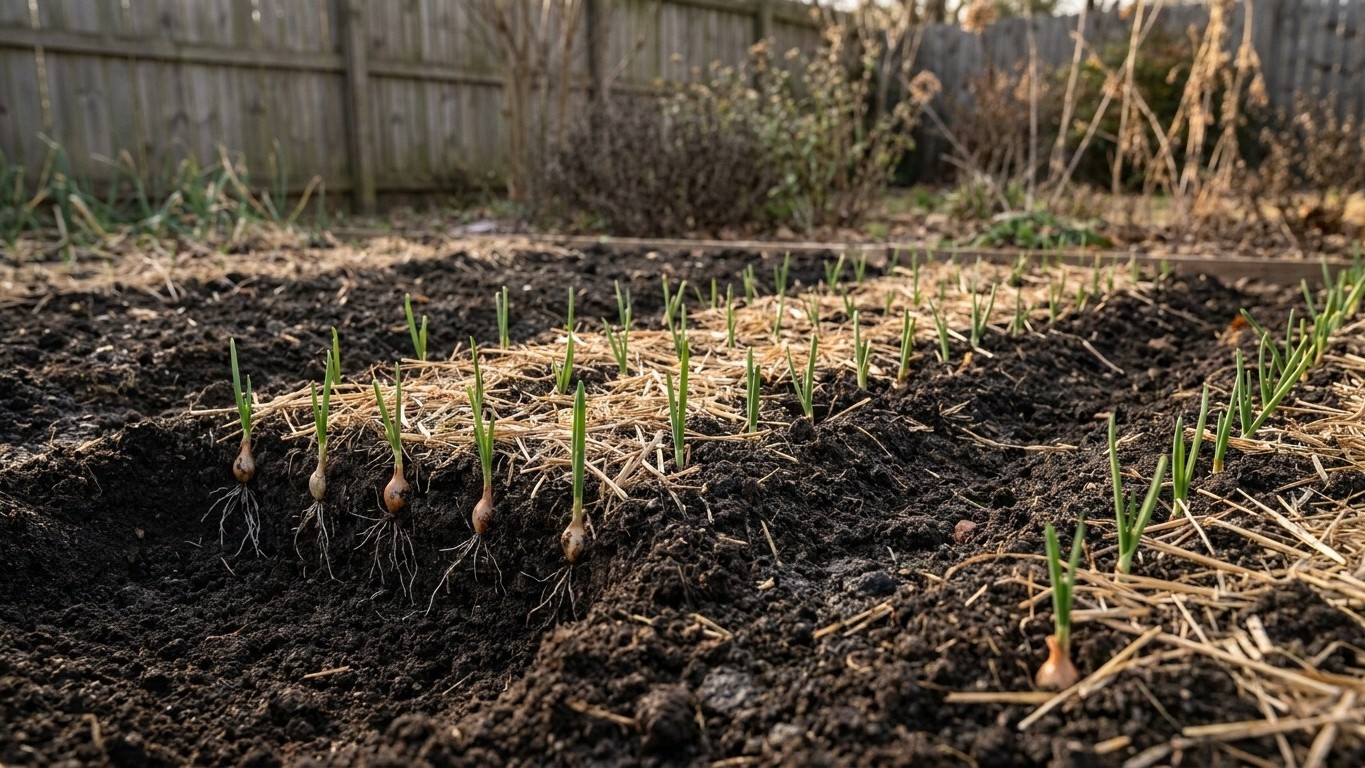

No single date marks when garlic gets eaten in Mississippi. Trouble comes in stages: wireworms and voles go after cloves in the ground that autumn, aphids and thrips show up on the leaves as spring warms, and bulb mites get into harvested heads over the summer. Each stage hangs on the calendar of a crop planted in autumn and lifted the following summer, and that calendar hangs on one date, the first fall frost.
The short answer for Mississippi
The first fall frost at the airport reference station behind NOAA’s 1991-2020 Climate Normals falls between November 7 and November 22, based on the 30-70% probability band of a 32F freeze (NOAA NCEI). Garlic planting is timed back from that window, and pest timing rides on it.
That is a reference-city figure, not a promise for your yard. A frost date in a climate table is a midpoint. In one year out of two the frost arrives later, and some autumns stay mild well past the end of that window. Airport stations also run warm, so a suburban or rural garden usually sees its first fall frost one to two weeks earlier than the figure above, and more than that at elevation.
The mechanism links garlic’s calendar to its pests. Cloves go in before the frost, root in cool but still-workable soil, and sit through winter. A clove sitting in the ground for months is a long target for anything that digs or chews underground. Leaves that emerge during a warm spell become a landing pad for aphids. The longer the frost holds off, the longer the insects and rodents stay active, which is why a late frost year tends to be a heavier pest year.
Then comes the second half of the cycle. Garlic matures and is lifted in summer, when Mississippi heat and humidity favor mites and rot in bulbs that are slow to dry. Pest pressure never fully disappears from the calendar. It just changes targets: cloves in fall, foliage in spring, finished bulbs in summer.
Working it out for your own garden
A state is not one climate, so the reference figure needs adjusting. The arithmetic takes four lines, and you can redo it for any county.
Start from the frost window, then subtract
Take the November 7 to November 22 window. If your garden sits in a rural spot or a low pocket where cold air settles, subtract one to two weeks. Subtracting one week gives October 31 to November 15, and two weeks gives October 24 to November 8. Your own first frost probably lands somewhere in that spread. Elevation, a large lake, or the coast can push it two weeks either way, so a hilltop garden near the Tennessee line may sit at the early end, while a lot a few blocks from the Gulf may land after the reference window altogether.
Now add the frost-is-a-midpoint rule. If the date you computed is the 50-50 point, half of all autumns bring the frost later. A cautious gardener plans around the later end for the pest schedule below, because a mild autumn keeps pests active for longer.
Lay the pest calendar over it
Once you have your frost date, three checkpoints follow from it:
- At planting, before frost: inspect seed cloves for soft spots, brown streaks, or powdery debris, and look at the bed for wireworms (thin, hard, yellowish-brown larvae) and vole runs.
- Through the first warm spell after emergence: check leaf bases for aphids and for slug damage, since mild, damp winters let both carry on.
- As spring warms: look for thrips, which leave pale silvery streaks on leaves and tend to build up in warm, dry weather.
Then the finish: because the crop is lifted the following summer, cure the heads in a shaded, airy spot and check them for mite damage before storing. Clove skin that looks chewed or dusty at the base is the sign.
If you are comparing against a colder state, the Missouri planting calendar shows how the same arithmetic plays out under a colder winter. The pests in this article stay the same family, but the stretch of time they have to feed is shorter there.
What changes across Mississippi
Mississippi runs roughly from hill country in the northeast down to a sea-level coast, and the garlic calendar and its pests shift with that.
The Gulf Coast, around Harrison, Hancock, and Jackson counties, runs behind the reference date. Frost comes later, winters are mild and damp, and that keeps slugs, aphids, and soil pests active deep into the season. The Mississippi Delta in the northwest is flat, with heavy clay soils that stay wet. Cold air pools on that open ground, but the real trouble there is drainage: soggy beds favor slugs, mites, and rot. The northeast hills near Tishomingo County sit at the opposite end, with the earliest frost and the coldest nights, so planting runs earlier and winter pest activity drops off sooner. Between them, the Piney Woods of the south and the loess bluffs along the Mississippi River behave like the middle of the state.
| Area | Frost compared with the reference window | Pest pressure to watch |
|---|---|---|
| Gulf Coast counties | Later; mild winters | Slugs, aphids, wireworms active through winter |
| Piney Woods (south) | Near the reference window, often slightly earlier in rural spots | Wireworms in beds cut from sod, voles under mulch |
| Delta (northwest) | Near the reference window; cold air pools on flat ground | Slugs and rot where clay stays wet |
| Northeast hills | Earlier, with the coldest nights | Shorter fall window for soil pests; thrips arrive with spring warmth |
Where a garden lies matters more than its county name. A bottomland lot by a creek and a ridge lot a mile away can differ by as much as the two ends of the state. For the same reason, the variety you choose affects how much fall and winter growth is exposed to pests, which is covered in garlic varieties that suit Mississippi winters. The broader picture of the crop is in growing garlic in Mississippi, and a month-by-month version of the arithmetic lives in when to plant garlic in Mississippi.
The mistakes this climate punishes
Mississippi winters are mild enough that the usual cold-climate worries (heaving, deep freeze) matter less here. The mistakes that cost a crop are mostly about warmth and moisture.
Planting a hardneck without thinking about it comes first. Hardnecks are bred for cold winters, and in a mild one they can underperform, so the plant spends a long season in the ground without the cold signal it expects. Softnecks are the safer default here. A weak plant is also a bigger target for pests. The variety guide for Mississippi sorts this out.
Planting too early is the next one. If cloves go in well before the first frost and the soil is still warm, they put up top growth that stays tender through a long mild autumn. Tender growth invites aphids and slugs before the plant has settled in. Planting after the frost window has closed, by contrast, leaves too little time to root before winter.
Buying garlic from a grocery store bin is a third. Seed from an unknown source can carry stem and bulb nematodes or bulb mites into a bed, and neither is easy to remove once established. Rotating is the matching mistake: planting garlic again in a bed where onions, leeks, or garlic grew the previous year leaves the soil pests already in place.
Mulch can backfire too. A thick layer holds moisture through damp Mississippi winters, which suits slugs and gives voles a covered tunnel to the cloves. Use enough to hold weeds and temper swings, and pull it back from the leaf bases if slug damage appears.
Finally, leaving finished bulbs in wet ground costs a crop. Once the lower leaves yellow, lift on a dry day. Heads left in saturated summer soil are exposed to mites and rot, and bulbs stored before they cure fully can lose cloves in a few weeks.
Checking this against your county
County-level frost dates and pest alerts are published by Mississippi State University Extension, which has offices across the state. Ask your county office for the local first-frost range, for advice on pests common in your soil type, and for help identifying anything you find on a clove or leaf. A sample brought to the office beats a guess from a photo.
Common questions
What is the most common pest of garlic in Mississippi?
Aphids and thrips are the ones most gardeners see on the leaves, while wireworms, voles, and bulb mites do the damage underground or in storage. Which one dominates depends on your soil, your mulch, and how mild your winter turns out.
Do deer eat garlic?
Deer generally leave garlic alone because of its strong smell. The usual diggers in Mississippi beds are voles under mulch and armadillos hunting grubs, and both can uproot cloves while looking for something else.
When should I check for pests?
Check at planting before the first frost, again during the first warm spell after emergence, and once more as spring warms. Then inspect the heads when you lift them the following summer. Counting from your own frost date keeps the checks on schedule.
Can I use grocery store garlic as seed?
It is a gamble. Store garlic is not screened for nematodes or mites and may not suit Mississippi’s mild winters. Seed garlic from a supplier that sells for your region, or from your own healthy heads from a previous season, carries less risk of bringing pests into the bed.