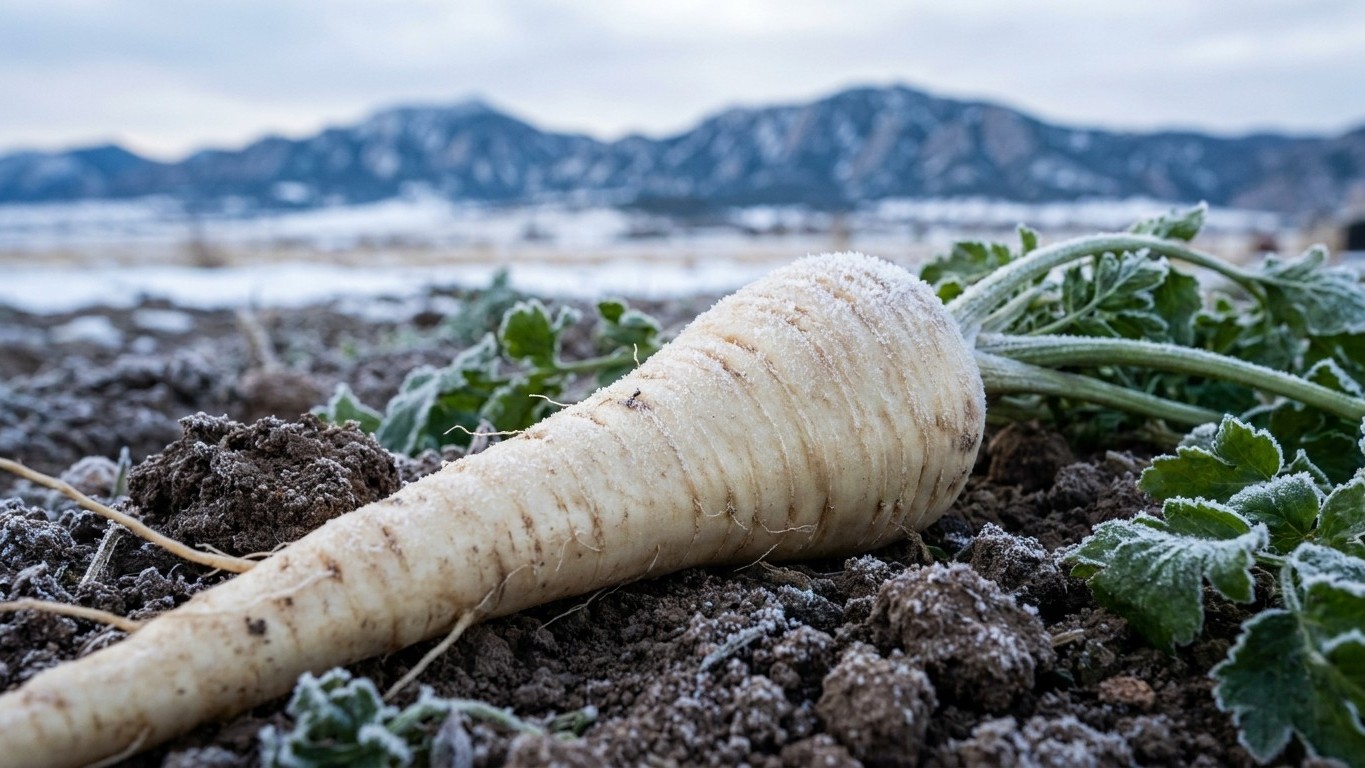

Minneapolis frost dates, not the look of the foliage, are what should set your parsnip digging schedule. Since the first fall freeze in the Twin Cities lands somewhere between October 11 and October 23, most of the crop can stay in the ground through that window and past it, because parsnip roots handle freezing weather better than almost anything else in the row. Pull a test root once the tops have died back, and go by shoulder size rather than the calendar.
When to lift parsnips in Minnesota
Lift parsnips once the shoulder, the widest part of the root at the soil line, measures 1 to 3 inches across, the size Utah State University Extension uses to judge a mature root. Parsnip takes roughly 100 days from seeding to reach that size, and because seed sown in place takes 14 to 21 days just to germinate, count the whole season from the day you sowed, not from when the seedlings finally showed themselves.
Working the window from local frost dates
In the Twin Cities area, NOAA’s 1991-2020 climate normals put the first fall freeze between October 11 and October 23, and the last spring freeze between April 17 and April 30, both measured at the Minneapolis reference station. Northern Minnesota runs two to three weeks tighter at both ends, so a gardener near the border should shift this whole window earlier. Sown two to three weeks before the last frost, a 100 to 120 day parsnip reaches maturity somewhere in the second half of summer, well ahead of the first fall freeze, which means the digging date in most of the state is really a question of how long you want to leave the roots in the ground to sweeten, rather than whether they’re ready.
That sweetening is its own subject: Will Parsnips Sweeten in Minnesota? covers what several weeks of frosty weather actually does to the starch in the root. For lifting day, the practical rule is simpler. Dig once the shoulders are wide enough and the ground hasn’t frozen solid, any time from the first hard frost up through the point a shovel won’t go in anymore.
Extraction is where a full-season root punishes shortcuts. A parsnip in deep sandy soil comes out with a gentle pull and a garden fork loosening the ground alongside it, but heavy or compacted ground, the kind Utah State University Extension says needs double digging before parsnip goes in at all, snaps taproots off a few inches down and leaves the best part of the root behind. If the bed wasn’t worked deeply back at seeding time, a step covered in Growing Parsnips in Minnesota, loosen the soil a full spade’s depth alongside the row before pulling, rather than levering straight up on the foliage.
When you do lift, twist or cut the leafy tops off close to the crown, but never slice into the crown itself. USDA Handbook 66 notes that parsnips are topped after harvest but should not be trimmed into the crown, since that cut opens the root to rot in storage. A pair of pruners or a sharp knife an inch above the shoulder does the job without touching the tissue that has to survive the next several months.
Four to six months, if the air is right
USDA Agricultural Handbook 66 states that parsnip roots keep 4 to 6 months at 0 to 1°C (32 to 34°F) with 98% relative humidity, a figure traced to research by van den Berg and Lentz. That’s an unusually long window for a root vegetable, but every part of that sentence is a condition, not a guarantee, and the humidity figure is the one home storage gets wrong most often.
Ninety-eight percent relative humidity is close to saturated air, wetter than almost any refrigerator or root cellar runs without help. A domestic crisper drawer typically sits well below that, and an unheated basement or cellar loses moisture through the day as outdoor temperatures shift. Unless you take steps to keep the air right at the root, the parsnips dry out and go soft and rubbery long before six months are up, even if the thermometer reads exactly right.
Getting close to 98% at home
- Layer roots in damp sand or damp sawdust in a box, so the material touching the root stays moist rather than the air around it.
- Store in perforated plastic bags in the coldest part of a refrigerator, which slows moisture loss without sealing in the gas the roots themselves give off.
- Check the sand or bags every few weeks and remoisten before the surface fully dries out, since a cellar’s humidity swings with the weather outside.
Hold the temperature as close to 32 to 34°F as the storage space allows. USDA Handbook 66 notes parsnips are not chilling sensitive, so there’s no risk in running the low end of that range, unlike crops that develop chilling injury near freezing. What the roots can’t tolerate is actually freezing solid in storage, which ruptures the cell walls and turns the flesh mushy on thawing.
Some Minnesota growers skip the storage question by leaving the crop in the ground and digging through winter as needed, since soil holds humidity far better than any box. That works only as long as a shovel can still break the surface, and it trades one risk for another: a hard freeze that locks the topsoil solid before you’ve dug enough for the pantry.
Treat four to six months as the ceiling reached only under those steady conditions, not the figure to expect from a box in a garage that swings with the outdoor temperature. A root cellar holding close to freezing with damp sand and little air movement gets you toward the long end. A refrigerator crisper drawer, checked and remoistened, gets you a shorter but still useful stretch. A dry closet or an unheated porch that freezes and thaws gets you a few weeks at best, regardless of what the handbook’s figure promises.
The mistake that turns parsnips bitter
A parsnip that comes out of the cellar tasting bitter almost always got the temperature right and the neighbors wrong. USDA Handbook 66 is specific about this: parsnips produce very little ethylene themselves, less than 0.1 microliters per kilogram per hour at 68°F, so they aren’t the source of the problem. But exposure to even low levels of ethylene from something else in the same cold storage causes bitterness, which the handbook links to a buildup of xanthotoxin in the root.
Apples, pears, and ripening tomatoes are common ethylene sources, and a root cellar or a refrigerator crisper is exactly where they end up sharing space with parsnips, onions, and potatoes over the cold months. Put a bushel of storage apples on the shelf below a bin of parsnips, and the fruit’s own ripening gas seeps into the same air the roots are breathing, at concentrations too low to smell but high enough to trigger the reaction USDA Handbook 66 describes.
That the culprit is ethylene rather than temperature is exactly what makes this mistake persistent. Most storage advice for roots is built around temperature and moisture, and parsnip’s own tolerance for cold near freezing seems to confirm that’s all it needs. The bitterness shows up regardless of how carefully the thermometer and hygrometer were watched, because it has nothing to do with either one.
What that means for the shelf
The fix costs nothing but a second shelf. Keep parsnips away from any fruit in cold storage, in a separate refrigerator drawer, a different shelf entirely, or a section of the cellar the apple crates never reach. If a whole household stores everything in one cool room, put parsnips in a lidded, ventilated bin off to one side rather than open on a shared shelf, and check them a few weeks in for the dull, off flavor that signals the gas has already done its work.
This is worth taking seriously because the damage isn’t visible. A bitter parsnip looks exactly like a sweet one, and by the time it’s peeled, boiled, and on the plate, there’s no way to tell you got the temperature and humidity right and lost the crop to a bowl of apples three shelves up.
What goes wrong here
Three failures account for most lost parsnip crops in Minnesota, and none of them show up until it’s too late to fix.
Ground freezing before the roots are out
Minneapolis’s coldest month averages a daily minimum of 8.8°F according to NOAA’s 1991-2020 climate normals, cold enough to freeze unmulched topsoil hard enough that a shovel bounces off it. Parsnips tolerate freezing in the ground far better than most roots, which is the whole point of leaving them out for frost sweetening, but once the surface locks up you can’t dig at all until a thaw. A heavy mulch layer, straw or leaves piled over the row before the ground freezes, keeps enough warmth in the soil to dig into early winter.
A wet fall rotting damaged roots
A parsnip nicked by a fork at digging time, cracked by a rock in heavy ground, or tunneled by cabbage maggot larvae before you ever got a shovel near it, looks fine going into storage and then rots from that wound within weeks, taking neighboring roots with it in a damp cellar. Cabbage maggot damage often shows up as a fine, dark channel just under the skin, easy to miss on a quick glance; What Eats Parsnip in Minnesota, and When covers when the flies lay eggs and how to check for it before storing. Only lift roots you can get out whole, and store only the ones without cuts, splits, or soft spots, since a single damaged root in a bin of otherwise good ones spreads decay faster than the cold can slow it.
A cellar that runs too dry
Most home cellars and basements sit far below the 98% humidity USDA Handbook 66 calls for, and Minnesota’s dry winter air makes that worse, not better. Roots stored loose on a shelf in that kind of space shrivel from the outside in well before the four to six month ceiling, which is why the damp sand or perforated bag matters more here than in a naturally humid basement.
Forked roots
A forked or branched parsnip has two separate, unrelated causes worth telling apart: heavy or stony ground that splits the taproot as it pushes down, and overwatering that encourages the root to branch in search of air rather than growing straight. Neither ruins the root for eating, but a forked root is harder to clean, harder to peel evenly, and more likely to trap soil in the crevice where the two sides meet.
Common questions
Can I dig parsnips in spring instead of waiting for fall?
Yes, plenty of Minnesota gardeners leave the crop under a heavy mulch layer all winter and dig in early spring, right after the ground thaws and before new top growth starts. The tradeoff is timing: you have to get them out before the soil warms enough to wake the crown, or the root starts putting energy into new leaves instead of staying sweet and firm.
Can you store parsnips in the same bin as potatoes or carrots?
The ethylene risk documented for parsnip in USDA Handbook 66 is specific to ripening fruit like apples and pears, not other root vegetables, so potatoes and carrots aren’t flagged as a hazard in that source. Keep parsnips away from any fruit in the same cold space regardless of what other roots share the shelf.
Should I wash parsnips before putting them in storage?
Brush off loose soil and let the roots dry rather than rinsing them under water. A wet root going into damp sand or a perforated bag stays wet longer than the storage conditions can dry it out, which invites the rot a properly brushed, dry root avoids.
Why did my parsnips stay thin even after 100 days in the ground?
Overcrowded seedlings are the most common cause. Parsnip seed is sown thickly because germination is uneven and takes 14 to 21 days, but roots left too close together compete for room and never bulk up to the 1 to 3 inch shoulder size that signals maturity. Thin seedlings to a few inches apart once they’re clearly up, and give a slow-maturing root the full 100 to 120 days before judging it done.