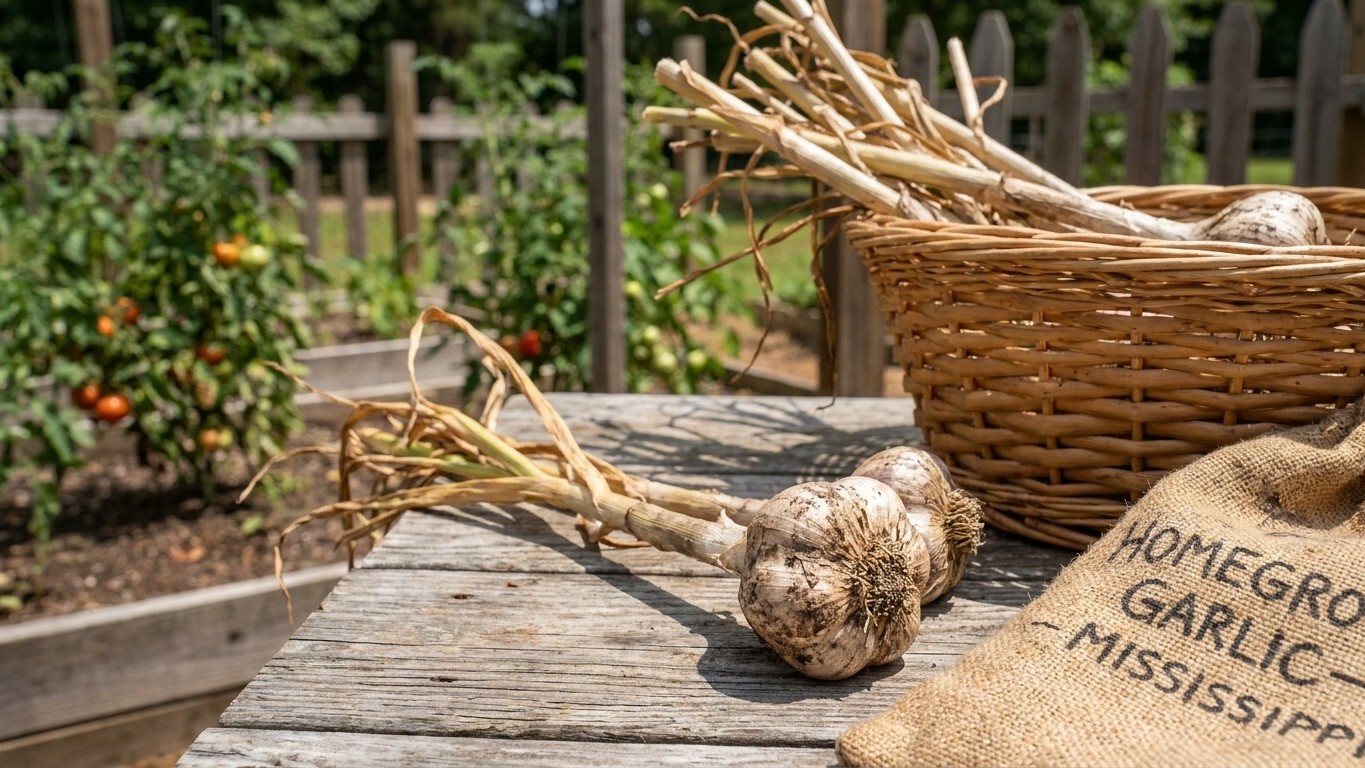

Garlic planted in Mississippi struggles to get the sustained cold it needs to divide into a full head of cloves. Jackson’s first fall frost arrives sometime between November 7 and November 22, according to NOAA’s 1991-2020 climate normals, which tells you the ground stays warm well into autumn most years. Plant the biggest cloves you can find in mid-October to early November, following the guidance on When to Plant Garlic in Mississippi that growers rely on, choose a softneck type unless you garden in the state’s coolest northern counties, and be ready to refrigerate hardneck cloves before planting if you want to try one anyway.
Will garlic get the cold it needs in Mississippi

Six to eight weeks below 40°F is what a hardneck garlic clove needs to split into cloves at all, and Mississippi rarely offers that stretch outside its northern hill country. Jackson’s first fall frost lands somewhere between November 7 and November 22, arriving late and leaving quickly, which means the chill hardneck varieties count on almost never shows up in full. Skip it, and you don’t lose the crop — you lose the scape, the division, and most of the size, ending up with a small bulb instead of a real harvest.
Mississippi’s winters make that stretch hard to guarantee. NOAA’s 1991-2020 climate normals put Jackson’s first fall frost between November 7 and November 22, a sign that autumn cold arrives late and doesn’t linger once it does. Even the hill country of north Mississippi rarely holds six to eight straight weeks below 40°F, and the Gulf Coast counties almost never do. This is the single fact that should decide which garlic you plant, more than soil, sun, or spacing.
Skipping vernalization doesn’t just cost you a clove or two. A garlic plant that never divides also skips the scape and matures earlier than a properly vernalized bulb, so relying on hope instead of a plan tends to produce a small, unremarkable harvest rather than an outright failure. Softneck garlic still appreciates some cold, just not the eight-week stretch a hardneck expects, and a typical Mississippi winter usually supplies enough of that lighter chill without any extra effort from the grower, which is why reviewing Garlic Varieties That Suit Mississippi Winters can help you pick the right type from the start.
The two workarounds
A gardener set on growing a hardneck type anyway has two real options. Refrigerate the cloves for six to eight weeks before planting, holding them in a paper bag in the crisper drawer at a temperature close to 40°F to simulate the missing chill, or simply grow a softneck type that needs far less cold to divide and has been the reliable choice across the Deep South for generations. Neither option means giving up on garlic in Mississippi. It just means matching the type to the winter you actually have, not the winter printed on a seed catalog grown somewhere much colder.
When to put the cloves in
Plant relative to the first fall frost, not a date on the calendar. NOAA’s 1991-2020 climate normals put Jackson’s average first fall frost somewhere in the November 7 to November 22 window, which centers on roughly the middle of November. That figure comes from the airport weather station and describes the Jackson area specifically. Gardens in low-lying rural spots, at higher elevation, or well outside the city often see their first frost one to two weeks earlier than that, so treat the window as a starting point to check against your own county rather than a fixed date.
The target is to get roots established before the ground turns cold without pushing much leaf growth above the surface. That points to planting cloves mid-October to early November, which lands roughly two to four weeks ahead of the Jackson frost midpoint. Go in too early and the plant grows lush green top growth that a hard freeze can knock back. Go in too late and the clove sits in cold, undeveloped soil without the root system it needs heading into winter.
What shifts the date
A few things move the actual date in either direction. Gardens near the Gulf Coast tend to stay warmer later into fall, which pushes frost later than the Jackson figure and gives a bit more planting flexibility. North Mississippi’s hill counties trend cooler and can see frost arrive at the early edge of NOAA’s window or before it. Elevation and local cold-air drainage matter more than latitude alone, so a low spot in a valley can frost well ahead of a hillside a few miles away in the same county.
Which types suit Mississippi
Hardneck and softneck garlic are not interchangeable in a state this warm. Hardneck varieties send up a stiff central stalk called a scape and generally need the strongest, most reliable cold to divide well. Softneck varieties skip the scape, tolerate a milder winter, and store for many months longer in a warm pantry, which matters through a Mississippi summer. For most of the state, softneck is the safer bet.
Softneck for most of the state
Inchelium Red is a widely grown softneck with a mild flavor and good size for a Southern grower working without much chill. Lorz Italian is another dependable softneck option, along with Early Red Italian and Italian Late, both of which set out in the same mid-October to early-November window as every other variety on this list. None of these four demand the eight-week cold stretch that hardnecks want, which is exactly why they’ve been the traditional choice through the Deep South for generations of home gardeners.
Hardneck for the coldest counties
Gardeners in the cooler hill counties of north Mississippi, or anyone willing to refrigerate cloves before planting, can still grow hardneck types like German Red, German White, Chesnok Red, Duganski, Georgian Crystal, Georgian Fire, Bavarian Purple, Blue Music, Fall Festival, and Ivan. These varieties tend to produce fewer, larger cloves and an edible scape in early summer, but without the pretreatment or a genuinely cold winter they risk the same non-division problem described above. Growers in colder states such as Missouri or Virginia can put these same hardnecks straight in the ground and let a normal winter do the vernalizing for them.
Soil and bed preparation
Garlic sits in the same patch of ground from planting in fall through harvest the following summer, which means it rides out every soaking rain the winter throws at it. Drainage matters more than any other single factor in bed prep, because a clove sitting in waterlogged soil rots before disease ever gets a chance to. Raised beds or ridged rows solve this in the state’s heavier clay soils, lifting the root zone a few inches above the surrounding grade so water moves off rather than pooling around the clove.
Amending and testing the soil
Work several inches of compost or well-rotted manure into the bed before planting, breaking up compacted clay and giving the young roots loose soil to push into. Do this a few weeks ahead of the mid-October to early-November planting window rather than the same day, so the amendment has time to settle and stop robbing nitrogen from the soil as it breaks down.
Garlic prefers a soil pH on the slightly acidic side of neutral. Mississippi’s clay and loam soils vary widely from one county to the next, so a soil test through your local extension office before planting tells you more than any general guideline can, and flags a lime or sulfur adjustment while there’s still time to make it before the cloves go in.
What the climate here favours, and what it does not
UC IPM’s Pest Management Guidelines for Onion and Garlic (UC ANR Publication 3453) publish temperature ranges for the fungi and pathogens that cause garlic’s worst field and storage losses. Matching Jackson’s monthly mean air temperatures against those published ranges shows which diseases the local climate tends to favor over a full growing season, from planting in fall through harvest the next summer. The published thresholds are soil temperatures, and the figures below are air temperatures, so treat this as a tendency built into the climate, not a soil reading or a diagnosis.
| Disease | Pathogen | Months in range | Note |
|---|---|---|---|
| Fusarium basal rot | Fusarium oxysporum f. sp. cepae | 6 of the growing season (September, October, April, May, June, July), 2 at the published optimum | Critical risk category |
| White rot | Sclerotium cepivorum | 5 months (October, November, March, April, May), 1 at optimum | Critical risk category |
| Pink root | Setophoma terrestris | 3 months, all at optimum (September, June, July) | High risk category |
| Southern blight | Sclerotium rolfsii | 0 months reach the 86-95°F optimum | High risk category, active outside its optimum too |
What the numbers mean
Fusarium basal rot and white rot both spend real time inside their published ranges across a Mississippi growing season, which tracks with how often Southern garlic growers report both as the diseases that actually show up in the ground and in storage. Pink root’s three months sit right at its optimum, all of them either at the start of the season in September or toward harvest in June and July, which is exactly when a stressed or wounded root system is most exposed to it. Southern blight never reaches its 86-95°F optimum in a Jackson monthly average, but that doesn’t mean it can’t turn up. Infected seed stock or a hot, wet pocket in the garden can bring any of these problems regardless of what the monthly average says, so buying certified or at least disease-free planting stock matters as much as anything measured in degrees.
Getting it through the winter
Lay two to four inches of clean straw or shredded leaves over the bed once the cloves are planted, before the ground turns cold. Mulch insulates the soil against sharp temperature swings and slows the freeze-thaw cycle that heaves a shallow-planted clove right out of the ground over winter. Plant cloves at a real depth, roughly two inches with the pointed end up, because a shallow clove under thin mulch is the one most likely to end up sitting on top of the soil by February.
Spring pull-back
Pull the mulch back, or thin it out, once new green shoots push through in late winter, since a thick mat left in place traps moisture against the emerging shoot and invites rot right at the point where disease pressure is already building for the season, as the table above shows. Leave a thinner layer down through spring rather than removing it completely. It still suppresses weeds and keeps soil moisture even through the dry stretches a Mississippi spring can bring.
This is where Mississippi’s mild winter actually helps. States with a hard, sustained freeze see much more heaving because the ground physically expands and contracts through repeated deep-freeze cycles. Mississippi’s shallower, more frequent freeze-thaw swings are gentler on a properly planted clove, but the basic precautions still matter even where the winter itself is friendlier, since anything planted too shallow or left without mulch is still exposed.
Harvest and curing here
Judge harvest by the leaves, not by a date circled on the calendar. Garlic is ready to lift once the lower third to half of the leaves have browned and dried back while the upper leaves are still green, a sign the bulb has stopped bulking but the wrapper leaves haven’t yet rotted away in the ground. Pulling too early leaves cloves small and the wrappers loose. Waiting too long, especially in a wet Mississippi summer, lets the bulb split open in the ground and lose its storage wrappers entirely.
Curing in humid air
Curing matters as much as the harvest itself, and Mississippi’s humidity works against you here in a way it doesn’t in a drier climate. Cure in a shaded, well-ventilated spot with air moving across the bulbs, not stacked in a pile or laid directly on the ground, and run a fan if the air feels heavy or still. Three to four weeks is typical, but watch the necks rather than counting days. A dry, tight neck and papery outer wrappers mean the bulb is ready to trim and store. Skipping ahead in humid weather is exactly how a good harvest turns moldy in storage a month after the hard work of growing it is already done.
Local help
Mississippi State University Extension is the best source for county-specific planting dates, soil testing, and current disease pressure in your part of the state, since conditions on the Gulf Coast and in the north Mississippi hills diverge more than a single statewide guide can capture. Reach the extension service at extension.msstate.edu to find your county office and request a soil test before you commit a bed to garlic for the winter.
Common questions
Can I Plant Garlic in spring in Mississippi instead of fall?
Not with any real success. Garlic planted in spring skips the cold period it needs to divide into cloves and misses most of the growing season it needs to bulk up before summer heat shuts growth down. Plant in the mid-October to early-November window described above and treat fall as the only real planting season for garlic here.
What happens if I plant hardneck garlic and it doesn’t get enough cold?
It usually still grows, but the bulb stays a single, undivided round instead of splitting into distinct cloves, similar to a shallot. It’s still edible, just not what most people are growing garlic for. Refrigerating cloves for six to eight weeks before planting, as covered above, is the fix if you’re set on a hardneck variety.
Do I need to buy seed garlic, or can I plant garlic from the grocery store?
Buy seed garlic from a supplier that names the variety rather than planting grocery store bulbs. Grocery garlic is often treated to slow sprouting, frequently carries diseases like white rot or Fusarium basal rot without showing symptoms, and is rarely labeled with a variety suited to a Southern winter.
How many garlic bulbs will I get back for what I plant?
A well-grown bed typically returns somewhere around five to ten times the cloves planted, since each clove grows into one full bulb of several cloves. Bulb size and clove count both depend heavily on getting the cold, drainage, and timing described above right, so a poorly vernalized or waterlogged bed can return far less.
Can I grow garlic in a raised bed or container instead of in the ground?
Yes, and a raised bed is often the better choice on Mississippi’s heavier clay soils, since it solves the drainage problem before it starts. A container works too, as long as it’s deep enough for root growth and gets left outside through winter so the cold, however mild, still reaches the cloves.