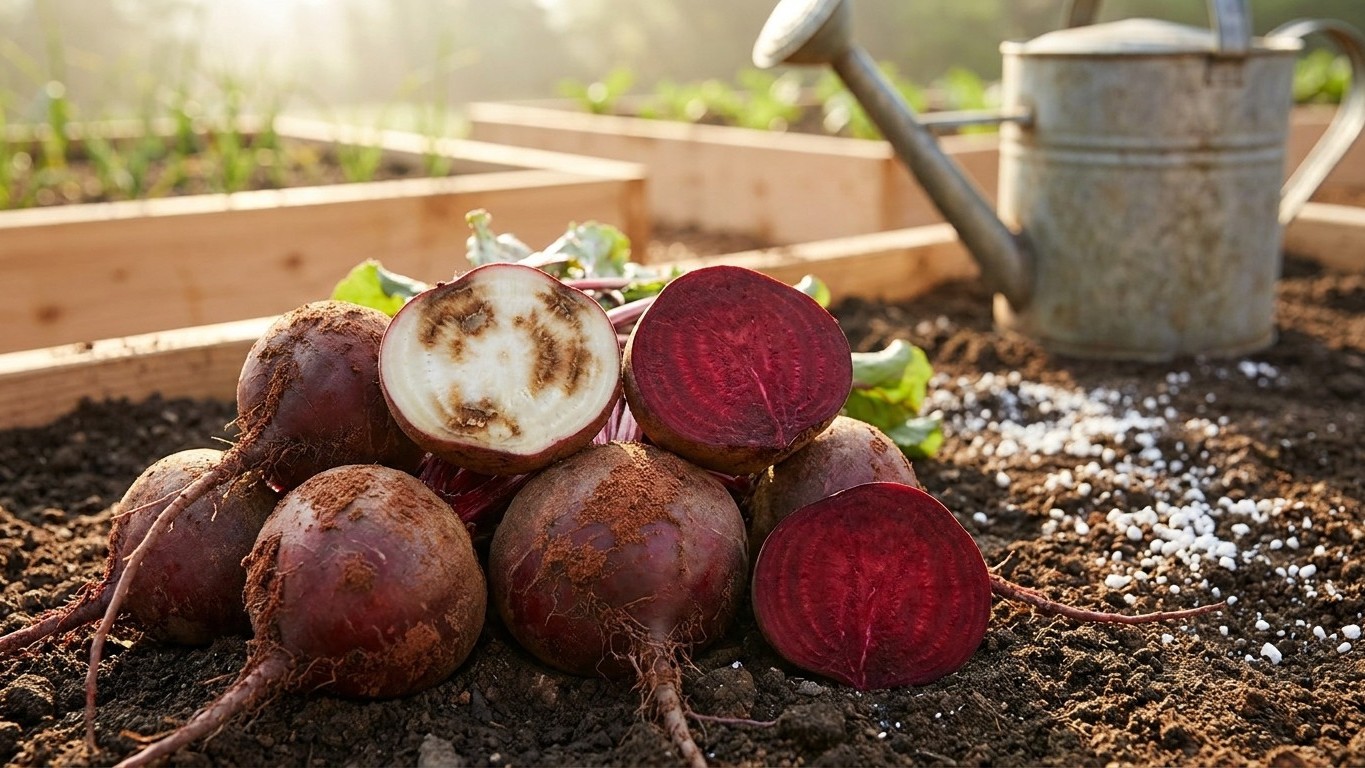

Jacksonville-area beets come out of the ground by root shoulder width, not by the calendar, and once they’re out, the coldest shelf in the house is the wrong place for them. Roots graded near an inch across are ready for bunching as early as 50 to 70 days from seeding, while roots left to size up for storage wait longer, into the weeks around the region’s last frost. Check the shoulders where they meet the soil every few days once plants pass the two-month mark, and pull by size rather than by date.
When beets are ready in Florida
A beet tells you it’s ready at the shoulder, the swollen top of the root where it meets the soil line, long before any seed packet’s day count matters much. Roots graded at about an inch across are the size at which bunching begins. If you’re pulling for the bunch, leaves and all, that shoulder width is the signal to watch. Roots you mean to hold for storage stay in the ground longer, bulking further before you lift them.
In days, that first bunching size shows up as early as 50 to 70 days from the day you sowed the seed, never from a transplant date, since beets are sown directly in place. Storage roots run past that window, sizing up for another stretch before you dig. If you’re just getting a bed started, back up to Growing Beets in Florida for spacing and depth before you worry about a pull date at all.
Working from the frost window
Near Jacksonville, NOAA’s 1991-2020 climate normals put the last spring freeze in the range of February 16 to March 7, measured at station USW00013889. That’s an inland airport site, and three of the thirty years in that record saw no freeze at all, so treat it as a window, not a promise. Beets tolerate a light frost better than the heat that follows it. Utah State University Extension notes that heat above 85°F combined with water stress turns the root woody, so the practical pressure in this territory is to get storage roots out before spring warmth builds past that point, roughly in the weeks as that frost window closes and days start holding warmer.
This whole calendar flips father south. Central and south Florida run close to frost-free, and there the beet season sits through winter with summer as the hard stretch, so none of this frost-based timing carries over to Orlando or Miami gardens.
Florida’s official state soil, the Myakka series, is a sandy, acid Spodosol running about 97 percent sand and around 2 percent organic matter at the surface, according to USDA’s NRCS soil survey data. It’s poorly drained despite the sand fraction, and your own bed is very likely nothing like it, but sandy ground across much of the state does share that habit of shedding moisture fast, which swings root growth unevenly from one week to the next. That unevenness is exactly why the shoulder check beats trusting the seed packet’s day count. For more on what your beets are actually rooting into, see Beet Soil in Florida: What the Root Will Meet.
One more reason to look before you dig: root-knot nematodes, documented for this territory by UF/IFAS Extension, distort root shape from below the shoulder, so a root that looks ready on top can be a mess underneath. Checking the shoulder as you pull is also your first look at whether something’s been at the root. For the full rundown of what to watch for while the crop is still in the ground, see What Eats Beet in Florida, and When.
Why colder is not better for beets
Once the roots are out of the ground, the instinct most gardeners carry over from carrots is to get them as close to freezing as possible. Beets punish that instinct. USDA Agricultural Handbook 66, in the chapter written by F. Adamicki, is explicit that storage at 32 to 34°F produces more black spot and rot than storage held a few degrees warmer. The target for topped roots is 33 to 36°F, held at 98 percent relative humidity, not the near-freezing shelf that works for carrots and parsnips.
Bunched versus topped
That target only applies once the tops are off. Bunched beets, leaves still attached, keep for 10 to 14 days at 32°F and above 98 percent humidity, according to the same USDA handbook, and that’s the ceiling, not a guarantee. The leaves keep drawing moisture out of the root the whole time they’re attached, which is why the bunched window is so much shorter than the topped one. If you want beets to last past two weeks, cut the tops within a day of pulling, leaving about an inch of stem, and store the roots on their own.
Treat every one of these durations as a maximum under close to ideal conditions, not a promise you can bank on. A home cellar rarely holds 98 percent humidity the way a commercial cold room does, and roots dry out faster in drier air even at the right temperature. Expect real storage life to run shorter than the published figures, especially the first season you’re guessing at your own setup rather than measuring it.
Where in the house that actually is
A kitchen refrigerator runs colder than the 33 to 36°F target for topped beets, which is the same problem the USDA handbook warns about, just made worse. A heated living space runs far warmer than either figure. The handbook’s own range for a cellar or a pit is between about 31 and 41°F, so the goal is a space that sits inside that band and holds there, not one that swings across it with the weather.
Finding that space in a Florida house
In this territory, an unheated garage, a breezeway, or a shaded outbuilding in the cooler months often comes closer to that range than anything indoors, but the only way to know is to put a thermometer in the space and check it over a few days, not to guess from how it feels. North Florida winters run mild with real swings, so a spot that reads fine on a cold morning can climb past the target by afternoon.
| Storage spot | Typical temperature versus the 33-36°F target | Fit for topped beets |
|---|---|---|
| Refrigerator crisper | Colder than target | Speeds up black spot and rot, per USDA Handbook 66 |
| Unheated garage or shed, cooler months | Close to target if checked | Best option in this territory, verify with a thermometer |
| Heated living space | Far warmer than target | Unsuitable, roots sprout and soften quickly |
Sort by size before anything else goes into storage. The USDA handbook is direct on this point: large roots keep much better than small ones because they lose water and shrivel more slowly. Put the big roots away for the long haul and eat the small ones first, not the reverse, which is the mistake most people make on instinct.
What goes wrong here
Three failures show up more often in this territory than the storage instructions alone would suggest. A cold snap can push an unheated garage or an outdoor pit below 31°F, and the handbook’s own floor for a cellar or pit is right at that line, so a hard freeze reaching the roots means frozen, mushy tissue once they thaw. Watch the forecast during any cold snap and move roots indoors, or add insulation, if a freeze is coming.
The opposite failure, and the simplest one
North Florida winters swing the other way just as often. A mild stretch can push a garage or shed past 41°F, and once storage runs warmer than that, roots start sprouting and soft rot moves in faster. A space that felt right in December can drift out of range by February, which is another argument for checking with a thermometer rather than trusting the location alone.
The third failure is the simplest to avoid and the easiest to forget: leaving the leaves attached past the bunched window. Greens still on the root keep pulling moisture out of it, and a beet that would have held for weeks topped goes limp in under two weeks with the leaves still on. Top the roots within a day of pulling unless you’re eating them within that short bunched window, leaves and all.
Common questions
Can I just leave beets in the ground longer instead of storing them?
You can, up to a point, but heat is the limit, not cold. Utah State University Extension notes that heat above 85°F combined with water stress makes the root woody, so a root left too long into a warm spring loses eating quality even if it never gets pulled at all.
Do I need to wash the roots before storing them?
No published figure here covers washing specifically, so treat it as unsettled and err toward brushing off loose soil rather than washing, since added surface moisture works against the low-humidity risk the handbook describes for home storage.
What if I don’t have anything close to a root cellar?
Then plan around the shorter bunched window instead of the longer topped one. Ten to 14 days at close to 32°F with the leaves left on, per USDA Handbook 66, is realistic in a refrigerator even if you can’t hit the warmer topped-root target anywhere in the house.
My beets tasted woody even though I kept them watered. Why?
Water stress and woodiness are two separate problems. Early-season water stress tends to push the plant toward bolting instead, while woodiness specifically comes from heat above 85°F layered on top of water stress later in the root’s growth, according to Utah State University Extension. Watered consistently but harvested too late into a hot spell, a root can still turn woody.