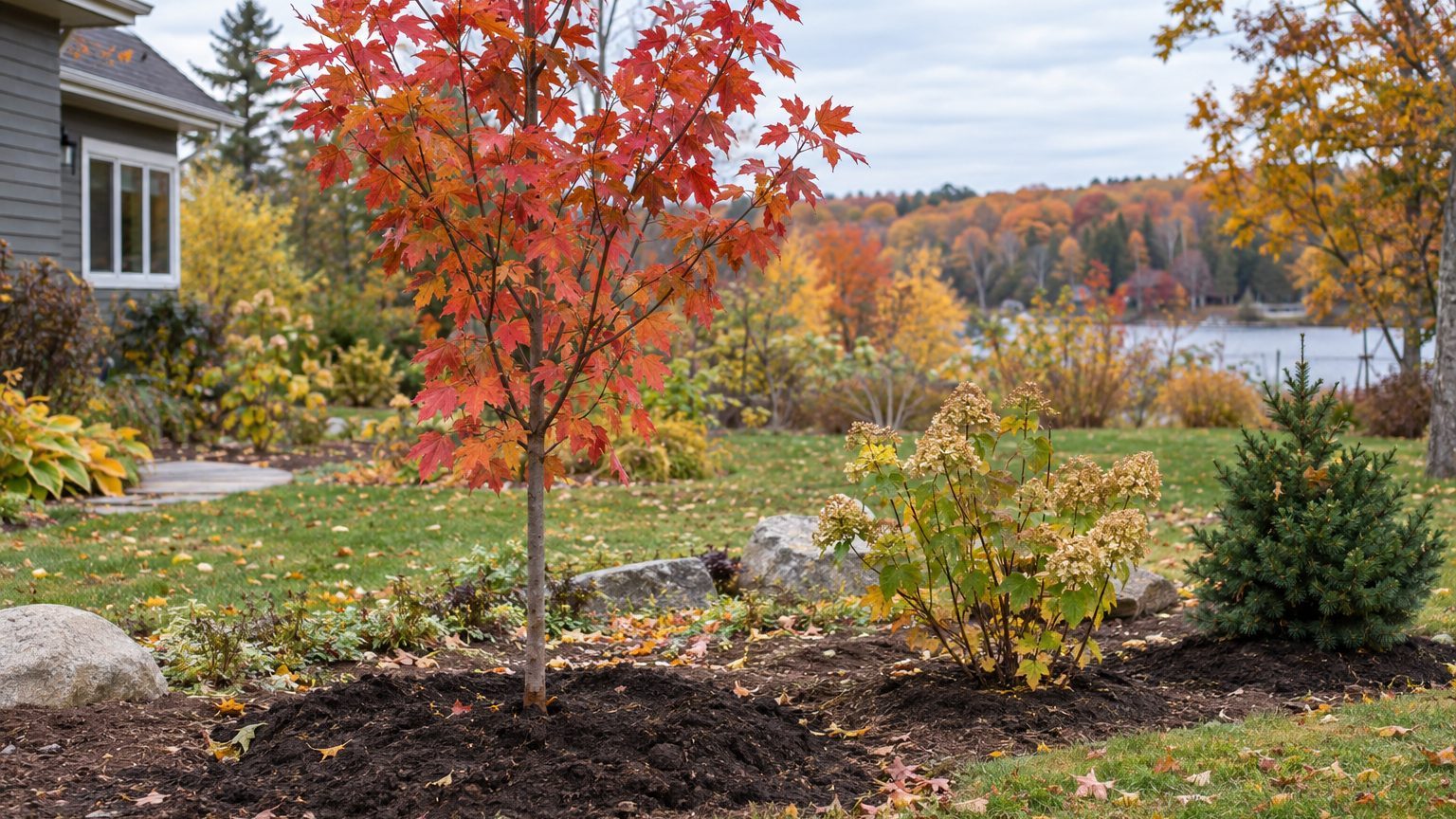

Plan to get trees and shrubs into the ground about six weeks before the first fall frost, which averages October 16 at Toronto Pearson. That puts the conservative target in early September. Hardy container and balled plants set out after that date can still root well. The real limit is the day the soil freezes, and it arrives later than the first frost. The closer you cut it, the more the weather decides for you.
The deadline in Ontario
Air temperature gets the attention, but roots follow the soil. Ground holds summer heat long after the nights turn cold, and a newly planted tree keeps pushing out fine roots as long as the soil is workable and above freezing. Tops go dormant, roots keep working. That gap between a cold air and a still-warm soil is the whole reason fall planting works, and it is why the deadline is counted from a freeze, not from the calendar.
The rule most extension programs lean on comes from Cornell Cooperative Extension in Orleans County, New York: “Fall is an excellent time for transplanting, provided you get them to their new home at least 6 weeks before the ground freezes, allowing them time to establish roots before winter dormancy.” The rule counts back from frozen ground, and ground is much harder to forecast than a frost. So the practical move is to count back from something you can look up.
For the Toronto area, that something is the first fall frost. Environment and Climate Change Canada’s 1981-2010 Canadian Climate Normals for the Pearson airport station put it on average at October 16. Six weeks earlier is September 4. That is the conservative deadline: early September, with a few days of give on either side depending on your yard. Think of it as the date by which you stop worrying.
Why October 16 is a midpoint, not a promise
That figure is a mean. In roughly one year out of two, the first frost falls later than October 16, and in the other half it falls earlier. Treat it as the middle of a window, never as a safe date. A cold snap in early October is perfectly normal, and a gardener who planned around the average will occasionally get caught.
The figure also comes from one station, and a province is not one climate. Northern and upland districts run weeks behind Pearson, which means their first fall frost comes earlier and their planting deadline moves earlier with it. A property well north of Lake Ontario or up on higher ground should aim for the start of September or before, not the middle of it. The Pearson normals also cover 1981-2010, so recent autumns may run a little different. For a closer read on your own area, First and Last Frost Dates in Ontario breaks the numbers down by region.
The ground does freeze here
Nobody in Ontario can skip the deadline. The mean daily minimum of the coldest month at the Toronto reference station is -10.2 °C (about 13.6 °F), per the same Canadian Climate Normals. Soil at that kind of cold will freeze, so the six-week rule applies in full. Natural Resources Canada places Toronto in Canadian plant hardiness zone 7a (1991-2020 normals). That is a Canadian zone, built on seven climate variables, and it does not convert to a USDA zone. Zone 7a for Toronto describes the city, not the province.
The six-week rule is a floor for comfort, not a cliff. Between early September and the weeks just before freeze-up, planting is still possible and often works for hardy stock. The odds shift against you every week, which is why the next section sorts plants by how much margin they need.
What to plant late, and what to wait on
Container-grown and balled-and-burlapped plants that are fully hardy for your zone are the best late-fall candidates. They arrive with intact root systems, so they spend less energy recovering from transplant shock, and a plant that is comfortably hardy has reserves to spare. Deciduous trees and shrubs are the easiest group of all. Once leaves drop they are dormant, and the root system can keep working in cool soil without feeding a canopy.
Hardy is a relative word, and the wording on the tag matters. A great many plant labels use USDA zone numbers, while Ontario uses the Canadian system. NRCan says plainly that there are no simple conversions between the two, and that Canadian zone 4a alone overlaps nine different USDA zones. So read which system a tag or catalog uses, and look for stock rated for a colder zone than your own, not one sitting right at the line. Toronto’s coldest-month mean minimum of -10.2 °C is an average, and individual nights go lower. A plant that is only just hardy has little buffer for a hard winter on top of a late planting.
The risky group is two kinds of plants. Borderline-hardy shrubs and trees are the first: anything that is a stretch for zone 7a in the Canadian system belongs in spring, when it has a full season to root before its first test. Evergreens that lose water all winter are the second. Needles and leathery leaves keep transpiring through winter, but frozen soil cannot deliver replacement water. A newly planted evergreen with a small root system is working against that gap, and a fall planted in a hurry leaves it with less root to draw on.
| Plant type | Late-fall outlook | Reason |
|---|---|---|
| Hardy deciduous trees and shrubs, container or balled | Good, once dormant | No leaves to feed, roots keep growing in cool soil |
| Hardy perennials in pots | Good, earlier is better | Small root systems need time to anchor before the ground freezes |
| Needled evergreens | Plant by the early-September target | Lose water all winter while roots are still settling |
| Broadleaf evergreens such as rhododendron and boxwood | Wait for spring if late | Leaves transpire and scorch in winter sun and wind |
| Plants borderline for Canadian zone 7a | Wait for spring | No margin for a cold winter after a late start |
Perennials are worth a thought too. Small potted perennials have shallow roots and little mass, so they need the full runway more than a large shrub does. If the calendar is already past the target, wait until spring for evergreens and anything near the edge of its hardiness. A spring planting has all summer to build roots, and a plant that sits in a nursery pot for a few more months comes to no harm. The broader principles of picking and siting stock are in Planting and Caring for Trees, Shrubs and Perennials.
Watering and mulch until the ground freezes
A fall planting is judged by its roots, and so is its first winter. Top growth during that first winter is zero, and that is fine. Whatever the tree does next spring (how fast it leafs out, how far the new shoots extend) depends on how much root it laid down between planting day and freeze-up. That changes how you spend your effort. Water and mulch are the two levers you actually control.
Water deeply until freeze-up
Soak the root zone slowly, so the water travels down into the planting hole and the soil beyond it. A light sprinkle wets the top inch and encourages roots to stay shallow. Fall can be dry, and cool air hides how thirsty a new planting still is. Keep checking the soil near the root ball, not just the surface, and water again when it begins to dry. Carry on until the ground freezes, which is the same event the six-week rule is counting back from. Evergreens benefit most, because they enter winter still losing moisture through their foliage. A well-watered root ball going into freeze-up is the best insurance against winter burn.
Mulch in a ring, not a volcano
NC State Extension, in its Extension Gardener Handbook chapter on woody ornamentals, gives two figures for mulch. For weeds: “A 2-inch to 3-inch layer of mulch suppresses most annual weed seeds and makes it easy to hand-pull any that do germinate.” And on trees: “Provide a 3-inch layer of mulch to reduce water loss and maintain uniform soil moisture and temperature around roots.” The two purposes are different and the depth is the same. Use a 2-inch to 3-inch ring spread wide around the planting, and keep it off the trunk.
More is not better. Mulch piled against the bark in a cone holds moisture on the trunk, invites rot, and gives mice and voles a sheltered place to nest and chew. Pull it back so the base of the trunk stays visible and you can see where the flare meets the soil. Spread the ring outward instead of upward. The same logic, and the common mistakes, are covered in Mulching Without Killing the Plant. A ring also does a quieter job in an Ontario winter: it evens out soil temperature, which slows the freeze-thaw swings that push young roots around.
What goes wrong
The most common failure is simply planting too late for the climate. A tree set out after the soil is already cold and nearly frozen has had no time to root, and it enters winter with a root ball that is still just a root ball. Northern and upland parts of Ontario hit that point earlier than the Pearson-based September target suggests, because their first frost comes weeks ahead. If you are in a colder district and it is past the start of September, take that as the signal to plant in spring instead unless the stock is clearly hardy and the soil is still easy to dig.
Winter burn is the next one. It shows up on evergreens as brown, dry needles or leaves in late winter, because sun and wind pull moisture out of foliage faster than frozen roots can resupply it. A deep soak before freeze-up and a ring of mulch are the main defenses. Burlap screens on the windward side can help young broadleaf evergreens, but they are a patch, not a substitute for good timing.
Heaving catches shallow root balls. When soil freezes and thaws repeatedly, it expands and contracts and can push a small root ball up out of the ground, exposing roots to air and drying wind. Planting at the correct depth, firming the soil around the ball, and keeping an even mulch ring all reduce the risk. Check new plantings after a thaw and press any lifted root ball gently back down.
And then there is the dry fall. It is easy to let the hose slide when days are cool, but a dry autumn is exactly when a new root system is most stressed. If rain has been scarce, keep watering until the ground freezes. Gardeners in colder climates face the same set of problems on an earlier calendar, as How Late Can You Plant Trees and Shrubs in Fall in Maine? shows. More Ontario-specific timing is collected in the Ontario guides.
Common questions
Can I plant trees in Ontario in November?
Sometimes, if the soil is still workable and the stock is fully hardy for your area. It is past the conservative target, so the odds of a good result are lower, and evergreens and borderline plants should wait for spring. Water thoroughly and mulch the ring right after planting.
Is October 16 a safe cutoff date for planting?
No. October 16 is the average first fall frost at Toronto Pearson, from the 1981-2010 Canadian Climate Normals, and the frost comes later than that in about half of years. The six-week count back from it gives the early-September target, not a cutoff for the day you stop planting.
Is Canadian zone 7a the same as USDA zone 7a?
No. Canada’s system uses seven climate variables and the USDA system uses one, and NRCan states that the two do not convert simply. When you buy a plant, find out which system the label uses before you decide whether it is hardy enough for you.
Do northern Ontario gardeners follow the same dates?
They should work from their own frost dates. Northern and upland districts run weeks behind the Pearson station, so their first frost arrives sooner and the planting deadline moves earlier. The ground there also freezes earlier, which shortens the root-growing window further.
One more detail for the calendar: the Pearson normals describe the airport, and the lakeshore tends to stay milder than inland sites a few miles away. If you garden away from the lake, lean toward the early end of the window.