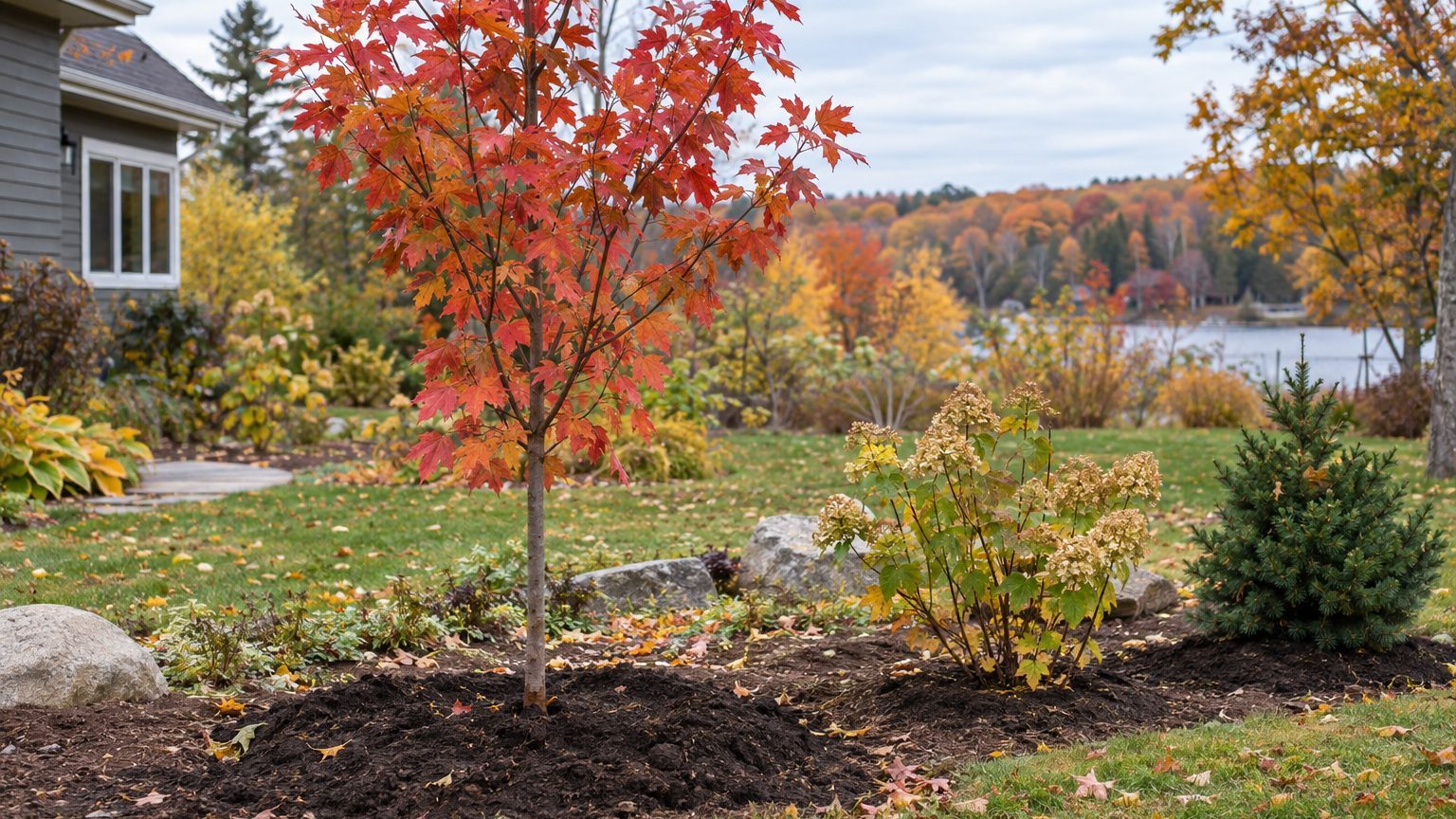

The conservative cutoff for planting trees and shrubs in Pennsylvania is September 24 to October 5, which is six weeks before the first fall frost. NOAA’s 1991-2020 climate normals put that frost at November 5 to November 16 around Philadelphia. The cutoff is a safety margin, not a wall. Roots keep growing in cool soil long after the leaves drop, so a hardy container or balled plant that goes in a bit late can still make it, provided the ground stays workable and you keep it watered.
The deadline in Pennsylvania
Why the ground matters more than the air
Air temperature gets the attention, but roots answer to the soil. Soil lags the air by a wide margin. It is still giving back summer heat when the first frost blackens the tomato vines. Root tips keep extending as long as the soil is workable and above freezing, which is why a tree planted in October can be building new roots while its branches are already bare.
Cornell Cooperative Extension states the rule this way: “Fall is an excellent time for transplanting, provided you get them to their new home at least 6 weeks before the ground freezes, allowing them time to establish roots before winter dormancy.” The count starts from frozen ground, not from the first frost. Those are two different dates, and the ground freezes later.
Pennsylvania does have frozen ground. NOAA’s 1991-2020 normals for Philadelphia, the mildest corner of the state, show a mean daily minimum of 26.0°F in the coldest month. That sits well below 32°F, so winter soil freezes and the Cornell rule applies here.
Turning the rule into a date range
NOAA’s U.S. Climate Normals for Philadelphia, using the 30 to 70 percent band of 32°F freeze probabilities, place the first fall frost at November 5 to November 16. Six weeks earlier gives September 24 to October 5, the safe target to write on the calendar. For frost timing in other parts of the state, see First and Last Frost Dates in Pennsylvania.
Because the ground freezes after that first frost, the true biological limit falls later than the safe date. That is why plants set in mid-October, and sometimes into early November, often come through fine. Each week past the safe window shortens the time roots get before dormancy, though, so the odds slip gradually, not all at once.
Today is October 10, 2026, so in the Philadelphia area the conservative window has just closed. First frost is still ahead, and the soil is warm and workable. A hardy plant that goes in this week is in a very different position from one that goes in during mid-November. What you choose to plant matters more now, which is the subject of the next section.
Philadelphia’s numbers do not describe the whole state. The northern tier and the Alleghenies see the first fall frost earlier, and the ground freezes earlier there too, so the cutoff moves earlier. Treat September 24 to October 5 as the latest reasonable date in those areas, not the typical one. The USDA Plant Hardiness Zone Map (2023 edition, built on 1991-2020 normals) runs from 5a to 7b across Pennsylvania, so a plant rated for Philadelphia’s winters may not be rated for a northern hillside. Colder states do the same arithmetic from their own dates, as in How Late Can You Plant Trees and Shrubs in Fall in Colorado?
What to plant late, and what to wait on
Plants that handle a late start
Container-grown and balled-and-burlapped plants that are fully hardy for your zone are the best bet after the safe window. They arrive with a root mass already formed, so they need less new root growth to anchor and drink. “Fully hardy” is a specific claim: the plant’s rating should cover the winters where you live, with room to spare. Check the USDA zone on the tag against your own location, since the state ranges from 5a to 7b, and keep in mind that Philadelphia’s coldest-month average minimum of 26.0°F is the mild end of the state.
Deciduous trees and shrubs are the easiest group because they are already shedding leaves and shutting down above ground. With no foliage to feed, nearly all of the plant’s energy can go below ground.
Plants that carry more risk
Two groups deserve caution. Evergreens keep their leaves or needles all winter, so they keep losing water through them while frozen soil locks up the supply. Plants at the edge of their hardiness range have little cold tolerance to spare, and an unestablished root system makes a cold snap harder to survive. Some trees also have a reputation for sulking when moved in fall. Birch and magnolia are often cited, and a local nursery can tell you which species it prefers to plant in spring.
| Plant type | Late-fall outlook | Reason |
|---|---|---|
| Hardy deciduous shrubs, container-grown | Good | Dormant tops, intact root mass |
| Hardy deciduous trees, balled and burlapped | Good, if planted promptly and watered | Roots keep growing in cool soil |
| Evergreen shrubs (broadleaf) | Risky | Leaves lose water all winter while soil is frozen |
| Conifers | Better early; risky late | Needles keep transpiring through winter |
| Plants at the edge of their zone | Wait for spring | No cold tolerance to spare, weak roots |
The practical decision: after the first week of October, favor hardy deciduous container or balled plants and hold evergreens and borderline plants for spring. A plant bought now and kept in its pot is not wasted. Set it somewhere sheltered, keep it watered, and plant it when the soil thaws. Plenty of nurseries mark down stock in fall, but a discounted plant only counts as a bargain if it survives the winter.
Watering and mulch until the ground freezes
Water deeply, then keep going
A newly planted tree has a small root system sitting in loose backfill, and a dry fall can leave that zone parched even while the air feels damp. Soak the root ball and the surrounding soil slowly at planting, then repeat whenever the soil begins to dry. Rain does not always do the job on its own, because a light shower may wet only the surface. Dormant trees still lose moisture through twigs and buds, and roots still drink, so watering does not stop when the leaves fall. Keep watering until the ground freezes, and stop only when the soil is too frozen to take water.
One check helps more than any schedule: push a finger or a screwdriver into the soil beside the root ball. If it comes out dry and crumbly a few inches down, water. If it is cool and damp, wait. Overwatering is possible in heavy clay, where saturated soil starves roots of oxygen, so deep and occasional beats shallow and constant.
Mulch in a ring, not a volcano
Mulch evens out soil temperature and slows evaporation, both useful on a plant that has just been disturbed. NC State Extension’s Gardener Handbook gives the depth in two sentences. On shrubs and beds: “A 2-inch to 3-inch layer of mulch suppresses most annual weed seeds and makes it easy to hand-pull any that do germinate.” On trees: “Provide a 3-inch layer of mulch to reduce water loss and maintain uniform soil moisture and temperature around roots.” The two sentences, as published, point to the same depth, so more is not better.
Shape matters as much as depth. Spread mulch in a wide, flat ring and keep it pulled back from the trunk or stems so bark stays dry. Heaped against the trunk, mulch holds moisture on the bark and invites rot, and that pile is what gardeners call a mulch volcano. For more on technique, see Mulching Without Killing the Plant, and for the rest of the planting routine, Planting and Caring for Trees, Shrubs and Perennials.
Expect little to happen above ground the first winter, and do not take that for failure. The goal of the first winter is roots, not growth. A fall-planted tree spends its first months extending roots into the surrounding soil, and it pays off in spring, when it can leaf out with an established system behind it. That is why heavy pruning and a push of fertilizer in fall are poor ideas. Both encourage top growth that the roots cannot yet support.
What goes wrong
The most common mistake is planting too late for the local climate. A tree that goes in after the soil has started to freeze gets almost no root growth before dormancy, and it leans on whatever moisture the root ball arrived with. In the northern tier and the Alleghenies, where frost and frozen ground arrive earlier than in Philadelphia, that point comes sooner than many gardeners expect. If the shovel will not break the ground, wait for spring, and do not chip a hole into frozen soil.
Winter burn is the next problem, and it is mostly an evergreen one. Sun and wind pull water out of needles and leaves while frozen roots cannot replace it, so foliage turns brown, often showing up in late winter. Newly planted evergreens are the most exposed because their roots have not spread yet. A site out of the prevailing wind and consistent watering until freeze-up reduce the risk.
Frost heave is the third. Repeated freezing and thawing can push a shallow or loosely set root ball up out of the soil, exposing roots to cold and drying air. Pennsylvania’s coldest-month mean minimum of 26.0°F in Philadelphia means those freeze-thaw cycles do occur. Plant at the right depth, firm the backfill, add mulch in the recommended ring, and check after thaws. If a root ball has lifted, press it back down and add soil.
Last is a dry fall. Many gardeners assume the cooler weather has taken care of watering. In a dry autumn the soil can stay parched right up to freeze-up, and plants go into winter short on moisture. A soak every so often costs a few minutes and can decide whether a plant leafs out in spring.
Common questions
Can I still plant a tree in Pennsylvania in November?
Sometimes. The conservative window is September 24 to October 5, but the ground does not freeze on the day of the first frost, which NOAA places at November 5 to November 16 in Philadelphia. If the soil is workable, a hardy deciduous container or balled tree can go in and has a fair chance with deep watering and a ring of mulch. Evergreens and borderline plants are better held for spring. In the northern tier and Alleghenies, the cutoff arrives earlier.
Does Cornell’s six-week rule count from the first frost?
No. Cornell Cooperative Extension counts six weeks back from when the ground freezes. Since the ground freezes after the first frost, counting from the first frost builds in a safety margin. That is where September 24 to October 5 comes from, and it is a safe target, not the true limit.
Is the deadline the same across Pennsylvania?
No. The Philadelphia figures describe the mildest corner of the state. The northern tier and the Alleghenies reach frost and frozen ground earlier, so the window closes earlier there. The USDA Plant Hardiness Zone Map (2023) shows a range of 5a to 7b statewide, so check your own location. The Pennsylvania guides cover more of the state’s regional differences.
Is fall or spring better for planting trees and shrubs?
Both work. Cornell calls fall “an excellent time” for transplanting when plants go in early enough, because roots get a head start before dormancy. Spring avoids winter burn and heaving, which suits evergreens and plants near the edge of their hardiness. In practice, the first half of the safe window is the sweet spot for hardy deciduous plants, and plants bought late are worth holding in their pots until spring.