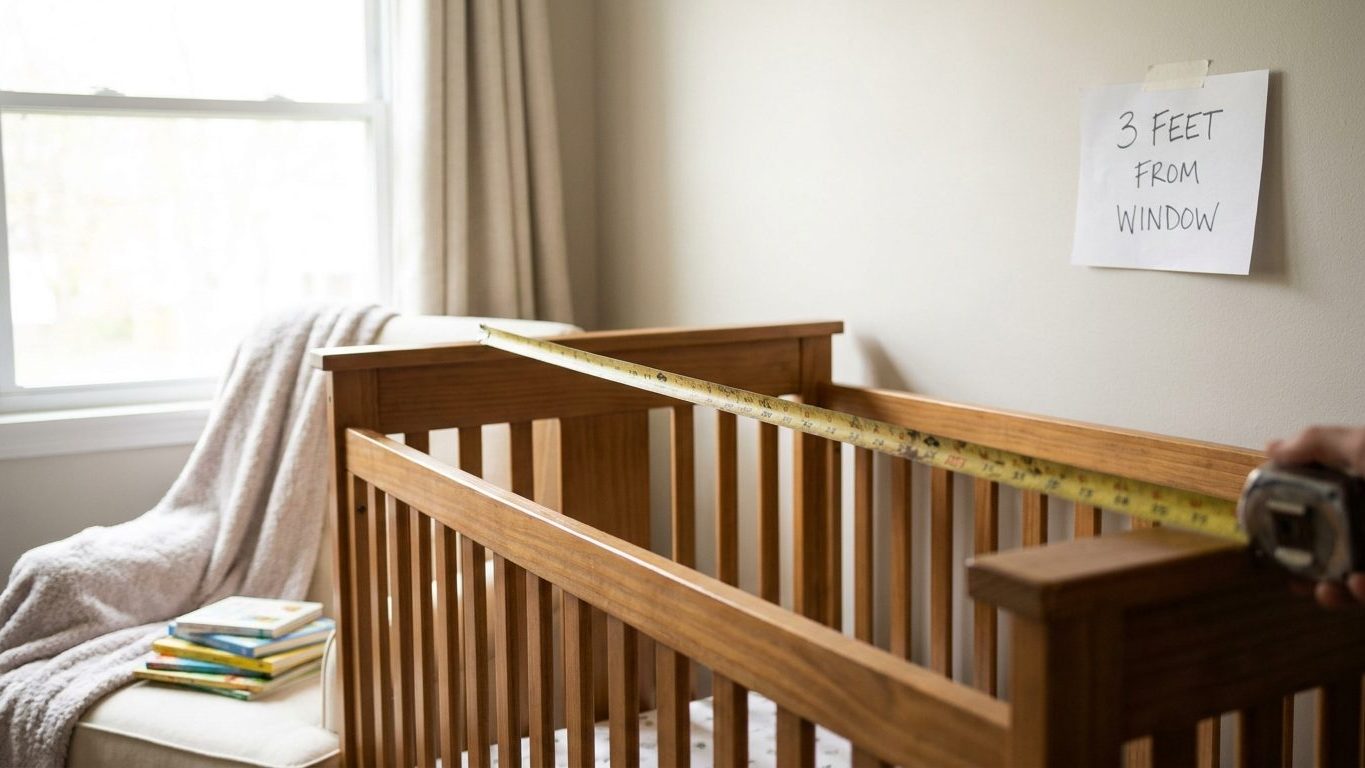

The gap between two crib slats can’t be wider than 2⅜ inches, close enough that a baby’s arm or head can’t slip through and get trapped. That number covers the crib itself. Where you set it down in the room is a separate decision, and it turns on what sits within arm’s reach of the rail once the baby can stand: a window cord, a chest of drawers, a shelf a toddler could use to climb. Before you push the crib against any wall, walk the perimeter and check every one of those things first.
What has to be out of reach of a crib

Federal law already covers the crib itself: 16 CFR 1219, the US CPSC’s full-size crib standard, requires slats spaced no more than 2⅜ inches apart, measured slat to slat, so a baby’s body can’t pass through and a head can’t get caught trying. That’s a binding manufacturing standard, not a suggestion, and it’s why a crib built before the rule tightened can fail it outright.
What CPSC crib safety guidance addresses next is what’s near the crib, not what the crib is made of. The rule of thumb there is qualitative rather than a number: nothing climbable within reach of the rail. A chest of drawers, a low bookshelf, a rocking chair pulled up beside the crib. None of them get measured out to a fixed distance in the guidance, because the hazard isn’t proximity in inches, it’s whether a standing toddler can use the object as a step to get a leg over the rail.
Why “climbable” matters more than “close”
A dresser two feet away isn’t automatically safer than one four inches away if a child can still reach it by leaning, and a low, wide piece with drawer pulls or an open shelf gives a toddler handholds a flat wall never will. Anything with a horizontal surface at or below the top of the crib rail counts as climbable, whether or not you’d call it furniture. That includes a stack of stored boxes, a laundry hamper, or a diaper pail with a lid flat enough to stand on.
Window covering cords, the hazard people plan around last
Corded blinds and shades hang there for the life of the window treatment, long after the nursery gets rearranged around them, and that’s exactly the problem. A pull cord, or the looped cord on the back of a corded blind, puts a strangulation hazard within reach the moment a baby can pull up to standing inside the crib, which happens well before most parents think to check the window again. The US CPSC’s Window Covering Safety guidance treats the cord itself as the hazard, not the crib’s distance from the window in some fixed number of inches, because a cord can be pulled toward a crib that sits several feet away.
That’s the detail that catches people off guard: moving the crib a foot or two farther from the window doesn’t solve anything if the cord still reaches. The fix is the product, not the placement. A cordless blind or shade removes the hazard outright, where a corded one requires a cord cleat, a tension device, or moving the cord out of reach every single time, and those workarounds fail the moment someone forgets to re-secure them after opening the blind.
The cord you can see isn’t always the one that matters
Roman shades, mini blinds and cellular shades made before cordless designs became standard often use a continuous loop cord in the back, easy to miss because it isn’t the obvious pull cord hanging off to one side. Checking a nursery for cords means checking both the visible pull and this rear loop, not just glancing at whether a wand or cord dangles at eye level when the blind is fully raised.
None of this is a hypothetical worst case dressed up as caution. The CPSC’s guidance on window coverings exists because corded products have been tied to child strangulation, which is why the agency’s advice is blunt: replace corded products near a crib with cordless ones rather than manage the cord. A cord wound around a cleat looks secure at 8 p.m. and can come loose by morning if a curious toddler tugs at it, and a sleeping baby doesn’t give anyone the chance to notice before it matters.
If the nursery has an inherited blind or a landlord-installed one you can’t replace right away, treat the whole wall as off-limits for crib placement, not just the space directly under the window, since a mounted cord or looped chain can extend well past the frame depending on the hardware it’s mounted with.
The furniture that becomes a step at eighteen months
CPSC’s crib safety guidance about nearby furniture doesn’t come with an age attached to it, and that’s worth sitting with for a second. A dresser that was harmless when a newborn slept ten feet below the rail becomes exactly the hazard the guidance warns about as soon as that baby can stand, pull up, and reach. That shift doesn’t happen on a birthday. Some babies pull to standing well before their first birthday, others take longer, and the guidance doesn’t distinguish, because it’s written for the whole stretch of time a crib gets used, not for one age.
What changes isn’t the rule but the child. A crib set up in a nursery at three months, with a changing table two feet from the rail, might look fine at the time. The same layout stops looking fine the week a baby starts using furniture to stand. No code inspection revisits a nursery at that point to flag it, and no permit or occupancy rule requires one, which is exactly why this part of crib safety depends on a parent noticing the shift rather than any outside authority catching it.
Furniture guidance is not a building code
It matters to be precise about what kind of rule this is. Unlike the slat spacing in 16 CFR 1219, which binds crib manufacturers under federal law, the furniture-clearance guidance is a safety recommendation from CPSC, not a construction or occupancy code enforced by a local building department. No inspector checks a bedroom for a dresser near a crib the way one checks a stair rail height under a residential code. That doesn’t make the guidance optional in practice. It just means the only enforcement is the parent walking back into the room every few months and looking again.
The same test applies to furniture added after the fact, not just what was there on day one. A glider brought in for night feedings, a toy shelf added once a baby starts sitting up, a laundry hamper parked beside the crib out of convenience: none of it gets a pass just because it wasn’t part of the original nursery plan. If it sits within reach of the rail and a standing child could use it to climb, it counts, no matter when it arrived in the room.
Walking the room from the crib outward

The clearest way to check a nursery is to start at the crib rail and work outward in every direction, the way you’d check for tripping hazards along a hallway, rather than looking at the room as a whole and guessing what’s close enough to matter.
Start with the cord, and check it extended
For any window treatment in the room, check the cord’s reach with the blind or shade pulled all the way down, not rolled up out of the way, since that’s the position a cord sits in for most of the night and the one that puts it closest to a crib nearby. A cord that looks short and tidy when the blind is raised for daytime light can hang much lower once it’s lowered for the evening.
Then the furniture, at its actual height
Check furniture height as it actually sits in the room, with drawers closed, not as it might look in a showroom photo. A change table with a drop-down drawer, or a rocking chair with an ottoman pushed against it, changes the working height of the piece and can turn something that looked clear of the rail into a usable step once a drawer is left open, which is a common way this gets missed on a first walkthrough.
- Cord reach: check with the blind or shade fully extended, not raised
- Furniture height: check with drawers, lids and ottomans in their normal position, not tucked away
- Wall distance: check whether the crib itself sits close enough to a wall-mounted cord bracket or outlet cover to be reached from inside the rail
While you’re at the wall, it’s worth checking the outlets too. A tamper-resistant outlet matters in a room where a crawling baby will eventually spend time on the floor near it, and that’s covered separately in our piece on Nursery Wiring: Tamper-Resistant Outlets and AFCI. The same walkthrough is a reasonable time to confirm outlet coverage along that wall generally, a bedroom electrical question we cover in Bedroom Outlets: No Wall Point More Than 6 Feet From One.
None of this tells you whether the room passes some official inspection, because no inspector visits a nursery to sign off on crib placement. It’s a walkthrough you repeat as the baby grows and starts reaching farther, not a one-time check done before the mattress goes in.
What a second-hand crib may not meet
A crib picked up secondhand, inherited from a relative, or pulled out of storage after a few years doesn’t come with a guarantee that it still meets 16 CFR 1219. If the slats measure wider than 2⅜ inches, that crib fails the standard outright, and a wider gap is exactly the kind of thing that shows up on an older crib built before the rule tightened, or on one that’s been repaired with mismatched or missing slats.
A drop-side mechanism, missing hardware, a cracked rail, or a mattress that doesn’t sit flush against the frame all raise the same question a resale platform, a licensed childcare provider, or a consignment shop will ask before accepting it: does this crib still meet the current standard, and can that be confirmed. Plenty of secondhand cribs get turned away at that question, not because anyone inspected them formally, but because nobody minding other people’s children wants the liability of a crib nobody can vouch for.
The safe-bedding side of this carries its own version of the same problem. CPSC and AAP safe-sleep guidance calls for a firm, flat surface with a fitted sheet and nothing else, no bumper, no blanket, no pillow tucked in for softness. A crib that came with a padded bumper set or a decorative pillow doesn’t need those items to still be a functional crib. The fix there is simply not using what came in the box, not replacing the crib itself.
If there’s any doubt about whether an older or secondhand crib meets the current slat-spacing standard, a local fire department or a pediatrician’s office can often point a parent toward how to check it, and the CPSC’s own site lists crib recalls by model, which is worth checking before anything else.
Common questions
Is it fine to put the crib right under a window if there’s no blind?
A bare window with no blind or shade doesn’t carry the cord hazard this guidance is about, since there’s no cord to reach for. Other reasons might still make it a poor spot, drafts or direct sun among them, but those aren’t governed by the clearances covered here.
Does the furniture rule mean I can’t have a changing table in the room at all?
No. The guidance is about reach from the rail, not about banning furniture from the room. A changing table across the room, out of arm’s reach of a standing child in the crib, isn’t the hazard the guidance describes. One placed close enough to climb on is.
Does the 2⅜ inch slat rule apply to a crib with mesh or fabric sides instead of slats?
16 CFR 1219 covers full-size cribs with slats specifically. Mesh-sided cribs, play yards and other styles are built to their own separate CPSC standards, so check the product’s labeling for which standard it was certified against rather than assuming the slat-spacing figure applies.
My blind has a wand instead of a hanging cord, is that still a hazard?
A wand-operated blind with no pull cord is generally the kind of cordless product CPSC’s guidance points to as removing the hazard. It’s still worth checking behind the slats for a hidden inner loop cord, since not every wand-operated blind is fully cordless in its lift mechanism.