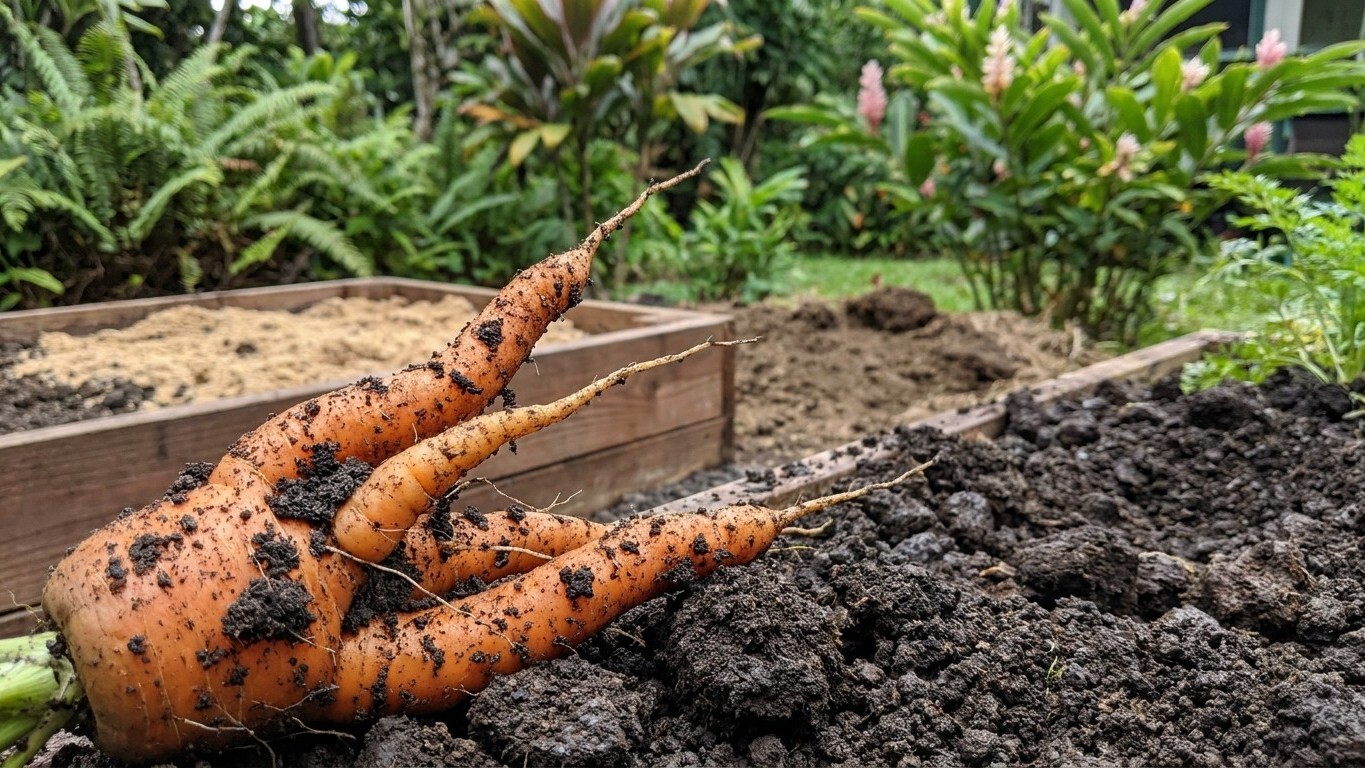

Pull carrots about 65 to 75 days after planting, according to Clemson Cooperative Extension. Utah State University Extension gives a wider window of 70 to 100 days. Carrots are sown in place, so the count starts the day the seed goes in the ground. Once they are out, store them at 33 °F with high humidity, and cut the tops off first. Bunched carrots with leaves attached keep about 10 to 14 days. Trimmed ones keep for months.
The short answer
North Carolina’s state soil is the Cecil series, an Ultisol. That is an old, heavily weathered, leached soil, naturally acid and low in nutrients. USDA records its surface layer as 68 percent sand, 13 percent clay and 20 percent silt (the figures sum to 101 as published), with a surface pH of about 5.5, which is slightly acid, and organic matter of about 0.8 percent. It is well drained. Those numbers come from the USDA NRCS Soil Data Access database, averaged across 636 mapped components of the series.
Will a carrot fork in it?
On the surface, no. Utah State University Extension says carrots want deep, sandy, well-drained soil rich in organic matter, and that heavy or rocky soil makes the root fork. A surface that is mostly sand with modest clay and good drainage ticks the first two boxes. Forking is a response to resistance: the root tip hits a stone or a dense layer and splits or twists around it. Loose, sandy ground gives it little to hit.
The third requirement is where this soil falls short. Organic matter at 0.8 percent is thin, and a soil that is naturally low in nutrients will not feed a root crop generously by itself. Compost fixes that. It also helps sandy ground hold a little more moisture, which matters for the uneven-water problems covered below. Our guide on Will Carrots Fork in North Carolina Soil? goes deeper on the root-shape side of this.
A starting point, not a diagnosis
A state spans hundreds of soil series, and Cecil is the one USDA lists to represent North Carolina. It is not necessarily the one under your tomatoes. River bottoms, hill country and any lot a builder has scraped, filled or compacted can differ completely from these numbers. The figures also describe the mapped surface layer, not a worked garden bed and not the deeper ground a carrot reaches into. Never read that 5.5 as your own pH. Only a soil test gives you that.
If your ground turns out heavy, with high clay and slow drainage, the answer is plenty of compost and double digging, or a raised bed. It is not a different variety. A raised bed filled with loose, sandy, compost-rich mix lets you build the soil carrots want instead of fighting the soil you have. For the full picture of the crop in this state, see Growing Carrots in North Carolina.
The test that settles it in your own garden
The state soil tells you what the region tends to do. Your bed may do something else, and an hour with a spade will show you. Do this on a day when the soil is damp but not soaking, ideally a few days after rain.
- Dig a test hole. Go at least as deep as the carrots you hope to grow, and wide enough to see into. A shallow scratch tells you nothing about what the root tip will meet.
- Read the wall of the hole. Look for layers, color changes, and any point where the spade stops easily. A hard band, a pan of packed soil, or a scatter of stones at depth is exactly what makes a carrot fork.
- Count the stones. Pull out what you find as you dig. Rocks in the top layer can be sifted out by hand. Rocks all the way down mean a raised bed is the practical route.
- Feel the texture. Take a moist handful and squeeze it. Sandy soil feels gritty and falls apart when you open your hand. Silty soil feels smooth and floury. Clay holds a shape, and if you can roll it into a ribbon that stays together, it is heavy.
- Watch the water drain. Fill the empty hole with water and let it soak away. Fill it again and watch. If water is still standing hours later on the second fill, drainage is poor, and carrots in that spot will struggle.
- Send a sample for a soil test. Your county Cooperative Extension office can tell you how to submit one. That gives you your own pH and nutrient picture instead of a state average.
Read the results together. Loose, gritty or silty soil with no hard layer and quick drainage is carrot ground, probably needing compost. Heavy, rocky or slow-draining ground needs compost and double digging, or a raised bed.
What goes wrong here
Most failures with carrots in this state come from three places: the ground, the weather, and what happens after harvest.
- Forked or twisted roots. The cause is resistance in the soil, from stones, clods or a compacted layer. Remedy: work compost in deeply, double dig heavy ground, sift out stones, or move to a raised bed. Sown in place, a carrot can’t be moved to better soil later, so fix the bed before seeding.
- Poor germination in a hot spell. Carrot seed is slow to come up, and sandy, well-drained ground dries out fast on the surface. A crust or a dry seedbed leaves gaps in the row. Remedy: keep the seedbed evenly moist until the seedlings are up, using a light covering such as a board or burlap laid over the row, and checking it daily so it comes off as soon as sprouts show. Resow gaps rather than waiting.
- Splitting from uneven water. A long dry stretch followed by a heavy rain makes the root swell faster than its skin can stretch. Remedy: water steadily, mulch to even out moisture swings, and compost the bed, since added organic matter helps sandy soil hold water between rains.
- Pulling at the wrong time. Counting from a transplant date doesn’t work, because carrots are never transplanted. Remedy: mark the seeding date, start counting from it, and pull a test carrot when the window opens (65 to 75 days by Clemson’s figure, 70 to 100 by Utah State’s). Check the maturity days printed on your seed packet, since those vary by variety, and let the test carrot, not the calendar, decide.
- Soft, sprouting or wilted stored carrots. A 50 °F cellar is far too warm. Carrots stored there sprout and soften in a fraction of the time they would last cold. Remedy: store at 33 °F, just above freezing, with high humidity to prevent wilting.
- Tops left on. The leaves keep drawing moisture out of the root, which is why bunched carrots last only 10 to 14 days. Remedy: cut the tops off before storing. Trimmed carrots keep for months.
- Pest damage that looks like soil trouble. Tunneled or scarred roots are often something feeding on them, not a soil flaw. Our guide to What Eats Carrot in North Carolina, and When helps you tell the difference.
Common questions
How many days until I can pull carrots?
Clemson Cooperative Extension says to harvest about 65 to 75 days after planting. Utah State University Extension gives 70 to 100 days. The spread reflects variety and growing conditions, so check your seed packet and pull one test carrot before you commit to the whole row.
Do I count the days from transplanting?
No. Carrots are sown in place and don’t take transplanting, so there is no transplant date. The days run from seeding. Write the seeding date on a plant marker at the end of the row so you don’t have to remember it.
Can I store carrots in a cool cellar?
Only if it is genuinely cold. Clemson’s figure is 33 °F with high humidity, which is just above freezing and colder than most cellars. At around 50 °F carrots sprout and go soft much faster. A refrigerator’s crisper drawer is closer to the target than a basement corner.
Do I still need compost in sandy soil?
Probably. The state’s representative soil is sandy and well drained, which suits carrots, but its organic matter is only about 0.8 percent, and the soil is naturally low in nutrients. Utah State University Extension describes the ideal carrot soil as rich in organic matter, so compost helps. Your own soil test will show how much your bed needs.