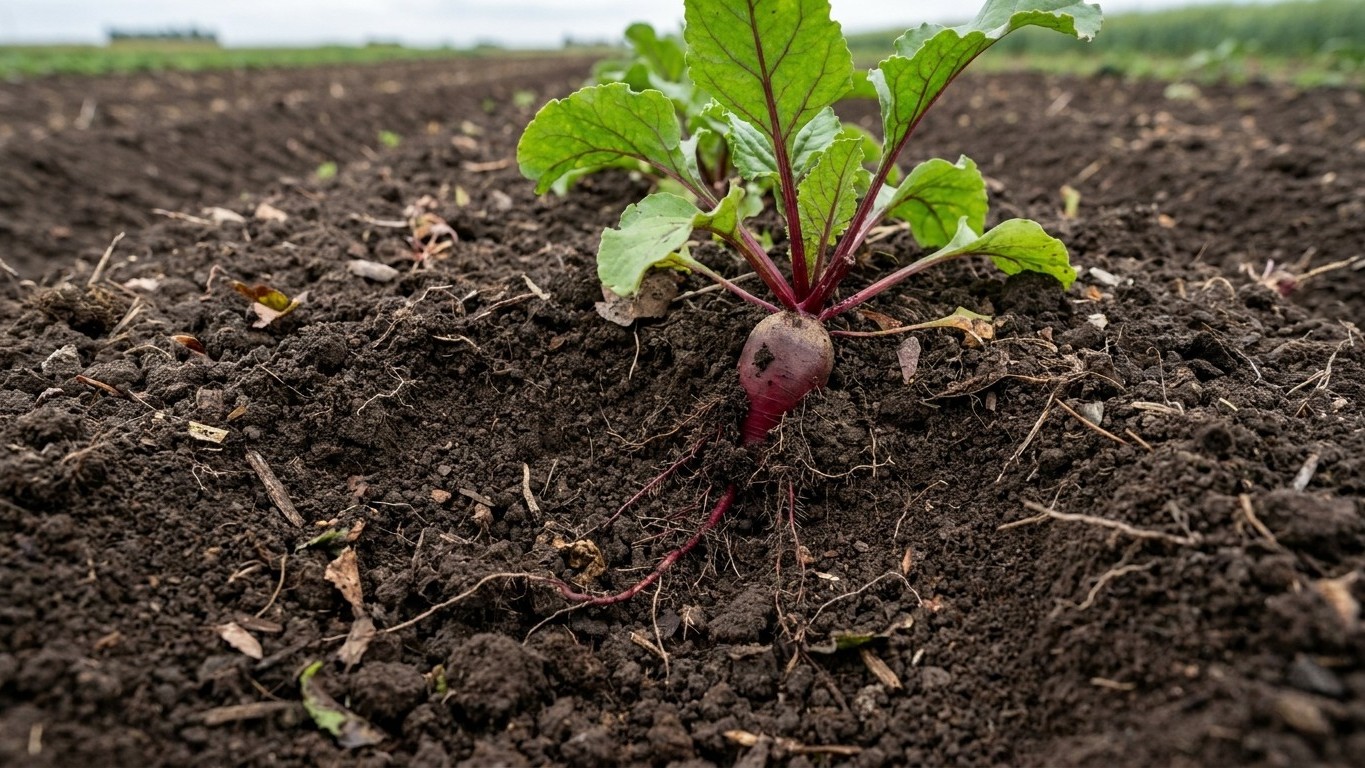

In a Vermont garden, what eats into a beet crop is mostly water and heat, timed badly. Thirst in the first six weeks after seeding pushes the plant to flower early. Heat above 85 F combined with thirst later turns the root woody. Those are two separate failures with two separate windows. Insect and disease pressure isn’t covered by the sourced figures behind this page, so it isn’t covered here. The wider picture sits in Growing Beets in Vermont.
The short answer
What the state soil says about your beets
Vermont’s official state soil is the Tunbridge series, a Spodosol: a sandy, acid, strongly leached soil that typically forms under conifers. USDA NRCS records representative surface values for the major components of the series (442 of them in its Soil Data Access database). Those values put the surface at 79 percent sand, 21 percent clay and 0 percent silt, with a pH of about 3.5, which is strongly acid. The drainage class is well drained. Organic matter comes in at about 75.0 percent.
That last number needs a caveat. Anything above roughly 20 percent means the mapped surface is a natural organic layer, in this case forest litter. A cultivated bed will not look like that, and the pH of 3.5 is not your pH either. Treat these figures as a description of what the ground in this region tends to do, not as a diagnosis of your plot.
Read against what a beet wants, the match is partial. Utah State University Extension describes the ideal as deep, sandy, well-drained soil rich in organic matter. Sand and good drainage are right there in the Tunbridge profile. The catch is that a soil which drains well also sheds water quickly, so a dry week shows up in the plants sooner than it would in a heavy clay.
Heat, woodiness and the limits of one soil
Woodiness is a heat problem layered on a water problem. The same Extension source says heat above 85 F with water stress makes the root woody. The count of days per year that Burlington passes 90 F is not published in the figures behind this page, so I won’t hand you a number. What the sources do support is the threshold that matters: 85 F sits below 90 F, so a stretch of hot afternoons can cross the line before the thermometer reaches the 90s.
Burlington sits on Lake Champlain, the mildest corner of the state. The Green Mountains and the Northeast Kingdom run substantially shorter seasons, which shifts every date on this page later.
And a state spans hundreds of soil series. The river bottoms, the hill country and any lot a builder has scraped or filled will differ completely from Tunbridge. Use it as a starting point, then get a soil test for your own numbers. The page on Beet Soil in Vermont: What the Root Will Meet goes further on that.
The six weeks that decide it here
Where sowing puts those weeks
Beets are sown in place, so the clock starts at seeding. Sow two to three weeks before the last spring frost and the first six weeks of the crop fall in a known stretch of Vermont’s spring. In Burlington the last frost falls between April 30 and May 10 (NOAA NCEI climate normals, 32 F freeze probabilities, 30 to 70 percent band). Do the arithmetic and the seeding window runs from roughly April 9 to April 26. Six weeks later lands you between about May 21 and June 7.
Farther up in the hills, the frost date moves later and so does everything downstream of it. The page on When to Sow Beets in Vermont covers how to shift the window by location.
Why this spring is a bolting risk
Vermont’s spring tends to swing. Snowmelt and April rain leave the ground wet, then a run of dry, breezy, warming days can follow within a week or two. The figures behind this page carry no rainfall data, so I can’t tell you how often that happens. The mechanism is what matters. Water stress during the first six weeks causes premature flowering, and a sandy, well-drained bed gives a dry spell little cushion.
That is where the bolting risk sits here: in the gap between a wet start and the first dry stretch, when seedlings have shallow roots and the soil drains fast. Heat has not arrived yet in those weeks. This is thirst alone, and the cure is steady moisture while the plants are small.
The woody-root problem belongs to a later window. A crop seeded in that April range takes 60 to 80 days to mature, counted from seeding, which puts harvest from early June into mid-July. Warm afternoons late in that run are when heat and thirst together do their damage. Watering well in May does nothing to protect you from woodiness in July, and the reverse is just as true.
What goes wrong here
- Bolting after a dry start. A dry spell in the first six weeks, on ground that drains as freely as this, triggers early flowering. Water on a steady schedule from seeding through the sixth week, and check the bed a few inches down rather than trusting the surface.
- Woody roots in warm weather. Heat above 85 F combined with water stress is the cause, and it arrives later than bolting. Keep moisture even through the final weeks before harvest, and don’t treat the early watering as having covered it.
- Too much compost. Because the mapped surface is so high in organic matter, it’s tempting to pile it on. Utah State University Extension caps amendment at no more than 1 inch of composted organic matter per 100 sq ft.
- Assuming your soil is the state soil. A pH of about 3.5 and 79 percent sand describe a mapped forest-floor surface, not your bed. Test before you amend, and let the result, not the series name, decide what goes in.
- Storing beets with their leaves on. Bunched beets keep for about 10 to 14 days at 32 F and above 98 percent relative humidity, and no longer. Top them first if you want to hold them for weeks.
- Storing them too cold. USDA Agricultural Handbook 66 says more black spot and rot occur at 32 to 34 F than at slightly warmer temperatures. The target for topped roots is 33 to 36 F at 98 percent humidity. Pits and cellars should stay between 31 F and 41 F. The full text is in the USDA commercial storage handbook.
- Saving the small roots. Large roots keep much better because they lose water and shrivel more slowly. Eat the small ones first and put the big ones away.
Common questions
When should I sow beets in Vermont?
Two to three weeks before the last spring frost. For Burlington, where the last frost falls between April 30 and May 10, that works out to roughly April 9 through April 26. Hill towns and the Northeast Kingdom run later, so count from your own last frost rather than Burlington’s.
Do beets need rich, high-organic soil in Vermont?
They want soil rich in organic matter, but not unlimited amounts. Utah State University Extension recommends no more than 1 inch of composted organic matter per 100 sq ft. The 75.0 percent figure for the Tunbridge series describes a natural forest-litter surface, not a garden bed, so it shouldn’t be your target.
Can I start beets indoors and transplant them?
Beets are sown in place, so don’t count on a transplant head start. The 60 to 80 days to maturity run from seeding in the bed, and that is the timeline to plan around.
What temperature should I store beets at?
Topped roots belong at 33 to 36 F and 98 percent relative humidity. Colder is not better here: the USDA source reports more black spot and rot at 32 to 34 F than at slightly higher temperatures. Cut the tops first, because bunched beets with leaves last only 10 to 14 days. Keep the big roots for storage, since small ones shrivel faster, and eat those first.