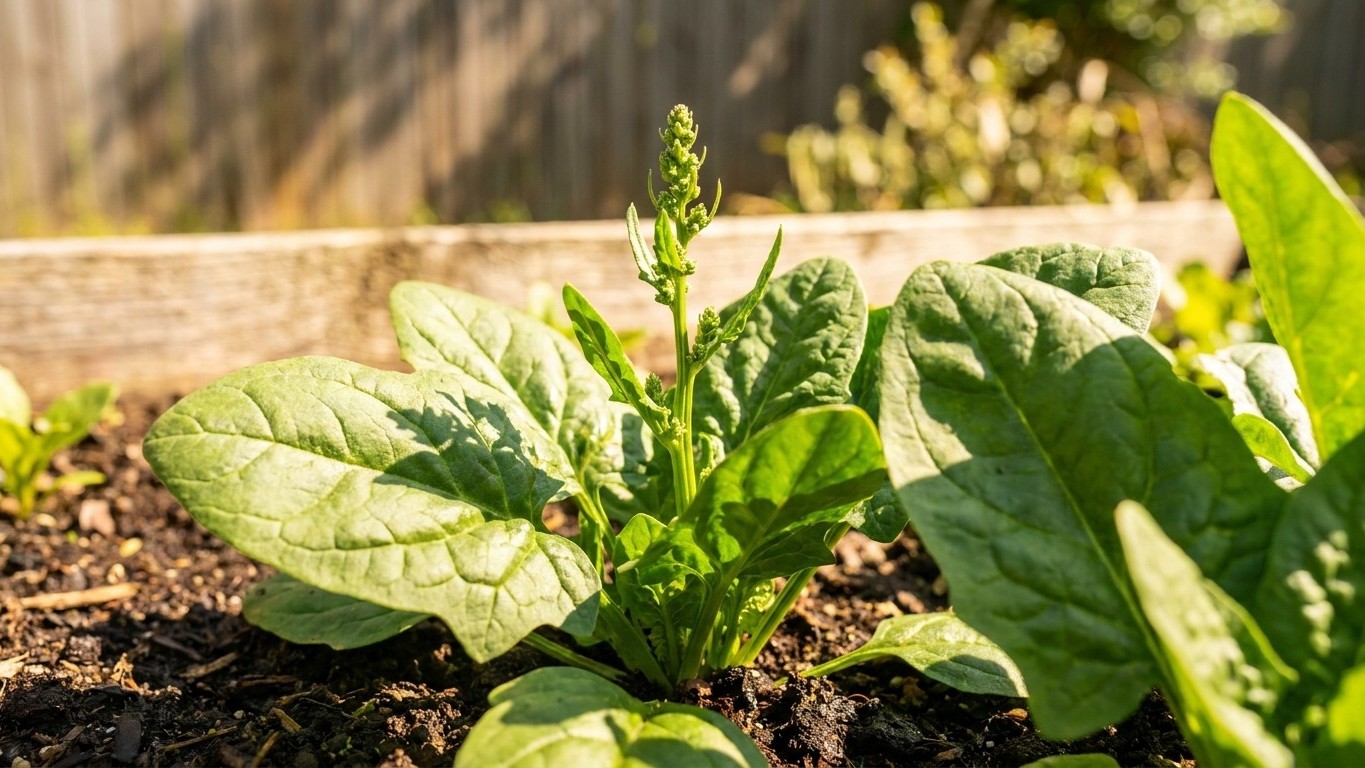

Not a bug, mostly. What eats a Vermont spinach crop is the calendar: a summer day that peaks at 15 h 22 of daylight, a growth ceiling of 75 F, and a first fall frost between October 3 and October 13. The sources behind this page cover timing, not pests, so timing is what follows. Every date below comes from Burlington’s numbers, and Growing Spinach in Vermont covers the rest of the crop.
The short answer
On the longest day of the year, Burlington gets 15 h 22 of daylight. That figure matters more than any thermometer reading, because spinach bolts during long days and warm temperatures, according to Utah State University Extension. Long days alone are enough to start the flower stalk. A cool summer does not buy extra weeks.
Day length is the limit you cannot garden around
A cool July feels like it should help. Leaves stay sweet, the bed stays moist, and the plants look fine. But the flowering signal comes from the sky, not from the air. Once the days stretch toward that 15 h 22 peak around the June solstice, the plant is being told to make seed no matter how mild the afternoons are. Gardeners in the north sometimes assume their cool summers extend the season the way they do for lettuce in a lower, hotter state. They do not extend it for spinach. For a closer look at the early warning signs, see Will Spinach Bolt Early in Vermont?
Heat is the second limit, and it sits lower than you think
Spinach grows best where temperatures do not exceed 75 F. Burlington averages only 5.4 days a year at 90 F or more, a mild summer by national standards (Lake Champlain helps). That number can mislead, though. The spinach ceiling sits 15 degrees below the 90 F mark, so a summer can be easy by the 90 F measure and still be well past what spinach likes. And 75 F does two jobs at once: it is where growth stops being good, and it is where leaves turn bitter. It is a temperature, never a calendar date.
So the answer to which limit applies here is both. Day length sets the outer wall in late June. Heat can close the window sooner. And the frost dates used on this page, April 30 to May 10 for the last spring frost, belong to Burlington, the mildest corner of the state. The Green Mountains and the Northeast Kingdom run substantially shorter.
How long the spring window really is
Spring spinach is a sprint. Sowing starts 2 to 3 weeks before the last frost, and good growth ends when the weather passes 75 F. Counting what sits between those two points for Burlington works like this.
- The window opens. With the last spring frost falling between April 30 and May 10, sowing 2 to 3 weeks ahead lands between about April 9 and April 26. Seed goes into cold ground, which suits spinach, since germination only drops when soil climbs above 80 F.
- The frost gap. Three weeks before April 30 is April 9. Two weeks before May 10 is April 26. Seedlings sit through the last freezing nights before any warmth arrives, and the early sowing gets the longest runway.
- The heat ceiling. Growth stops being good above 75 F. The date when Burlington’s afternoons settle above that mark is not published in the data behind this page, and guessing at it would be inventing it. A thermometer in the shade next to the bed will tell you more than any guess.
- The hard stop. The solstice, around June 20, is the day length peak at 15 h 22. Counting from April 9 to that date gives about ten weeks. From April 26 it is about eight. Those are the outer edges, and the usable spring is shorter because the heat ceiling arrives first.
- The harvest count. No days-to-maturity figure for spinach is published in the source, so a first-cut date cannot be calculated here without borrowing a number from another crop. Four varieties are named in the source: Bloomsdale, Melody, Teton and Olympia. The data on how each performs is not published.
What the count leaves out
Eight to ten weeks is a ceiling, not a forecast. A cold, wet April keeps ground workable but slows germination, and a warm May can push the 75 F mark forward without warning. The practical reading is that the early end of the sowing range does the most work. Seed that goes in during the second week of April has more weeks before the solstice than seed that goes in at the end of the month. Anywhere north or up in elevation, add days to every date, since the frost figures here describe the lake shore.
The autumn crop, and when the soil lets you sow
Autumn flips the problem. Days shorten after June, which removes the long-day trigger, and the question becomes when seed can germinate and whether the crop gets a few weeks of growth before frost. The source gives one rule for it: plant 50 to 75 days before the date you want to harvest. The sowing window for fall is covered in more depth in When to Sow Autumn Spinach in Vermont.
Obstacle one: the soil is still too warm
Counting back from Burlington’s first fall frost, October 3 to October 13, gives a start range. Fifty days before October 3 is August 14, and 75 days before it is July 20. From October 13, the range is August 24 back to July 30. So the arithmetic points to sowing from late July through late August, depending on how late a harvest you are willing to chase.
That is also when the ground is warmest. Seed germination is reduced above 80 F soil, and it is the warm soil, not cold, that blocks autumn sowing. A bed in full sun with dark mulch can read several degrees higher than the air above it. Vermont’s low count of 90 F days (5.4 a year) means the soil clears the threshold sooner than in hotter states, but the source publishes no date for it. A soil thermometer pushed 2 inches into the bed settles it. Watering the row and shading it until seedlings show are common ways to keep the seedbed cooler, though neither is covered by the source behind this page.
Obstacle two: the frost that ends the season
The other end of the count is the first fall frost, October 3 to October 13 at Burlington. That is the date the 50 to 75 day count works backward from. The fact that matters for a home gardener is that those are lake-shore dates. In the Green Mountains and across the Northeast Kingdom, the first frost comes earlier, which pulls the entire sowing window earlier too. A garden at elevation may need to sow in July to hit the same 50 to 75 day count that a Burlington garden meets in August.
Pick a harvest date you can live with, subtract 50 to 75 days, and check the soil. If the thermometer reads above 80 F on the sowing day, wait a few days. If the calendar says you are already inside the 50-day line, the crop has little room left.
Common questions
Does a cool Vermont summer keep spinach from bolting?
No. Spinach bolts during long days and warm temperatures, and long days alone are enough. With 15 h 22 of daylight on the longest day, Vermont summers are long-day summers regardless of how cool they feel.
What is the latest I can sow fall spinach?
Count back 50 to 75 days from the date you want to harvest. Against a first fall frost of October 3 to October 13 at Burlington, that is roughly July 20 to August 24. Earlier sowing is usually blocked by soil above 80 F, so check the soil first.
Which variety should I grow?
The source names Bloomsdale, Melody, Teton and Olympia. It publishes no data on any of them, so this page cannot say which resists bolting or tolerates cold better. Check the seed packet for the specifics.
How long does harvested spinach keep?
UC Davis puts the optimum at 32 F and 95 to 98 percent humidity, and says spinach will not maintain good quality for more than 2 weeks. That is a ceiling, not a plan. At the 41 to 50 F a fridge door typically holds, leaves yellow within days. The coldest spot is the back of the bottom shelf, so keep it there, not in the door.