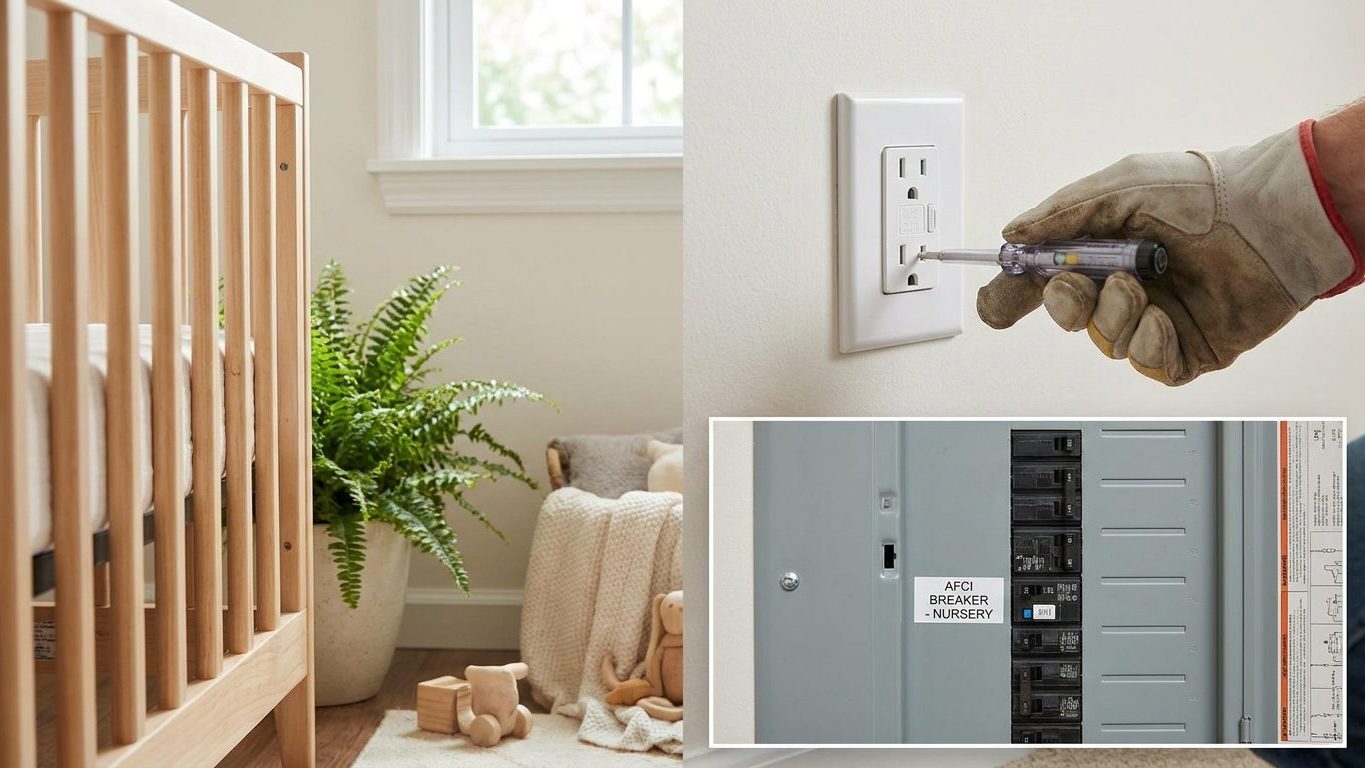

Every 15- and 20-amp receptacle in a nursery has to be tamper-resistant, with no exception for outlets mounted above a crib rail or behind a changing table. The spring-loaded shutter built into that receptacle, not a snap-in plastic cap, is what actually stops a toddler from working a hairpin or a fork into the slot. Check the face of every outlet in the room for the letters “TR” molded into the plastic before you assume it’s covered.
What the code requires in any modern bedroom

The 2020 National Electrical Code, section 406.12, requires that all 15- and 20-ampere receptacles installed in dwelling units be listed tamper-resistant. That figure is the ampere rating stamped on the device itself, the same rating found on almost every general-purpose outlet in a house. It’s not a nursery-specific rule. It covers the living room, the kitchen counter, the hallway, and every bedroom in a house wired under that code cycle, nursery or not.
Two separate requirements, not one
A second, unrelated requirement sits in the same chapter. Section 210.12(A) of the 2020 National Electrical Code requires arc-fault circuit-interrupter protection on the branch circuits that feed bedroom outlets. Tamper resistance is a property of the receptacle itself, physically blocking a foreign object. Arc-fault protection lives at the breaker or at the first outlet on the circuit, and it watches for the electrical signature of a damaged cord or a loose connection before it can start a fire. A nursery needs both, because a nursery is, electrically, just a bedroom.
Whether either rule actually applies to the house in front of you depends on which edition of the National Electrical Code your state or municipality had adopted at the time the room was wired. Adoption is local and it lags the national code cycle by years in some places, so a bedroom wired a decade ago may predate one or both of these requirements entirely. A permit record at the local building department, or a look at the panel and receptacles by a licensed electrician, is the only way to know which cycle applies to a specific room.
How a tamper-resistant receptacle works
Pull the cover off a standard old-style receptacle and the two vertical slots are just open air, connected straight to the hot and neutral bars behind them. A tamper-resistant version adds a pair of spring-loaded shutters directly behind the face plate, one for each slot, and they’re linked so that neither one moves unless something pushes on both at the same time and with roughly the same amount of force.
Why it takes two, not one
That’s the entire mechanism, and it’s built around a very specific failure it’s designed to prevent: a child pushing something narrow and metallic, a key, a hairpin, the tine of a fork, into a single slot. A standard plug does exactly what the shutters are checking for. It presses both prongs into both slots at once, at even pressure, because that’s how a two-prong plug is shaped. A single object pressed into one slot can’t satisfy that condition, so the shutter on that side simply doesn’t retract, no matter how hard or how long a kid works at it.
This is why the fix has to live inside the receptacle rather than on top of it. The hazard the rule addresses isn’t a plug being pulled out and left dangling, it’s a slot sitting open and energized in a room where a child spends unsupervised time on the floor, near the baseboard, at exactly outlet height. A tamper-resistant receptacle removes that open slot as a possibility at all times, plugged in or not, rather than relying on anyone remembering to put something back over it.
Why a plastic cap is worse than nothing
A tamper-resistant receptacle is built-in protection, part of the device itself, permanently in place every time the outlet isn’t in use and every time it is. A plastic outlet cap is the opposite of that: it’s a separate, removable object, and a removable object small enough to plug into an outlet is also small enough for a child to pull out, carry off, and put in their mouth. The 2020 National Electrical Code makes this comparison directly in section 406.12, which is the reasoning behind requiring the receptacle to do the job rather than an accessory added afterward.
Where this changes by jurisdiction
The tamper-resistant requirement is a construction rule, meaning it governs what goes into a wall when a room is built or rewired under the National Electrical Code. Whether a similar standard applies to a room after it’s already occupied, in a rental unit or an existing house that isn’t being renovated, is a separate question governed by property maintenance codes, most commonly the International Property Maintenance Code. The IPMC is not adopted everywhere the NEC is, and plenty of jurisdictions that require tamper-resistant outlets in new construction have no parallel requirement for existing rental housing. A trade habit of using outlet caps as a stopgap in an older rental is a convention, not a code requirement, and it isn’t enforceable anywhere on its own.
None of this means caps are useless as a temporary measure in a house that predates the requirement and isn’t being rewired soon. It means they shouldn’t be treated as equivalent to a tamper-resistant receptacle, and they shouldn’t be the reason a rewiring project gets put off. If a nursery is being set up in a room with standard receptacles, and an electrician is already being called in for any other reason, swapping those outlets is a small addition to that visit rather than a separate project.
Identifying TR receptacles in a house you did not build

The only reliable way to confirm a receptacle is tamper-resistant is to look at the device itself, not at the age or type of house around it. Newer construction doesn’t guarantee it, and an older house that’s had partial rewiring can have a mix of both types on the same wall.
What to check, room by room
- Look for the letters “TR” molded into the face of the receptacle, between the two vertical slots. This marking is required on every listed tamper-resistant device and it’s the fastest confirmation.
- If the marking isn’t visible or the plate is painted over, a plug-in receptacle tester with a single blade engaged should meet resistance. A tamper-resistant slot will not accept one blade alone, even lightly.
- Check both the top and bottom halves of a duplex outlet. They share a yoke but each half has its own independent shutter mechanism, and a receptacle can occasionally have one half functioning and the other worn or damaged.
- Don’t assume a receptacle is compliant just because the house was built recently. Confirm with the marking or a tester rather than the construction date.
A room that will eventually hold more than a crib is worth checking over as a whole rather than outlet by outlet. If the nursery is going to become a child’s room with a loft or bunk bed down the line, the ceiling height rules for a bunk bed are a separate check worth doing at the same time, since both come up during the same room-planning conversation.
The extension cord that undoes all of it
An extension cord run under a cot or across the floor to reach a lamp or a monitor is exactly the situation the receptacle spacing rule in section 210.52(A) of the 2020 National Electrical Code exists to prevent. That section governs how outlets are distributed around a room precisely so that a cord across a walking path, or tucked under furniture where it can be pinched, chewed, or overheated unnoticed, shouldn’t be necessary in ordinary use.
What actually happens when the cord stays
In practice, the cord is the failure point almost every time, not the receptacle. A tamper-resistant outlet and an arc-fault breaker do nothing for a cord that’s been pinned under a crib leg for months, insulation slowly wearing thin against a hard edge. That’s the kind of damage nobody notices until the jacket has already frayed through, and it’s a far more common cause of a bedroom electrical fire than a bare receptacle slot ever is. A working smoke alarm in and around the room matters here too, and where smoke alarms have to go in and around a bedroom is worth checking against the same list as the outlets.
If a nursery genuinely needs more outlets than the wall provides, the answer is another receptacle installed by a licensed electrician, not a cord run across the floor or tucked under a rug. For anything beyond that, a local fire department will generally answer questions about cord and outlet safety directly, and a building or zoning office can confirm which code edition applies to the specific room.
Common questions
Do I have to rip out old outlets that aren’t tamper-resistant?
Not automatically. The tamper-resistant requirement in the 2020 National Electrical Code applies to new construction and rewiring done under that code, not retroactively to every existing outlet in an older house. Whether your local jurisdiction has a separate rule for existing rental housing is a property maintenance question, best confirmed with your local building department.
Can I use outlet covers on regular outlets instead of replacing them?
A plastic cap can work as a stopgap, but it isn’t equivalent to a tamper-resistant receptacle, and a cap is itself a small object a child can remove and put in their mouth. If an electrician is already coming for another reason, swapping the receptacles is usually a small add-on to that visit.
Is AFCI the same thing as GFCI?
No, they protect against different problems. Arc-fault protection, required for bedroom circuits under section 210.12(A) of the 2020 National Electrical Code, watches for the electrical signature of damaged wiring or a failing cord. Ground-fault protection is a separate system aimed at shock from water or grounding faults, and whether it also applies to a given nursery circuit depends on other things in the room, so it’s worth asking a licensed electrician directly.
How do I know if my breaker box even has arc-fault protection?
Look at the breakers themselves. AFCI breakers are usually labeled on the switch and have a test button on the face, similar in appearance to a GFCI breaker but wired differently. If you can’t identify it confidently from the panel, a licensed electrician can confirm which breakers protect which rooms in a few minutes.