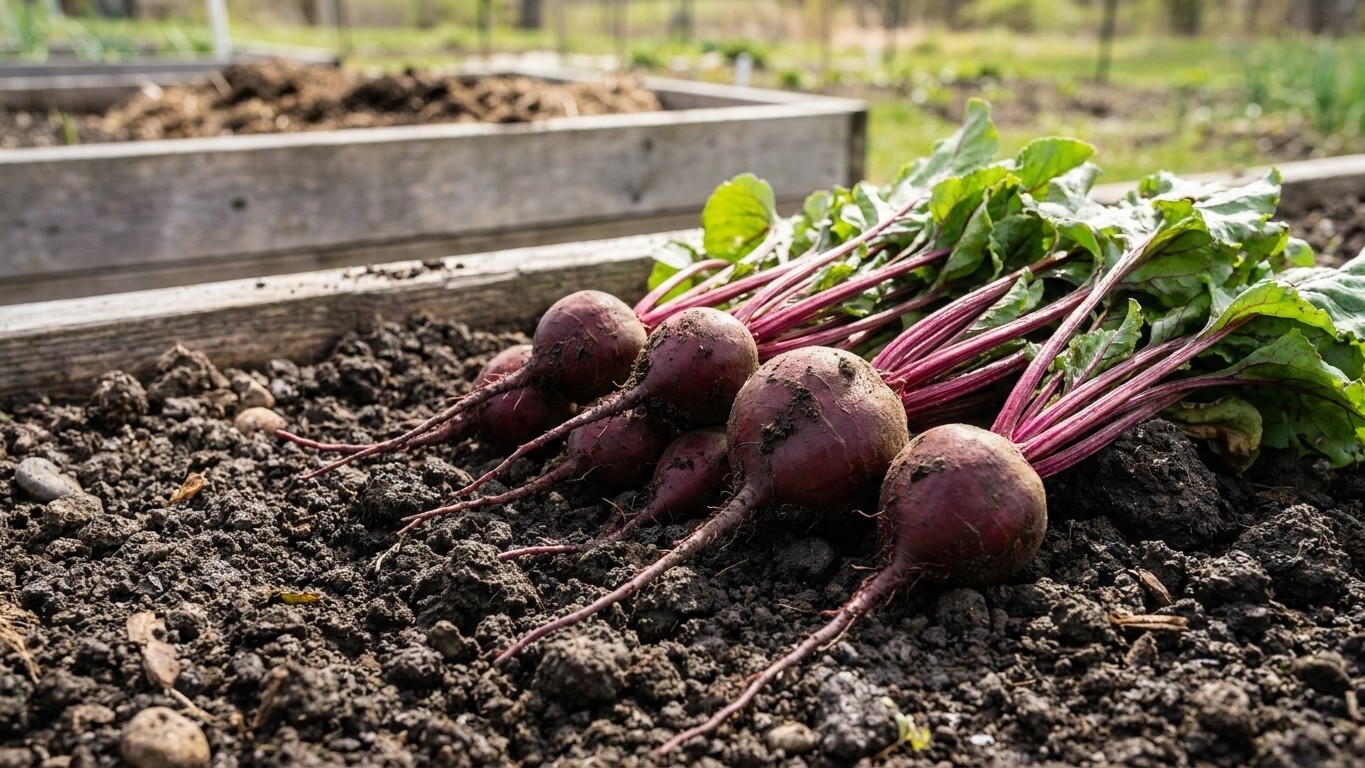

Pull Georgia beets 60 to 80 days after the seed goes in the ground, and pull them before heat above 85 F turns the root woody. For a spring sowing, that lands roughly between mid-April and early June. The second half of the answer surprises people. Once the roots are out, colder storage is not better. Topped beets keep best at 33 to 36 F, and the USDA’s storage handbook says 32 to 34 F brings more black spot and rot.
The short answer
Start with the ground, because it decides how forgiving the first weeks are. The soil USDA lists as representative of Georgia is the Tifton series, an Ultisol: an old, heavily weathered, leached soil that is naturally acid and low in nutrients. The surface layer runs 84 percent sand, 6 percent clay and 9 percent silt, with about 0.8 percent organic matter and a pH around 5.5, which is slightly acid. It is well drained. Those are USDA’s representative values for the mapped surface of the series, not a reading from a worked garden bed, and not your pH.
Set that against what Utah State University Extension says beets want: deep, sandy, well-drained soil rich in organic matter. Tifton delivers the sand and the drainage. It does not deliver the organic matter. At 0.8 percent, there is very little in the surface to hold water between rains. A beet in that ground drains well and rarely sits wet, but it can go thirsty fast. Utah State also caps compost at no more than 1 inch of composted organic matter per 100 sq ft, so the fix is a measured dose, not a heap.
One caution matters more than any number above. A state spans hundreds of soil series, and this one is a starting point, not a diagnosis. River bottoms, hill country and any lot a builder has scraped or filled will behave nothing like Tifton. A soil test gives your own number, and Beet Soil in Georgia: What the Root Will Meet walks through what to do with it.
Then there is heat. The figures behind this page do not include a count of the days a year Atlanta passes 90 F, so no number appears here. The threshold that matters in the Utah State guidance is lower anyway: heat above 85 F combined with water stress makes the root woody. Georgia’s late spring and summer clear that line routinely. Woodiness is a late-season failure, a problem of roots left in the ground too long as the weather warms. It has nothing to do with the early flowering that dry weather causes in the first six weeks. Two different failures, two different calendars.
The pulling window follows from the sowing date. Beets are sown in place, so the 60 to 80 days count from seeding, never from a transplant. Sow in late winter, and you pull in spring ahead of the heat. Sow late, and the last weeks of growth run straight into it. For the full growing picture, see Growing Beets in Georgia.
The six weeks that decide it here
NOAA NCEI’s climate normals, from the Atlanta station, put the last spring freeze between March 11 and March 29 (that is the 30 to 70 percent probability band at 32 F). Sowing 2 to 3 weeks ahead of it means seed goes in from about February 18 at the earliest to about March 15 at the latest. The first six weeks of growth then run from late February or March into April, ending somewhere between about April 1 and April 26.
That stretch is where Georgia’s spring does its swinging. A cool, wet week can give way to a warm, breezy, dry one within days, and the pattern rarely repeats from one year to the next. Sandy, well-drained ground amplifies the swing. Water that arrives with a front drains through the surface quickly, and a dry week afterward pulls the top few inches down to dust. With so little organic matter to buffer it, a seedling can go from comfortable to stressed faster than the forecast suggests.
The bolting risk sits right there. Utah State is plain that water stress in the first 6 weeks causes premature flowering. A plant that flowers early puts its energy into a seed stalk instead of a root, and a bolted beet is not one you can fix later. So for the earliest sowings, the danger weeks fall in March and early April. For the latest sowings, they fall in mid-April and on into the month. Whichever you pick, the rule is the same: do not let the bed dry out during those six weeks. A cheap rain gauge or a finger pushed two inches into the soil tells you more than the calendar does.
After the six weeks, the clock shifts from bolting to heat. A seeding on February 18 reaches 60 days around April 19. A seeding on March 15 reaches 80 days around June 3. The early end of that range comes ahead of the worst heat. The late end does not, which is why a late sowing is the one most likely to produce a tough, woody root. Do not read those dates as guarantees. Atlanta is an urban airport heat island. North Georgia and the mountains freeze several weeks earlier in fall, and the coastal plain runs milder, so your own last-frost date may sit well outside the March 11 to March 29 band. Shift the whole calendar to match.
Young seedlings are also a target for more than weather. What Eats Beet in Georgia, and When covers who shows up and in which weeks.
What goes wrong here
- Bolting after a dry spell. Sandy, low-organic-matter ground dries fast, and water stress in the first 6 weeks triggers premature flowering. Water deeply and on a schedule through that window, and keep a rain gauge in the bed. A thin mulch slows the drying.
- Woody roots in warm weather. Heat above 85 F with water stress makes the root woody, and this is separate from bolting. Pull the crop by the 80-day mark, or sooner, before the weather climbs, and keep water steady in the final weeks so the two stresses do not stack.
- Overcorrecting with compost. A thin soil tempts people to bury it. Stay at no more than 1 inch of composted organic matter per 100 sq ft, and use a soil test to see what the bed actually needs.
- Assuming the state soil is your soil. Tifton is a representative series, not your yard. Clay, fill, river-bottom ground and scraped subdivision lots all behave differently, so test first and adjust the plan to your own number.
- Counting from the wrong date. The 60 to 80 days run from seeding, since beets are sown in place and not transplanted. Write the sowing date on the row marker, then count forward.
- Storing bunched beets too long. Bunched beets with leaves keep only about 10 to 14 days at 32 F and above 98 percent relative humidity. Top them first, as soon as they are out of the ground, and store the roots by themselves.
- Chilling the roots too hard. Topped beets want 33 to 36 F and 98 percent humidity. USDA’s handbook states that storage at 32 to 34 F brings more black spot and rot than a little warmer. Check the real temperature with a thermometer, because a refrigerator’s dial is not a reading.
- Saving the small roots. Large roots keep much better than small ones because they lose water and shrivel more slowly. Eat the small ones first and keep the big ones for storage.
Common questions
How many days from seeding until I can pull beets in Georgia?
Plan on 60 to 80 days from seeding. Because beets are sown in place, the count starts the day the seed goes in, not when the seedlings have leaves. For a late-February to mid-March sowing, that works out to roughly April 19 through June 3.
Can I leave beets in the ground as the weather warms?
You can, but the root pays for it. Heat above 85 F combined with water stress makes the root woody. The figures behind this page do not include a count of the days a year Atlanta passes 90 F, so there is no safe number of extra days to quote. The practical answer is to pull on schedule, not wait for them to get bigger.
Is colder really worse for stored beets?
Yes, within limits. USDA Agricultural Handbook 66 (The Commercial Storage of Fruits, Vegetables, and Florist and Nursery Stocks) says topped beets belong at 33 to 36 F and 98 percent relative humidity. It also says storage at 32 to 34 F produces more black spot and rot than a little warmer. For pits and cellars, it gives a range: not below 31 F and not above 41 F.
Which beets should I store, and which should I eat?
Keep the big ones. Large roots lose water and shrivel more slowly, so they keep much better than small ones. Eat the small roots first, and cook the greens within a few days of pulling, since bunched beets with leaves hold only 10 to 14 days. Topping them first is what gets the roots into the longer storage window at all.