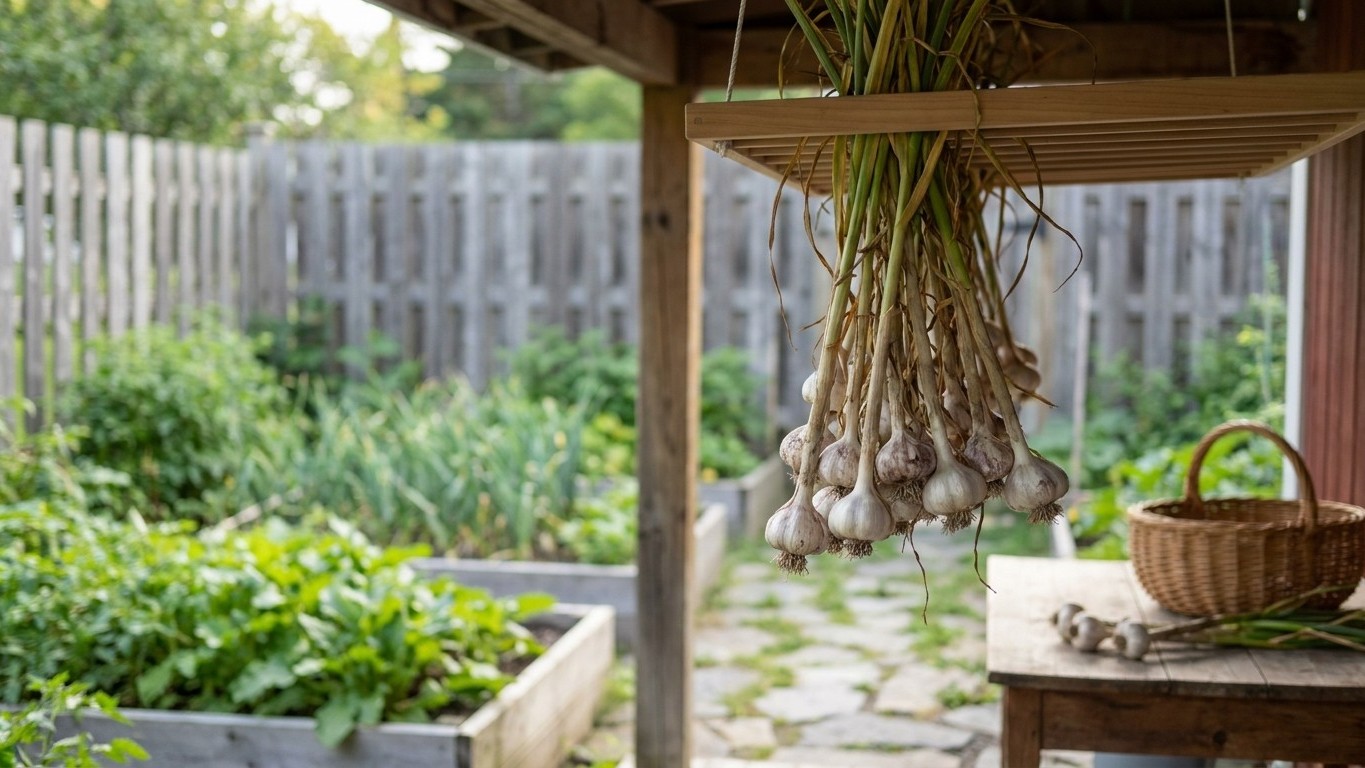

Garlic has a reputation as the bug-proof crop, and in Georgia that reputation is only half earned. Few insects chew the leaves, but the bulb faces trouble at every stage. Squirrels and wireworms go after cloves in the ground over fall and winter. Thrips and nematodes show up as spring warms. Mites move in when bulbs sit in wet soil or storage. Each threat has its own season, and the calendar starts at planting.
The short answer for Georgia
The pest calendar is anchored on the first fall freeze, which for Atlanta’s long-term weather station falls between November 13 and December 1. That range is the 30 to 70 percent probability band for a 32F freeze in the NOAA NCEI 1991-2020 Climate Normals (station USW00013874). Garlic goes in around that window in autumn and comes out the following summer, so everything that eats it happens somewhere between those two bookends.
Treat the date as a midpoint, never a safe date. In one year out of two, the first freeze lands later than the date you are counting from. A warm November can push the first hard freeze into December, and cloves planted into soil that has stayed warm are exposed longer to soil-dwelling pests before the ground chills.
The Atlanta station also comes with a built-in bias. It sits at an urban airport, which is a heat island, so its freeze dates run later than the countryside around it. North Georgia and the mountains freeze several weeks earlier in fall, while the coastal plain runs milder. Pest timing slides along with those dates, because insects and nematodes respond to soil and air temperature, not to the calendar on your kitchen wall.
The sequence is the same almost everywhere in the state. Fall brings diggers and soil borers, winter brings gnawing rodents under mulch, spring brings thrips and a nematode-driven decline, and early summer, when bulbs are lifted, brings mites and storage rot. Which of those hurts most depends on how far your garden sits from the Atlanta numbers.
Working it out for your own garden
You can redo the arithmetic for any Georgia address in three steps. First, find your local first fall freeze date. Second, work out how far it sits from Atlanta’s window. Third, shift every pest date by the same amount. The pests do not follow the month on the calendar. They follow your soil temperature, and the first freeze is the best proxy a home gardener has.
Here is a made-up example to show the math. Say your county in the foothills typically freezes three weeks ahead of Atlanta. Subtract 21 days from November 13 and from December 1, and your planting window becomes roughly October 23 to November 10. Every other date moves with it: the weeks when cloves are rooting and most vulnerable to digging animals, the point when spring thrips start to build, and the lifting date the following summer. If instead you garden on the coastal plain and freeze later than Atlanta, add days rather than subtracting them.
Elevation, the coast and, to a lesser degree, large bodies of water move these dates by about two weeks either way. Georgia has no Great Lakes-style moderating effect, but big reservoirs can take the edge off cold snaps right at the shoreline. The coast, with its ocean-warmed air, pushes freeze dates later and stretches the season in which pests stay active. Plan for that two-week swing and you will rarely be caught off guard.
Matching the pest to the stage
Once you have your shifted dates, line the threats up against the growth stages. Cloves in the first weeks after planting are a target for squirrels, which dig where the soil has been freshly turned, and for armadillos rooting for grubs in the same bed. Wireworms and white grubs in the soil can bore into cloves, particularly where the bed was recently sod or turf. Through winter, voles and mice use a thick mulch layer as cover and may chew cloves or young shoots.
Spring is when sap-feeding and root-damaging pests catch up. Onion thrips are tiny insects that rasp the leaf surface, leaving silvery streaks, and they multiply as nights warm. Stem and bulb nematodes work unseen in the soil, and the symptom is twisted, stunted plants with swollen, distorted stems. By the time you see it, the bulbs underneath are usually compromised. If you grew garlic or onions in the same bed last year, the risk goes up.
Planting date and variety interact with all of this, since a variety that bulbs early gets out of the ground sooner. Our guide to When to Plant Garlic in Georgia: Counting Back From the First Frost walks through the dates in more detail, and Garlic Varieties That Suit Georgia Winters covers which types handle the state’s mild winters.
What changes across Georgia
Georgia is several growing regions stacked into one state, and the pests shift with them. The mountains and higher ridges in the north have the earliest freezes and the longest cold spells, so soil insects shut down early and rodents under mulch become the bigger concern. The Piedmont, which includes metro Atlanta, is the middle ground the NOAA figures describe, though the city’s heat island makes its own freeze dates later than the surrounding suburbs and farms.
The coastal plain, which covers the southern half of the state, has milder winters and, in many areas, sandy soils. Both factors favor nematodes and keep thrips and soil insects active later into the season. The immediate coast is the mildest of all, and gardeners there often find that pests never fully pause.
| Region | Freeze timing compared with Atlanta | Pest pressure to expect |
|---|---|---|
| North Georgia mountains | Several weeks earlier | Rodents under mulch; soil insects stop early |
| Piedmont and metro Atlanta | November 13 to December 1 at the airport station; cooler outside the city | Squirrels, thrips in spring, bed-to-bed nematode carryover |
| Coastal plain | Milder, later freezes | Nematodes in sandy soil; longer thrips season |
| Coast | Mildest, latest freezes | Little winter pause; mites and rot in humid conditions |
Gardeners elsewhere will notice the contrast. In Hawaii, with no frost to count back from, the logic is different, and our page on When to Plant Garlic in Hawaii: Counting Back From the First Frost and the companion piece on Garlic Varieties That Suit Hawaii Winters show how a mild climate rewrites the rules. If you are working through the whole state, start with the overview Growing Garlic in Georgia.
The mistakes this climate punishes
The most expensive error in a mild-winter state is planting a hardneck variety that never gets the cold it needs. The plant limps along, makes a small bulb, and a stressed plant is a more attractive target for thrips and for rot. Choosing a type matched to Georgia’s winters is a pest-control decision as much as a yield decision.
Second is planting too early. In a warm fall, cloves go into soil that has not cooled, send up green shoots ahead of schedule, and spend months exposed to digging animals and insects when they should be dormant underground. Waiting until your own first-freeze window has opened, adjusted for your elevation or coastal position, cuts that exposure. Remember that the midpoint is not a guarantee, and a late freeze means a longer wait in some years.
Third is the thick mulch that suits so many northern garlic guides. In Georgia’s mild winters, a deep straw layer can become a vole hotel. A lighter mulch, or one laid after the ground cools, gives rodents less cover. Where squirrels dig, a layer of wire mesh or row cover pinned over the bed for the first few weeks keeps them from unearthing cloves.
Fourth is replanting garlic or onions in the same bed year after year. Nematodes and soilborne disease persist in the soil, and Georgia’s mild winters do not knock them back the way a hard freeze can. Rotate the bed, and do not save seed cloves from bulbs that came out stunted or swollen.
Finally, there is the harvest. Georgia summers are humid, and bulbs left in wet ground after the leaves yellow invite mites and rot. Lift them when the lower leaves have browned, cure them in the shade, and store them somewhere dry. A bulb damaged by a spade is an open door for mites.
Checking this against your county
County-level freeze dates and local pest reports are the missing piece, since the NOAA figure describes one station. University of Georgia Extension has an office in every county, and the agents there know which pests are active near you and which varieties perform locally. They can also tell you how to have a soil sample checked for nematodes before you plant.
Common questions
Do deer eat garlic in Georgia?
Deer generally leave garlic alone because of its strong smell, though a hungry animal may trample a bed. The more common culprits in Georgia are squirrels digging up fresh cloves and voles chewing under mulch.
When are thrips a problem?
Onion thrips become noticeable in spring as the weather warms, which in Georgia means earlier in the south and later in the mountains. Watch for silvery streaks on the leaves, and shift your timing by how far your first freeze sits from Atlanta’s.
How do I know if nematodes are the problem?
Twisted, stunted plants with swollen or distorted stems are the classic signs. A county extension office can tell you how to confirm it with a soil sample, since several diseases look similar from above ground.
Is the Atlanta frost date safe for my county?
No. The November 13 to December 1 window is a midpoint for an urban airport station, so in half of all years the freeze comes later. North Georgia freezes several weeks earlier, and the coastal plain runs milder, so use your own county’s figures.