
The sources behind this page do not name a single insect, animal or disease that attacks asparagus in Missouri, and they give no dates for any of them, so there is no pest calendar below. Making one up would be worse than leaving the gap. What the sources do settle is the groundwork: whether Missouri’s typical soil drains, how much summer rain the bed gets, and when the crowns go in. Those three decisions come first, and they are the ones you can’t redo later.
The short answer
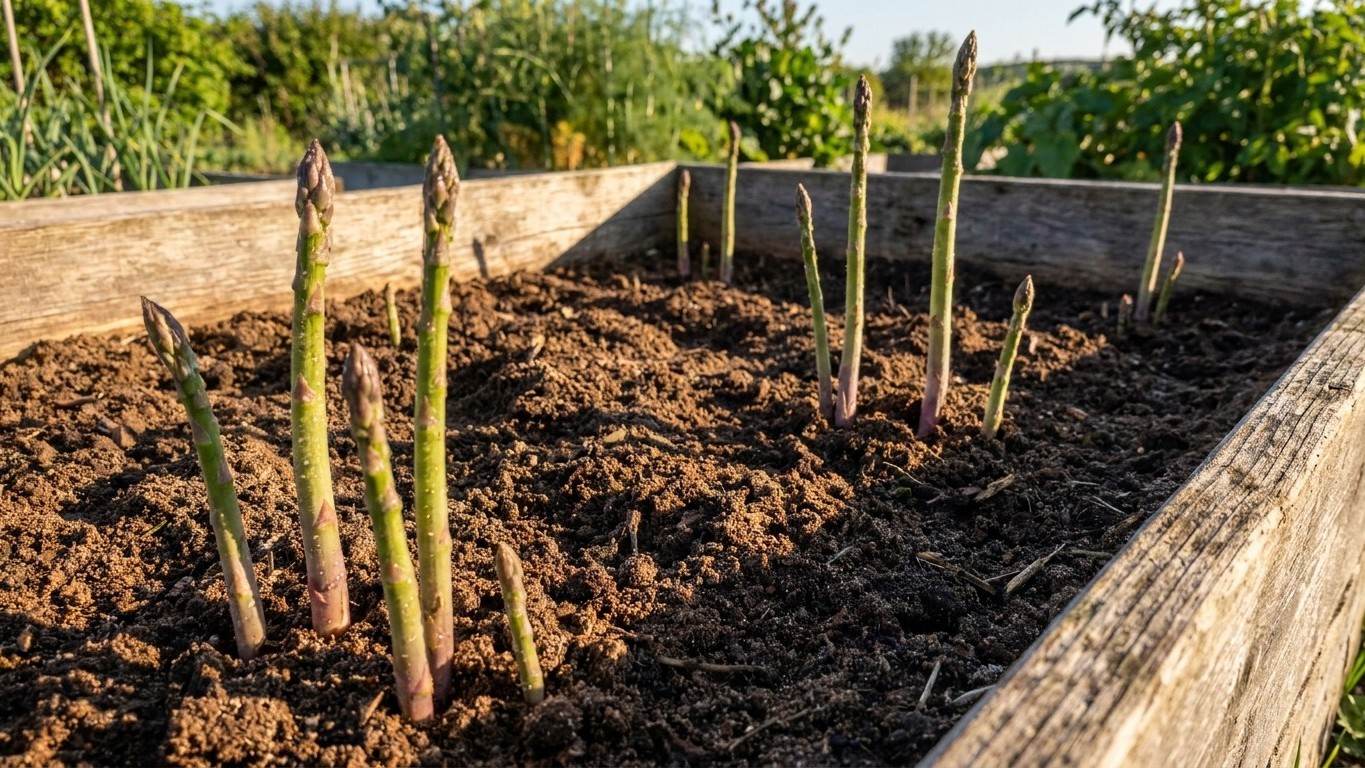
An asparagus bed is a fifteen-year decision. The crowns go into furrows 8 inches deep in early spring, nothing is harvested until year 3, and then the planting produces for 10 to 15 years. Utah State University Extension, the only authority behind this page, puts the soil requirement in one sentence: most soils will do, provided they are well drained. There is nothing about texture, fertility or fancy amendments. The ground has to drain.
Missouri’s state soil, the Menfro series, is a good sign. It is an Alfisol, a forest soil of moderate fertility that holds nutrients reasonably well. USDA’s representative surface values describe a loam to silt: 4 percent sand, 19 percent clay and 77 percent silt, with about 2.0 percent organic matter and a surface pH around 6.2, slightly acid. USDA classes it as well drained. Silt-heavy ground of that kind tends to let water move through instead of sitting on top, which is the behavior an asparagus bed needs for a decade and a half. So yes, the dominant soil here drains well enough on paper.
“On paper” is doing real work in that sentence. Menfro is the soil USDA lists as representative of Missouri, not the soil under every yard in the state. Missouri spans hundreds of soil series, and river bottoms, hill country and any lot a builder has scraped or filled can behave completely differently. The figures above describe the mapped surface layer of the series, not a worked garden bed. The 6.2 is not your pH. Asparagus’s source says nothing about soil pH, so I won’t hand you a target number. A soil test will give you your actual figure.
The easiest check costs nothing: after a heavy rain, walk the spot you have in mind. Water that is still standing a day or two later is a warning. A heavy or compacted site is a decision you can’t undo in a perennial bed. In an annual vegetable patch you would amend a bit more each season, but here the crowns sit in the same place for years, and you can’t dig a bed over without destroying it. If the site fails the walk-around, you have two honest choices. Pick a different spot, such as higher ground, a slope or a corner where water leaves instead of arriving. Or build the bed up above the surrounding ground so excess water has somewhere to go. Either one is far cheaper before planting than after.
More on the long-term side of the question lives in Will Missouri Soil Hold an Asparagus Bed for Fifteen Years?, and the overview of the whole crop sits in Growing Asparagus in Missouri.
Will the summer here water it for you?
Mostly, yes, on average. The reference station for these numbers, at Kansas City International Airport, records about 14.1 inches of rain across June, July and August, out of 39.3 inches for the whole year. By month that is 5.25 inches in June, 4.58 in July and 4.24 in August, which makes August the driest of the three. These are NOAA NCEI climate normals averaged over thirty years. They show what the region can usually expect, not a forecast, and not your garden.
The bed’s own appetite is modest: 1 to 2 inches every other week for the first two years, then every three weeks after that. Put the two side by side and the summer average works out to a bit over an inch a week, which is above what the bed asks for. Here is how to turn that into a watering routine.
- Put a rain gauge on the plot. A cheap straight-sided gauge beats any regional average. A slope, a city heat island or a storm track that favors the next county can all make your number differ from the airport’s.
- Count the inches you actually collected, not the rainy days. Summer rain here often arrives as one thunderstorm, and a hard downpour on hot ground partly runs off instead of soaking in. A 2-inch storm may deliver less than 2 inches to the roots.
- In years one and two, aim for 1 to 2 inches every other week. If the gauge shows that much from rain over a two-week stretch, leave the hose alone. If it shows less, make up the difference by hand.
- Watch the hot, dry stretches. Days at or above 90°F pull water out of the soil fast. August, at 4.24 inches, is the most likely month to need top-ups, and a dry spell can happen in any of them.
- From year three, stretch the interval to every three weeks. The same 1 to 2 inches applies. The established bed asks for less, and a summer that delivers near its normal rainfall will cover most of it.
How much you must add in a normal summer is therefore little, and in a dry one it is whatever fills the gap. Silt-heavy soil like Menfro is not sand, so it will not shed a soaking within the day, but it is not clay either. That mid-range behavior is part of why the state soil is such a comfortable match for a crop that dislikes sitting wet. The rain gauge settles it for good. After a season of readings you will know your plot better than any normal can tell you.
When to put the crowns in
Crowns go in during early spring, and in Missouri that means timing the planting against the last frost. NOAA NCEI’s normals put the last 32°F freeze at around April 6 to April 20 at the Kansas City International reference station, based on the 30 to 70 percent probability band. A mean frost date is an average, so some years it comes earlier and some later. Treat the window as a target, not a deadline.
Location shifts the window. That station sits well north of the city, and downtown Kansas City runs about five days earlier in spring. Southern Missouri is milder still, so a gardener near the Arkansas line is working with a noticeably earlier start than one in the northern counties. Pick the station nearest to you, not the state average, and expect to adjust by a few days either way. The details on timing, including how the weather in a given week should override the calendar, are in When to Plant Asparagus Crowns in Missouri.
Planting itself follows the furrow method. Dig the furrow 8 inches deep, set the crowns in it, and then do not fill it in at once. The furrow is backfilled gradually across the year, 2 inches every other month, not all at one go. Skipping that and filling it flat on planting day is the most common shortcut, and the source does not support it.
Four varieties are named in the source, and the only thing it says about them is their sex. Jersey Giant and Jersey Knight are all-male. UC 157 F1 and Purple Passion are male and female. No flavor, yield or reason to prefer one over another is published, so any claim that one is “the best” would be invented. I am also not naming a nursery, because the source does not either.
Seed is the alternative route to crowns. The source’s timeline (spring planting, no harvest until year 3) is written for crowns, and no seed calendar is published here, so I will not make one up. If you start from seed, expect to be earlier in the chain than a crown planter, which means the harvest clock begins from a different starting point. Confirm the details before you buy seed, since the numbers here will not do it for you.
Common questions
So what actually eats asparagus in Missouri, and when?
The sources used for this page do not say. They name no specific pest and give no dates for one. For a local answer, call your county Extension office, describe what you see on the spears or ferns, and ask what is active that month. A guess about timing can mean spraying for the wrong thing at the wrong time.
When can I harvest after planting crowns?
Not until year 3. Then harvest for 4 weeks, in the following year for 6 weeks, and after that for 8 weeks. Taking “a few spears” earlier is not what the source recommends. Stop each season when most spears are thinner than a pencil, which is a condition of the plants, not a date on the calendar.
How deep is the planting furrow, and when do I fill it?
The furrow is 8 inches deep. Backfill it gradually across the year, 2 inches every other month, rather than all at once.
How do I store spears after cutting?
Aim for 32 to 35°F with air that is nearly saturated, 95 to 100 percent humidity, according to UC Davis Postharvest. The window is narrow on both sides: above 50°F spears toughen within hours, and at about 31°F or lower they freeze and turn mushy when thawed. In a home kitchen, standing the cut ends in water, or wrapping them damp, is the practical way to get that humidity. Water loss through the cut end is the fastest way spears dry out.