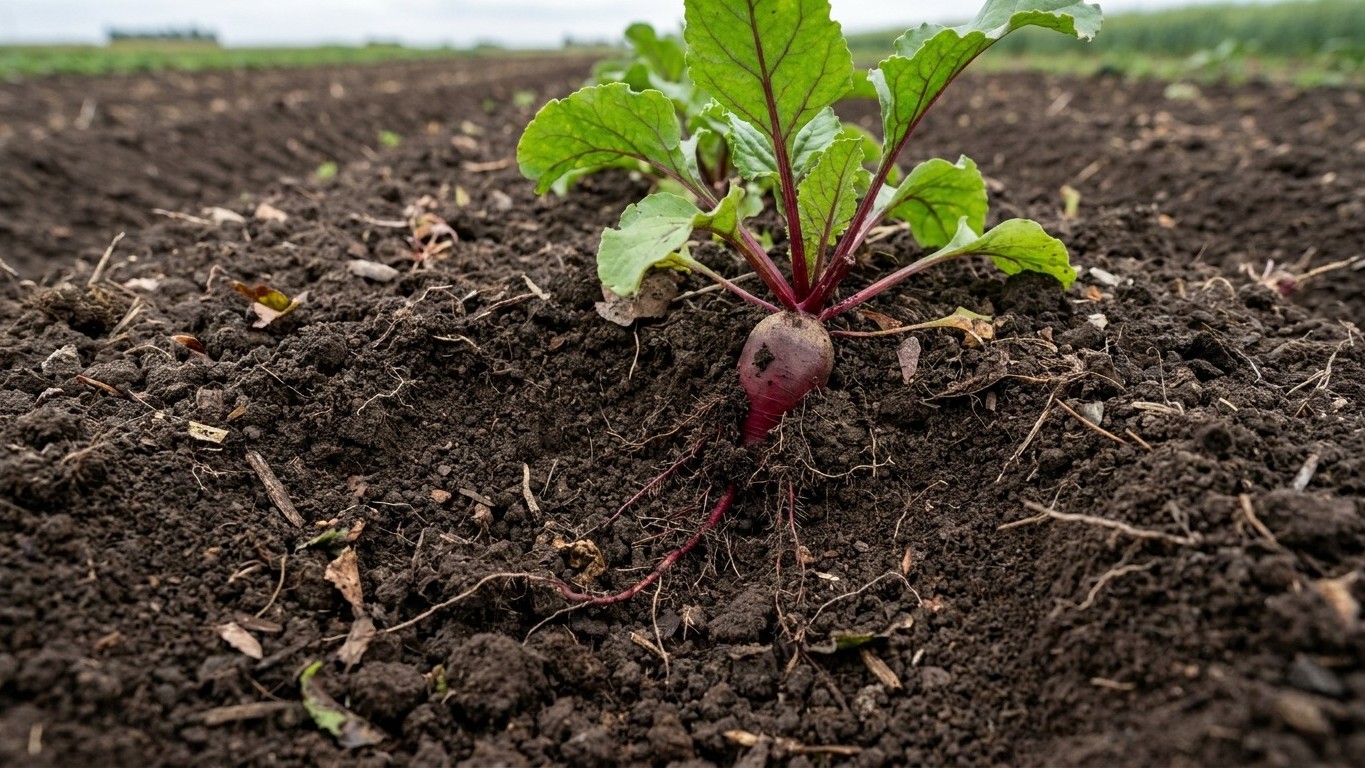

On this page, what eats a beet crop in Wisconsin is mostly weather and ground. Thirst in the first six weeks sends plants to flower. Heat above 85 F on dry soil turns roots woody. A storage room that is too cold invites black spot and rot. Leaf-chewing insects exist, but no pest calendar is published here, so this page sticks to what the soil and the season do to a beet, and when.
The short answer
Wisconsin’s official state soil is the Antigo series, an Alfisol, a forest soil of moderate fertility that holds nutrients reasonably well. USDA NRCS records its surface horizon as 20 percent sand, 10 percent clay and 70 percent silt, which makes it a loam to silt. Organic matter sits around 3.0 percent, surface pH is about 5.5 (slightly acid), and the drainage class is well drained. Those are representative values across 65 mapped components of the series, not a reading from anyone’s worked garden bed. A state this size spans hundreds of soil series, so treat Antigo as a starting point. River bottoms, hill country and any lot a builder has scraped or filled can be nothing like it.
Utah State University Extension describes the beet’s wish list as deep, sandy, well-drained soil rich in organic matter, amended with no more than 1 inch of composted organic matter per 100 sq ft. Antigo-type ground meets the drainage part and offers a middling organic matter figure. It is not sandy, though. With 70 percent silt, it tends to seal over after a hard rain, and a beet seedling has to push through that crust. The upside is that silt holds moisture between rains, a real buffer against the thirst that causes trouble early on. For the full picture of what the root meets underground, see Beet Soil in Wisconsin: What the Root Will Meet.
Heat and woodiness
How many days a year the reference city passes 90 F is not published here, and a guess would be worse than a gap. The number that matters to a beet is lower anyway. Utah State’s threshold is 85 F, and the trouble comes when that heat arrives together with water stress. The result is a woody root, tough and stringy in the middle. A count of 90 F days would understate the exposure.
Woodiness is a different failure from bolting. Bolting, premature flowering, comes from water stress in the first six weeks. Woodiness comes from heat later in the crop’s life. A grower can dodge one and still lose to the other, which is why “keep it watered” is not a complete plan. The calendar matters as much as the hose.
A well-drained silt loam helps with both, since it shed nothing it didn’t have to and stores what it gets. A lighter, sandier or gravelly patch of the same yard will dry faster and punish the same crop sooner. If you are unsure which ground you have, a soil test gives you your own numbers instead of the state’s. For the broader crop picture, Growing Beets in Wisconsin covers the full season.
The six weeks that decide it here
Beets are sown in place. There is no transplant to buy time, so the 60 to 80 days to harvest run from the day the seed goes into the ground, and the first six weeks of that clock are the ones that set up bolting.
The last spring frost falls between April 16 and April 29, according to NOAA NCEI climate normals, using the 30 to 70 percent band of 32 F freeze probabilities at the reference station. Sowing two to three weeks ahead of it means seed going in somewhere between about March 26 and April 15. Whether the ground is workable that early is a separate question, and When to Sow Beets in Wisconsin takes it on. The arithmetic alone puts the critical six weeks between roughly May 7 and May 27, counting from the earliest and latest ends of that window. Harvest then lands from about late May to early July.
Where the bolting risk sits
Wisconsin springs swing. Cold, soggy stretches give way to warm, dry spells, sometimes within the same week, and this page carries no rainfall figures to say how often. What the dates do tell you is where the exposure sits. The risk is a dry spell landing inside those six weeks, when seedlings are small and their roots are shallow. A wet April does not protect a May that turns dry.
Soil decides how much that dry spell costs. On Antigo-like silt loam, stored moisture carries seedlings through a few rainless days. On lighter ground, the same days can mean real stress, and Utah State is clear that stress in this window is what triggers premature flowering. A plant that bolts puts its energy into a seed stalk instead of a root, and no later watering undoes that.
Sowing early has a side benefit. A crop seeded in late March or April tends to be finished before the hottest weather arrives, which shortens its exposure to the later, separate failure of heat above 85 F. Sow late and you shorten the bolting window but walk the root into summer. Neither choice removes risk, it just moves it.
What goes wrong here
- Bolting in May. Water stress in the first six weeks after seeding triggers premature flowering. Remedy: water through dry spells from the day of sowing, and check the soil a few inches down rather than trusting the surface. A thin mulch after emergence slows drying.
- A crusted seedbed. Silt-heavy ground can seal after a downpour and trap seedlings. Remedy: keep the surface evenly moist until the seedlings are up, using light, frequent watering instead of one soaking that packs the top.
- Woody roots in summer heat. Heat above 85 F combined with water stress makes the root woody, a separate problem from bolting. Remedy: sow early enough to finish within 60 to 80 days from seeding, keep water steady when the heat arrives, and do not leave mature roots in the ground through July.
- Too much compost. More is not better here. Utah State caps the amendment at no more than 1 inch of composted organic matter per 100 sq ft. Remedy: stay under the cap and let a soil test, not habit, tell you what else the bed needs.
- Assuming the state’s pH is yours. The 5.5 figure belongs to the surface horizon of a mapped series, not to your bed. Remedy: test the soil you actually plant in, and treat Antigo as a rough guide only.
- Storing them too cold. Every other root crop on this site rewards colder storage, but beets do not. USDA Handbook 66 reports more black spot and rot at 32 to 34 F than a little warmer, and sets the target for topped roots at 33 to 36 F and 98% relative humidity. Remedy: top them first, since bunched beets with leaves last only 10 to 14 days. Keep the big roots for storage and eat the small ones first, because small roots lose water and shrivel faster. Lift fall roots ahead of your local first freeze, which comes later along the Lake Michigan shore, typically early October inland in the south, and far earlier in the north.
Common questions
When is the last spring frost for beets in Wisconsin?
NOAA NCEI climate normals put it between April 16 and April 29, based on the 30 to 70 percent band of 32 F freeze probabilities at the reference station. Your own yard may differ, especially near the lake or in the north. Sowing two to three weeks before that window is the usual target, which points to late March through mid April on the arithmetic.
Why did my beets flower instead of forming roots?
Water stress in the first six weeks after seeding is the cause named by Utah State University Extension. In Wisconsin that period typically falls in May, and a dry stretch then can trigger flowering even if the rest of the season is wet. It is a separate failure from woody roots, and watering later does not reverse it.
Why are my beets tough and woody?
Heat above 85 F combined with water stress makes the root woody. This is a later problem than bolting and has a different cause. Counting from seeding, beets mature in 60 to 80 days, so an early sowing tends to finish before the worst heat, and roots left in the ground into summer take the most risk. The number of days above 90 F at the reference city is not published here.
What is the right way to store beets from a Wisconsin garden?
Cut the tops off first. Topped roots keep best at 33 to 36 F and 98% relative humidity, because storage at 32 to 34 F produces more black spot and rot than a slightly warmer room does. Choose large roots to store and eat the small ones first, as they shrivel faster. Bunched beets with leaves last only 10 to 14 days. In a pit or cellar, USDA Handbook 66 says the temperature should stay between 31 and 41 F; the full text is in USDA Agricultural Handbook 66.