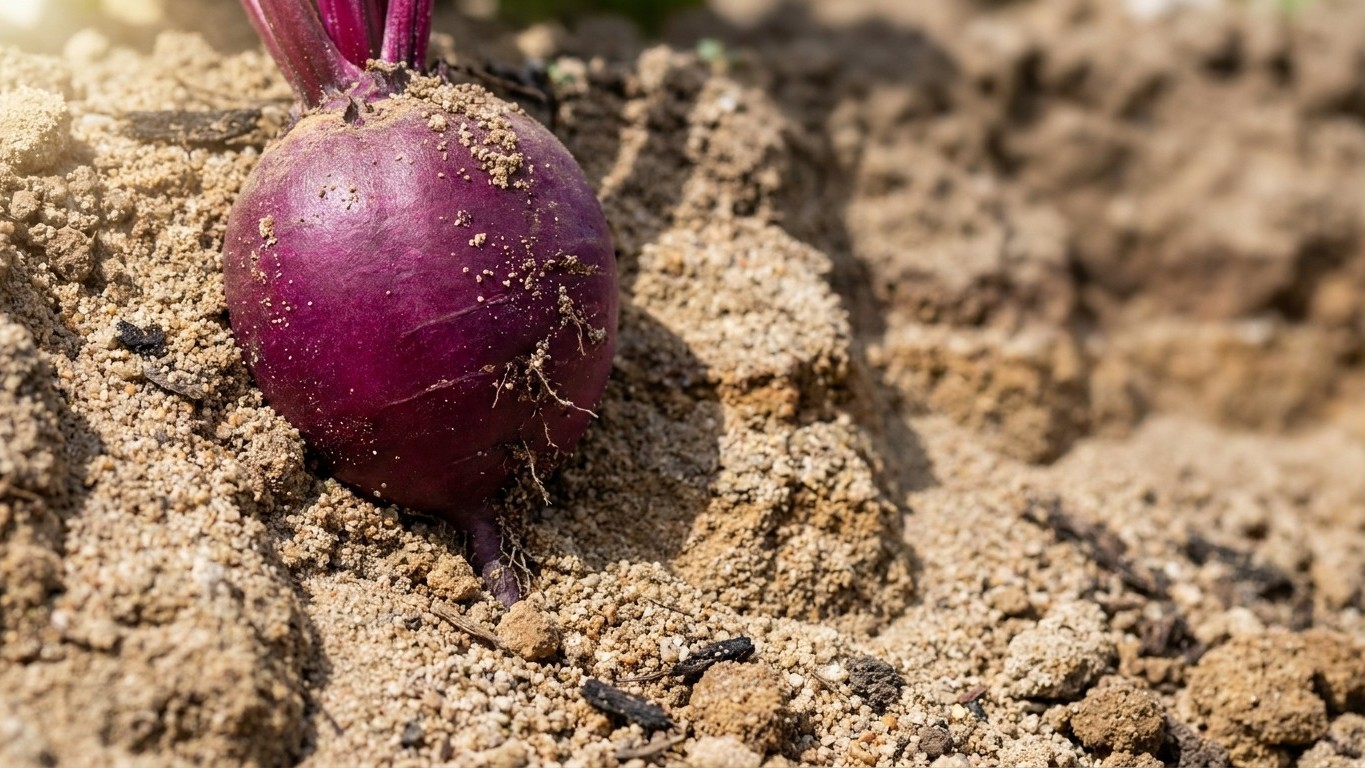

Pull beets 60 to 80 days after seeding, counted from the day the seed went into the ground, since beets are sown in place and never transplanted. In the Northwest Territories that points to early to late July for a crop sown in early May. The part most gardeners get wrong comes after harvest. Roots meant for storage keep best at 33 to 36 °F, not at the near-freezing temperature that suits many other root crops, and the USDA says so in plain words.
The short answer
Start with the ground, because it shapes both the timing and the risks. Agriculture and Agri-Food Canada’s soil survey (the Canadian Soil Information Service tables, 80 mapped surface horizons) puts the Northwest Territories’ commonest soil order at Cryosol. That is soil with permafrost inside the profile, thawing only to a shallow active layer each summer. It covers 99 percent of the mapped surface, with Regosolic soils making up most of the rest. The typical surface is loam to silt: 55 percent sand, 6 percent clay and 39 percent silt, with about 2.4 percent organic matter, and it is well drained. No median pH is published for the mapped surface, so there is no number to borrow here. Canada has no official soil series the way each US state does, so this is the dominant profile, not one named soil.
Now set that against what a beet asks for. Utah State University Extension describes the ideal as deep, sandy, well-drained soil rich in organic matter, amended with no more than 1 inch of composted organic matter per 100 sq ft. The sand share and the drainage class match well. With only 6 percent clay, the surface is unlikely to crust over the seedlings or sit waterlogged. The cost of that drainage is that the soil sheds water, which matters a great deal in the first weeks. Organic matter at 2.4 percent is workable, though it is no reason to pile on compost past that 1-inch limit. The one requirement this profile does not promise is depth, because a shallow thawed layer leaves a long root less room. The full picture is in Beet Soil in Northwest Territories: What the Root Will Meet.
Treat all of this as a starting point. The territory spans hundreds of soils, and the survey covers agricultural regions only, so the far north is not represented. River bottoms, muskeg and any lot a builder has scraped or filled can look nothing like the median. A soil test on your own bed is the only way to get your own numbers.
Heat is the second variable. The number of days a year Yellowknife passes 90 F is not published in the data behind this page, so no count appears here. The threshold that matters for the crop is lower anyway: Utah State University Extension says heat above 85 F combined with water stress makes the root woody. That is a late-season failure of the root itself, separate from the early-season bolting covered next. A well-drained soil makes the combination easier to trigger, because the water runs out faster when the weather turns hot.
The six weeks that decide it here
Beets go in 2 to 3 weeks before the last spring frost. Environment and Climate Change Canada’s climate normals for the YELLOWKNIFE A station (climate ID 2204100) give an average last spring frost of May 25. Count back and the sowing window opens around May 4 and runs to about May 11. That is a mean date, though, not a safe one. In one year out of two the last frost lands later than May 25, so the date is the midpoint of a window. The station sits in one corner of a very large territory, and northern or upland districts run weeks behind it. These are Canadian normals, built over a different reference period from the US figures elsewhere on this site, so don’t compare them number for number.
Where the bolting risk sits
The first six weeks after sowing are the stretch Utah State University Extension flags: water stress in that period causes premature flowering, which is bolting. Sown between May 4 and May 11, those six weeks run from mid-May to roughly June 15 through June 22. The page holds no spring rainfall figure for the territory, so I won’t claim to know whether a given spring runs dry or wet. What the soil tells us is enough to plan around. Snowmelt and thaw leave the ground wet at first, but a well-drained, sand-heavy surface dries from the top once the thaw is behind you, and the active layer below is shallow. A dry stretch in late May or early June is the likeliest place for early thirst to strike. Seedlings also face threats other than thirst, and What Eats Beet in Northwest Territories, and When covers the chewers.
Counting to harvest
Seed sown May 4 reaches 60 days on July 3 and 80 days on July 23. Seed sown May 11 reaches those marks on July 10 and July 30. A late frost year pushes everything back by the same number of days. Those are arithmetic guides from the sowing date, not promises, because cold ground slows germination. The variety on your seed packet matters too, though the source behind this page names five beet varieties and gives no season, color or use for any of them, so I won’t sort them for you. Use the days-to-maturity line printed on your own packet.
Pulling roots for eating can start at the front of that window. Roots meant for storage deserve more thought, which brings us to the failures.
What goes wrong here
- Bolting after early thirst. Water stress in the first six weeks sends the plant to flower and spoils the root. On sand-heavy, well-drained ground the bed dries quickly, so check moisture a few inches down through mid-June and water before the seedlings flag, not after.
- Woodiness from later heat. This is a different failure with a different cause: heat above 85 F together with water stress. Keep watering through hot spells in July, and don’t let roots sit past the 80-day mark in a dry heat wave.
- Too much compost. More than 1 inch of composted organic matter per 100 sq ft is over the limit Utah State University Extension sets. With 2.4 percent organic matter as the typical starting point, a soil test tells you whether the bed needs more at all.
- Storing roots too cold. The USDA’s Handbook 66 says more black spot and rot occur at 32 to 34 °F than at slightly higher temperatures. Topped roots belong at 33 to 36 °F and 98 percent relative humidity. In a pit (clamp) or cellar, keep the temperature from dropping below 31 °F or exceeding 41 °F. An unheated shed in the north can slide under that floor overnight, so put a thermometer in it.
- Storing roots with their leaves on. Bunched beets keep for about 10 to 14 days at 32 °F and above 98 percent relative humidity, and no longer. For anything beyond two weeks, cut the tops off first.
- Saving the small roots. Large roots keep much better because they lose water and shrivel more slowly. Eat the small ones first and put the big ones away.
The cold-storage item is the one that runs against habit. Advice for most root crops is to get as close to freezing as you can, and beets at 33 to 36 °F are an exception to that. The gap between 32 and 33 °F looks trivial on a thermometer, which is why it is easy to get wrong.
Common questions
How many days from seeding until I pull beets?
Plan on 60 to 80 days from seeding. Beets are sown in place, so the count starts when the seed goes into the ground, not at any transplant date. For the Yellowknife-based window of May 4 to May 11, that works out to July 3 through July 30.
Is colder storage better for beets?
No. USDA Handbook 66 reports more black spot and rot at 32 to 34 °F than at slightly warmer temperatures. Store topped roots at 33 to 36 °F with 98 percent relative humidity, and keep pits and cellars between 31 and 41 °F.
Which roots should I store and which should I eat first?
Store the big ones. Large roots lose water and shrivel more slowly, so they keep much better than small ones. Eat the small roots first. Top everything before storing, since bunched beets with leaves last only 10 to 14 days.
Is May 25 a safe date to plant?
It is an average last frost for the YELLOWKNIFE A station from Environment and Climate Change Canada, not a safe date. The frost falls later than May 25 in one year out of two. Beets are sown 2 to 3 weeks ahead of the last frost, and northern or upland districts run weeks behind the Yellowknife figure. For the wider crop picture, see Growing Beets in Northwest Territories.