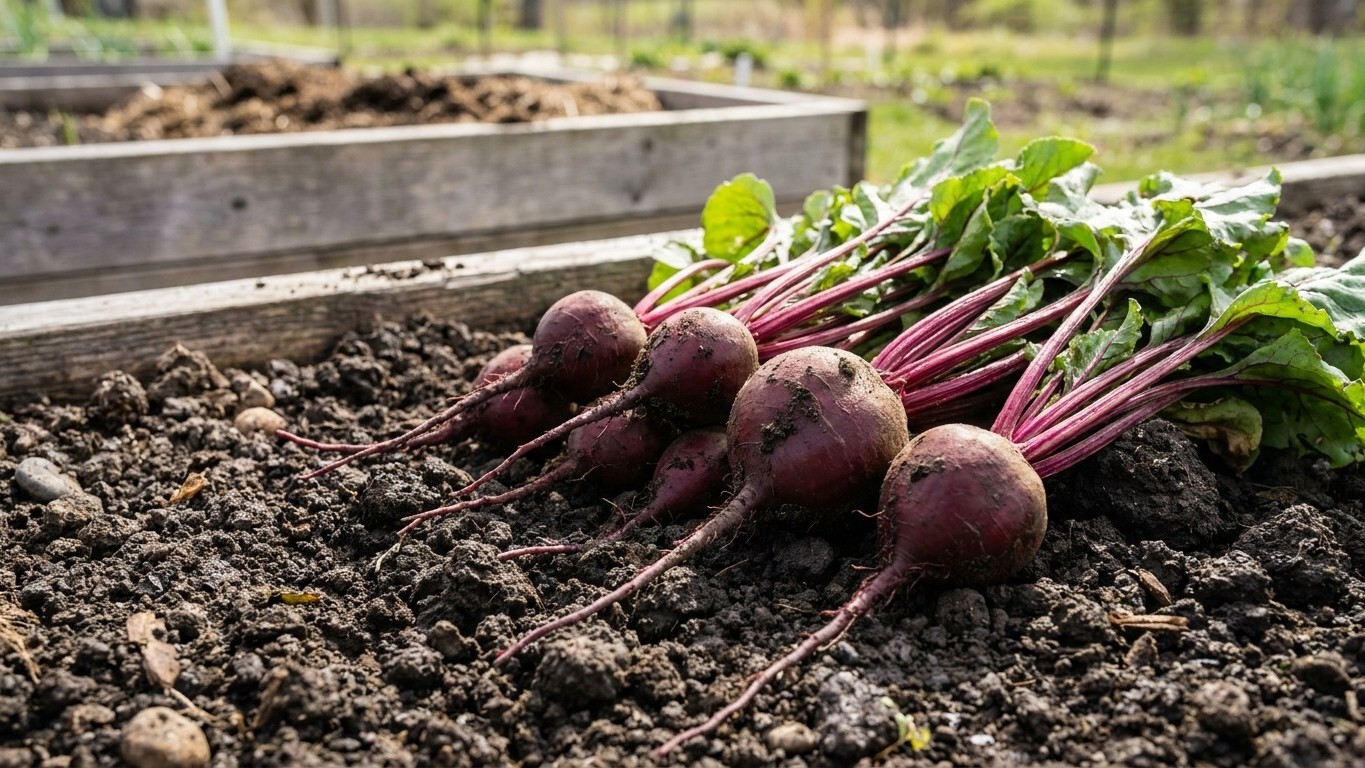

Pull Oklahoma beets about 60 to 80 days after seeding, which for a March sowing lands between early May and mid June, before summer heat toughens the root. Top them the day they come out, because leaves left on shorten storage to 10 to 14 days. Then store the roots at 33 to 36 F, not at the 32 F that works for most root crops. Beets rot and develop black spot faster at 32 to 34 F than a little above it.
The short answer
Oklahoma’s state soil is the Port series, a Mollisol: deep, dark prairie ground of the kind that built the Corn Belt. USDA’s representative surface values for it read 12 percent sand, 19 percent clay and 69 percent silt, which puts it in the loam-to-silt range. Organic matter sits at about 2.0 percent, the surface pH at about 7.0 (near neutral), and the drainage class is well drained. Those numbers come from USDA NRCS Soil Data Access, averaged across 93 mapped components, so they describe the mapped series and not a worked garden bed.
Set that against what a beet wants. Utah State University Extension describes beets as liking deep, sandy, well-drained soil rich in organic matter, with no more than 1 inch of composted organic matter worked in per 100 sq ft. Port matches on depth and drainage. It misses on sand, since 69 percent silt is a long way from sandy, and its 2.0 percent organic matter is modest. Silty ground drains well enough but holds a fair amount of water in the pores, and that matters for the thirst problems described below. The soil is a decent match with a few caveats. I wouldn’t call it a perfect one.
Heat is the other half of the picture. Utah State puts the line at 85 F: heat above that, combined with water stress, makes the root woody. The brief asked for the number of days a year the Oklahoma City reference station passes 90 F, and that count is not published in the figures behind this page, so I won’t guess one. What the 85 F threshold tells you is that woodiness starts below 90 F. Any Oklahoma gardener who has stood in a bed in late May knows how soon that arrives. A beet that is still in the ground when the afternoons climb past it, and is not getting steady water, is turning from tender to tough.
One caution before you build a plan on any of this. A state spans hundreds of soil series, and Port is a starting point, not a diagnosis. River bottoms, hill country and any lot a builder has scraped or filled will behave differently, some heavier, some sandier, some more alkaline. A soil test gives you your own pH and texture, and that beats any state average. For a closer look at what the root meets underground, see Beet Soil in Oklahoma: What the Root Will Meet, and for the broader growing picture, Growing Beets in Oklahoma.
The six weeks that decide it here
Beets are sown in place. There is no transplant stage, so the 60 to 80 days to harvest run from the day the seed goes in the ground. Sowing 2 to 3 weeks before the last spring frost is the usual advice, and the reference frost date gives you the calendar. NOAA NCEI’s U.S. Climate Normals put the last spring freeze at the Oklahoma City airport station between March 28 and April 10, in the 30 to 70 percent probability band for 32 F. Working back 2 to 3 weeks gives a sowing window of roughly March 7 to March 27.
Run the arithmetic forward and the first six weeks, the period Utah State flags as the one where water stress causes premature flowering, end somewhere between mid April and early May. That stretch of an Oklahoma spring is the part that swings. Warm, windy afternoons can dry a seedbed quickly, a cold snap can follow, and then a storm line drops an inch or more of rain in an hour, much of it running off. Dry spells between those storms are where the bolting risk sits. A beet that goes through two or three weeks of thirst in April can send up a flower stalk and put its energy there instead of into the root.
Count the same dates to the finish and the harvest window opens. Seed sown March 7 reaches 60 days around May 6. Seed sown March 27 reaches 80 days around June 15. So the spring crop comes out between early May and mid June, and the later sowings sit closer to the heat threshold.
Those dates belong to the reference station. Suburban and rural gardens usually see the last spring frost later than an airport does, often by one to two weeks, and more at elevation. If you are well outside the city, shift the whole schedule a week or two later and check your own county’s frost data before you commit seed. A later start also pushes harvest closer to the 85 F line, which is one more reason to keep the bed evenly moist from sowing onward.
For what comes after the roots size up, the pest calendar matters too. What Eats Beet in Oklahoma, and When covers it.
What goes wrong here
Bolting and woodiness are two separate failures with two separate causes, and “keep it watered” does not cover both. Here is how each problem shows up in Oklahoma ground and weather, with the fix.
- Bolting in April. Water stress during the first six weeks triggers premature flowering. Soak the bed deeply when rain skips a week or so, check the soil a few inches down instead of trusting the surface, and mulch lightly once seedlings are up so a windy dry spell does not strip the moisture.
- Woody roots in late May and June. This is a different problem, and it comes later. Heat above 85 F combined with water stress toughens the root. Pull the spring crop on schedule instead of leaving it to size up through the first hot stretch, and keep watering steady in the final weeks.
- Crusted seedbeds. Silt-heavy ground tends to seal over after a hard rain, and since beets can’t be transplanted, a poor stand means starting over. Keep the surface moist until seedlings emerge and break any crust gently with a rake tine. Test your own bed, because yours may be sandier or heavier than Port.
- Over-amended beds. With organic matter near 2.0 percent in the reference soil, the temptation is to pile on compost. Stay at no more than 1 inch of composted organic matter per 100 sq ft, per Utah State Extension.
- Storage that is too cold. USDA Agricultural Handbook 66 reports that at 0 to 1 C (32 to 34 F) more black spot and rot occur than at higher temperatures. The target for topped roots is 1 to 2 C, or 33 to 36 F, at 98 percent relative humidity. Colder is not better here, whatever you do with carrots or parsnips.
- Leaves left on. Bunched beets keep only about 10 to 14 days at 32 F and above 98 percent humidity. If you plan to store any, top them first.
- Storing the small ones. Large roots keep much better because they lose water and shrivel more slowly. Save the big roots for storage and eat the small ones first.
Pest damage is a separate list, handled in the pest guide linked above. The storage numbers come straight from USDA Agricultural Handbook 66, in the chapter by F. Adamicki.
Common questions
How do I know when to start counting toward harvest?
Count from the day you seeded, not from germination and not from any thinning date. Beets are never transplanted, so the 60 to 80 days always run from seeding. A March 7 sowing reaches 60 days around May 6, and a March 27 sowing reaches 80 days around June 15. Compare your own sowing date against those and against the days-to-maturity on your seed packet.
Can I leave beets in the ground to grow bigger?
Bigger roots store better, but waiting has a cost here. Heat above 85 F with water stress makes the root woody, and Oklahoma gets there fast. The figures behind this page do not say how long a mature beet holds in the ground, so I will not offer a number. If you want large roots for storage, keep the bed evenly watered and pull before the hot stretch, not after it.
Does the Port series description apply to my garden?
Only by luck. Port is the representative soil, and the 12 percent sand, 19 percent clay and 69 percent silt figures are USDA’s values for the surface of that mapped series. A state spans hundreds of series, and river bottoms, hill country and builder-scraped lots can differ completely. A soil test gives you a pH and texture you can actually plan around.
What is the right temperature for storing beets?
For topped roots, 33 to 36 F at 98 percent relative humidity. Do not chase 32 F: at 32 to 34 F the handbook reports more black spot and rot. A pit or cellar should stay between 31 F and 41 F, so a thermometer is worth the few dollars before you trust any spot with a crop.