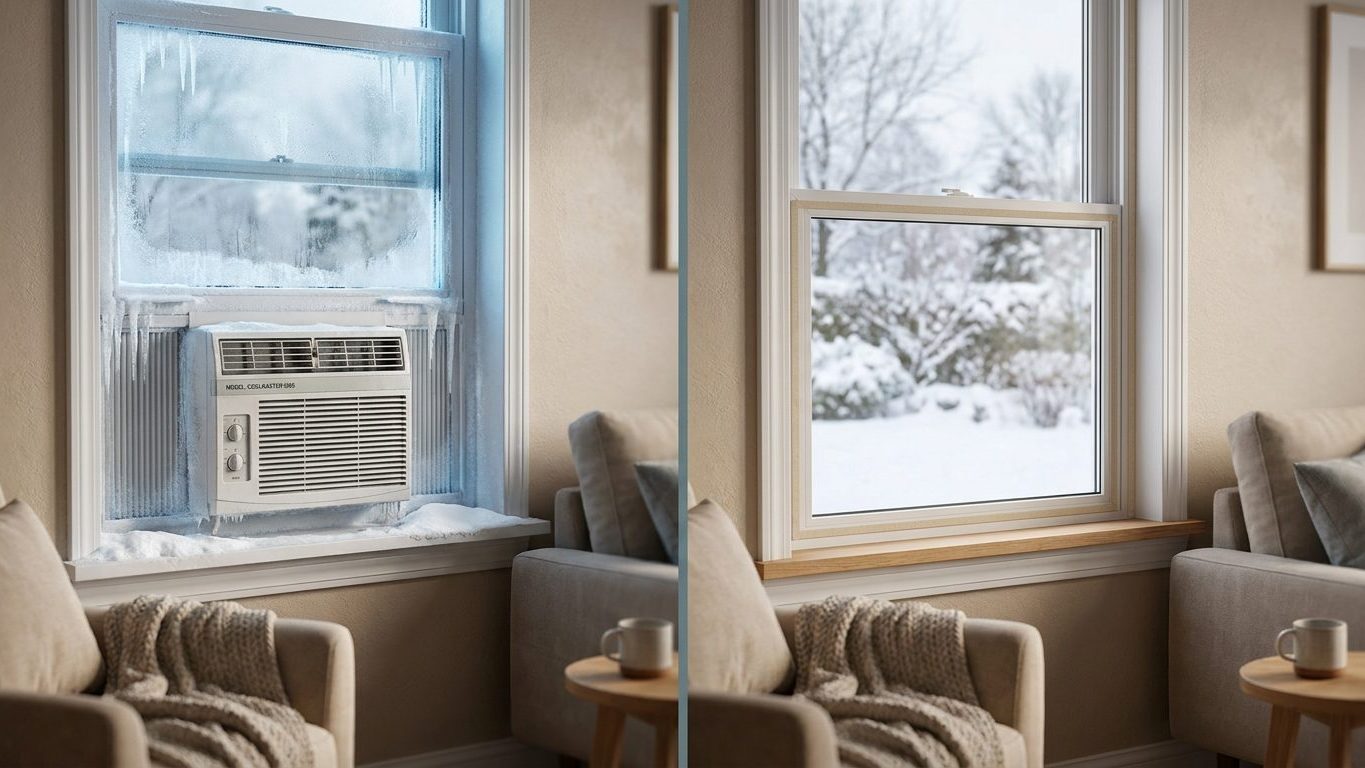

Short answer: taking a window air conditioner out for winter is the safer choice for the window itself and for the unit’s lifespan, but leaving it in place is workable if you seal it properly, both outside and in. Climate, how often the room gets used in winter, and whether you have a dry place to store the unit all tip the decision one way or the other.
The decision, honestly
Neither choice is free. Pulling the unit means a sealed window and no draft, but it also means physically lifting a heavy box twice a year and finding somewhere dry to keep it. Leaving it in means skipping the lift, but the unit becomes a permanent cold bridge sitting in your wall, and even a good cover only reduces the air leak around it, it doesn’t erase it.
| Choice | What it costs you |
|---|---|
| Take it out | Fully sealed window, no draft, unit shielded from rain, ice, and UV. Cost: lifting it twice a year, plus finding indoor storage. |
| Leave it in | No lifting, no storage needed. Cost: a cold spot at that window all winter, some air leakage even with covers, and the condenser exposed to weather unless it’s covered outside too. |
A few situations make the answer fairly clear. A unit in a second-story window, wrestled up there alone every spring, is a strong argument for leaving it put, since the removal itself is where most of the real risk lives. A guest room that sits closed off from November through March is the opposite case: there’s no reason to keep a cold bridge in a wall nobody’s warming. A milder climate, say coastal Georgia or the Carolinas, makes leaving it in a lot less costly in heating dollars than the same decision in Minnesota or Vermont, where that gap around the unit can turn into a real draft on a windy night.
Storage space matters more than people expect. A unit with nowhere dry to sit, a garage that floods in spring or an attic that swings from freezing to sweltering, is often better left exactly where it is, weatherproofed as best you can, than moved somewhere that will hurt it more than winter would. The honest version of this decision isn’t about which choice is objectively better. It’s about which set of costs, lifting and storing versus draft and exposure, fits your house and your back.
Taking it out safely
If you’re going the removal route, the order matters more than most people assume. Skipping steps is how units get dropped or how sashes come down on fingers.
- Get a second person before you touch the unit. Window air conditioners are heavier than they look, and the point where most injuries happen is the lift itself, not the carrying. Judge the weight first, get your grip and your footing settled, then move it, and never lean out the window to take the load, let it come to you.
- Drain any standing water before it comes inside. Tilt the unit slightly toward the outside first, over a towel or into the yard, so the water in the base pan doesn’t end up on your floor or, worse, inside the unit’s housing during transport.
- Remove the sash support or brackets holding the window frame against the unit. These are usually a bar or foam strip wedged between the sash and the top of the AC housing.
- Raise the window sash the rest of the way and hold it. This is the single riskiest moment in the whole process: once the sash is up, the unit is no longer supported by the frame, and it’s sitting on nothing but whoever is holding it. Have your second person ready to take weight the instant the sash clears.
- Lift the unit straight up and in, rather than pulling it toward you at an angle. Pulling puts uneven strain on both people and increases the odds of losing your grip partway through.
- Set it down on a stable, flat surface right away rather than trying to carry it further while off balance. Let it sit a minute before moving it to wherever it’s going for storage.
None of this requires special tools. It requires two people, a plan for where the unit lands, and treating that moment when the sash goes up as the part of the job that deserves your full attention.
Storing it so it works in June
How a unit spends the winter decides a lot about how it starts up in early summer. A few habits make the difference between a unit that runs fine on the first hot day and one that struggles, runs rough, or needs a repair call before it’ll cool anything.
- Let it dry out completely before boxing it. Any moisture left in the housing sits there for months, which is exactly the kind of environment that invites rust on metal fins and mildew on foam gaskets.
- Store it upright, never on its side. A compressor holds a reservoir of oil at its base, and that oil needs to stay where it belongs. Tip the unit on its side for an extended period and the oil can migrate into the refrigerant lines, which leads to a rough start, poor cooling, or in worse cases a compressor that struggles to run at all.
- Keep it off a damp concrete floor. Basements and garage floors hold moisture and cold in a way that works against everything you just did to dry the unit out. A wooden pallet, a shelf, or even a couple of scrap boards under it breaks that contact.
- Cover it against dust, not against air. A breathable cover or an old sheet keeps grime and cobwebs out over the winter. Wrapping it tightly in plastic does the opposite of what people expect: it traps whatever moisture is left inside against the metal, which is worse than leaving it uncovered.
- Pull the filter, clean it, and let it dry fully before storing it separately from the unit, ideally somewhere it can lie flat without anything crushing it. Worth noting: ENERGY STAR’s published guidance on filter maintenance is written for central heating and cooling systems, not window units, so this is common-sense practice rather than a manufacturer or program recommendation specific to room air conditioners.
If a unit ends up stored on its side by accident, whether it got knocked over in a garage or was packed that way without thinking, the fix is simple: stand it upright and let it sit for a few hours, ideally overnight, before plugging it in. That gives the oil time to settle back where it belongs instead of asking the compressor to work with oil in the wrong place the moment it starts.
If it stays in
Leaving a unit in the window all winter isn’t a bad decision by default, it just needs to be done properly rather than ignored. The two covers involved do different jobs, and skipping either one leaves a gap in the plan.
An outside cover, fitted over the exterior portion of the unit, keeps rain, snow, and ice off the condenser coil and the housing. It’s protecting the hardware. An inside cover, the insulated kind that fits over the front of the unit from inside the room, is the one that actually stops the draft, since it blocks the air path through the unit’s vents and around its edges where the cold gets in. Using only the outside cover and skipping the inside one is the most common way people end up disappointed that “covering it” didn’t stop the cold spot at that window.
Beyond the covers, a few small steps close most of the remaining gaps. Seal the side panels, the accordion-style extensions on either edge of the unit, with foam tape or weatherstripping, since these are often looser than the main housing and let in more air than people expect. If the unit has a fresh-air vent or exchange lever, close it; that vent is designed to bring outside air in during the cooling season, and left open in January it does exactly that with cold air instead. And unplug the unit rather than leaving it live all winter. There’s no reason for it to draw power on a warm February afternoon, and if the unit’s cord needs to reach an outlet across a longer distance, that’s a question for a licensed electrician rather than something to solve with whatever cord happens to be in the garage.
One thing worth avoiding altogether: sealing the whole unit, inside and out, in plastic sheeting for the winter. It feels thorough, but a fully wrapped unit traps whatever humidity accumulates against its metal parts for months at a time, and that trapped damp does more damage over a winter than the cold ever would on its own.
Common questions
Does leaving a window AC in over winter damage it?
Not on its own. The real risk isn’t the cold, it’s moisture and weather exposure. A unit that’s properly covered outside and sealed inside typically comes through winter fine; one left bare to rain, snow, and freeze-thaw cycles is more likely to show rust or a stiff fan by spring.
Is it safe to wrap a window unit in plastic for the winter?
Wrapping the whole unit in sealed plastic traps condensation against the metal parts, which encourages rust and mildew. A breathable, fitted cover designed for the purpose does the job without sealing in moisture.
How cold does it need to get before I should remove a window unit?
There’s no set temperature threshold. The decision has more to do with how long the unit will sit unused and how exposed that window is to wind and precipitation than with any specific reading on the thermometer.
Should I remove a window air conditioner in a mild climate?
It’s less urgent than in a cold-winter region, since the draft cost is smaller, but the window still won’t seal as tightly as it would with the unit out and the sash fully closed. In places with mild winters, leaving it in place with a good inside cover is a reasonable compromise.