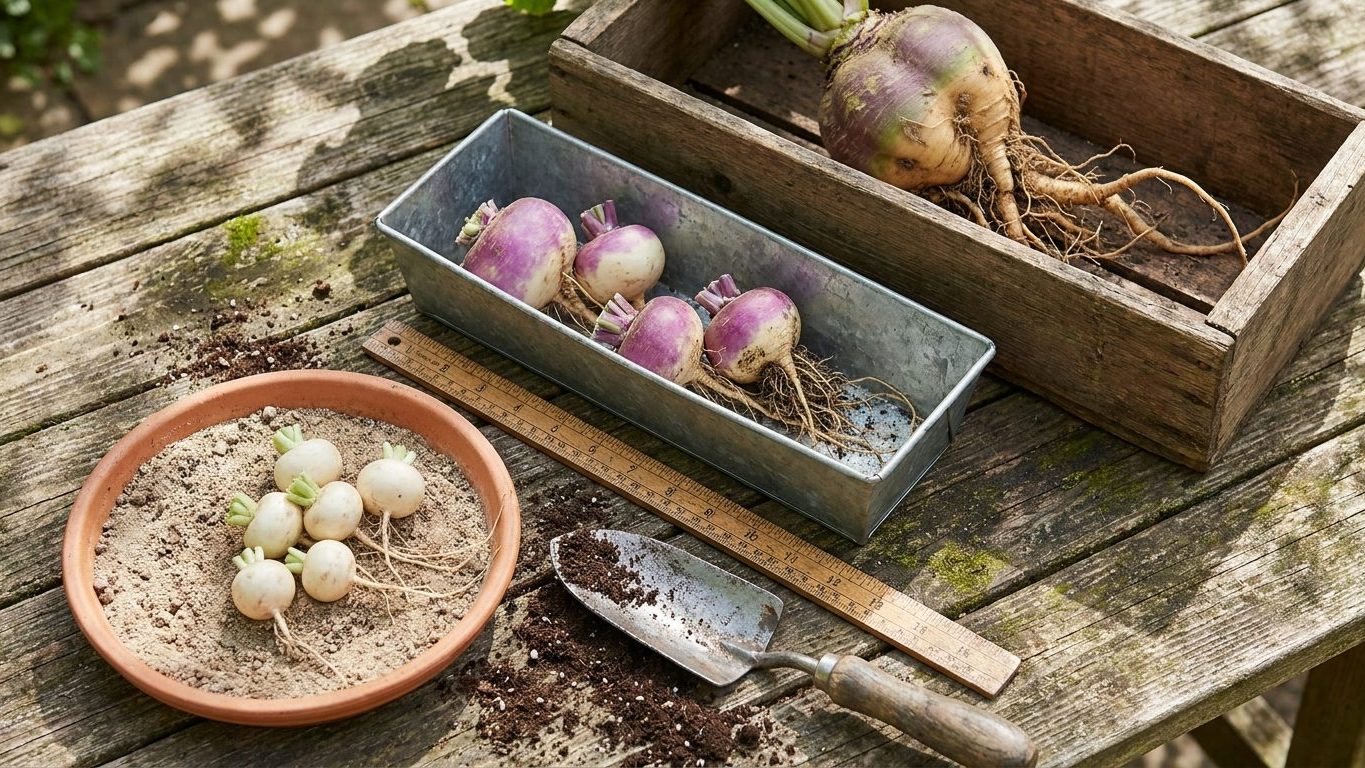

Yes, turnips grow well in containers, and small, fast varieties are the best fit. Rutabaga is a different story: it can be done, but it needs a pot at least 15 inches deep, a long season, and a lot more patience. If you have a deck, a patio, or a few 5-gallon buckets and about 8 weeks, turnips are one of the easiest root crops to grow in a pot. Rutabaga is a project for the gardener who wants to see how far a container can be pushed.
This guide covers which varieties suit pots, how deep and wide a container needs to be, and what changes when you grow roots in a pot instead of in the ground. For the wider picture of the crop, start with Growing Turnips and Rutabaga: An Autumn Crop, Sweetened by Frost.
Turnips That Do Well in Pots
Size and speed decide everything. A turnip that matures in 35 to 45 days and tops out at 2 to 3 inches across needs far less soil than one that swells to the size of a softball. So the best container varieties are the compact, quick ones, usually sold as “salad” or “baby” turnips.
Hakurei is the one most often recommended. It’s a white Japanese type, harvested at roughly 2 inches across, with a mild, almost fruity flavor you can eat raw. Tokyo Cross is a similar white hybrid that’s ready in about 35 days and holds up well to being picked small. Golden Ball (sometimes sold as Orange Jelly) has yellow-orange flesh and a slightly sweeter, nuttier taste, and it takes a little longer, around 50 days. All three do fine in a standard 8 to 10 inch deep container.
Purple Top White Globe, the classic garden turnip, also works, with a caveat. Its roots keep swelling to 4 or 5 inches if you let them, and it needs more room per plant. Pick it small, at 2 to 3 inches, and it behaves. Let it run and the crowded roots push against each other and the pot walls, and you’ll get lopsided, woody specimens.
Pick varieties with an eye on your goal, too. Turnip greens are edible and, in the South, a staple. If greens matter as much as roots, look for varieties bred for tops, such as Seven Top, which produces almost no root at all. In a pot, that’s a legitimate choice. A single 12-inch-wide container can supply several meals of greens over a season.
Rutabaga in a Container: Possible, With Conditions
Rutabaga is a cross between a turnip and a cabbage, and it grows like it. It takes 90 to 110 days from seed, builds a larger root (often 3 to 5 inches across, sometimes bigger), and has a taproot that wants to go down. That changes the math for containers.
The minimum I’d consider is a pot 15 to 18 inches deep, about 10 to 15 gallons of soil. A standard 5-gallon bucket is too shallow and too narrow, and the plants will stall. In a 15-gallon container, plan on 2 or 3 plants at most, thinned to 6 to 8 inches apart. Fabric grow bags in the 15 to 20 gallon range are a good option because the sides stay cooler than plastic and drain quickly.
The variety matters here as well. American Purple Top and Laurentian are widely available and dependable, though both produce full-size roots. If the seed catalog lists a smaller-rooted or “early” rutabaga, that’s the one to try in a pot. Expect a modest harvest: a few roots, not a bushel. Most people who try container rutabaga do it for the sweetness that cool autumn weather brings, not for volume.
If you’re still deciding between the two crops, Turnip and Rutabaga: What Actually Differs lays out the differences in flavor, texture, and growing time. For container gardeners, the short version is that turnips reward you in two months and rutabaga takes closer to four.
Container, Soil, and Spacing
Start with drainage. Every pot needs holes in the bottom, and root crops are less forgiving of soggy soil than leafy ones. Waterlogged mix invites rot and can leave roots that crack or taste off. Skip the old advice about a layer of gravel at the bottom, which doesn’t improve drainage and just takes up space roots could use.
For turnips, these dimensions work:
- Window box or trough: at least 8 inches deep, good for a row of baby turnips
- 5-gallon bucket (about 12 inches deep): 6 to 8 small turnips
- 12 to 14 inch wide pot: 5 or 6 plants at 3 to 4 inches apart
- 15-gallon container or larger: rutabaga, 2 or 3 plants
Use a quality potting mix, not garden soil. Dirt dug from the yard compacts in a pot, drains poorly, and brings weed seeds and soil pests along with it. A loose, lightweight mix with some compost blended in gives roots room to expand. Avoid chunks of bark, stones, or clods, because a root that hits an obstacle will fork or twist. Fresh manure causes the same problem, so use only finished compost.
Sow seed about 1/2 inch deep and keep the mix evenly moist until it sprouts, which in warm soil takes 3 to 7 days. Turnip seed germinates over a wide range of soil temperatures, from the mid-40s to the mid-90s Fahrenheit, but the roots develop best in cool conditions, roughly 55 to 75 degrees. Scatter the seeds, then thin hard. Thinning is the step most container growers skip, and it’s the reason they harvest a pot full of leaves and marble-size roots. Crowded seedlings can’t swell. Snip the extras at soil level with scissors rather than pulling them, which disturbs the neighbors. The thinnings make a good salad garnish.
Timing for a Fall Crop
It’s October 11, so a practical question: is it too late? That depends on where you live. In USDA zones 8 through 10, including much of Texas, Georgia, and Florida, fall and early winter is prime turnip season, and sowing now will produce roots by December. In the Upper Midwest and Northeast, the first frost has either arrived or is close, and a sowing made now probably won’t reach full size outdoors. A pot can solve that, though. Set it in a sunny spot near the house, cover it on cold nights, or move it into an unheated garage or porch. Baby turnips, which need only 5 to 6 weeks, are the best bet for a late start.
Gardeners farther north should treat the calendar as fixed: turnips for fall go in 8 to 10 weeks before the first expected frost, and rutabaga needs even more lead time. Mark next July on the calendar for next year’s rutabaga.
Watering, Feeding, and Pests in a Pot
Containers dry out faster than ground soil, and turnips punish uneven moisture. A pot that swings between bone dry and soaked leads to roots that grow, stall, then grow again, and the skin can split when it finally gets a big drink. That problem is common enough to have its own write-up: Turnips That Split Open in the Ground. The container version is the same, only faster. Check the top inch of mix daily in warm weather. When it feels dry, water until it drains from the bottom, then leave it alone. A 2-inch layer of shredded leaves or straw on top slows evaporation and levels out the swings.
Fertilizer needs are modest. Turnips are quick, so the compost in your mix may carry them most of the way. If you want to feed, use a balanced or low-nitrogen fertilizer, and go easy. Too much nitrogen pushes the plant to produce big, lush tops at the expense of the root, a classic result with root crops. Rutabaga, with its long season, benefits from one light feeding about a month after sprouting.
Light is the other variable. Turnips want at least 6 hours of sun, though they tolerate partial shade better than most vegetables, which is useful on a patio that gets sun only part of the day. In shade, tops grow fine and roots stay small, so lean toward the greens varieties if your spot is dim.
Pests are fewer in containers, not absent. Flea beetles chew small shotgun holes in young leaves and can hurt seedlings badly. Cabbage root maggots lay eggs at the base of plants in spring and early fall, and their larvae tunnel into roots. The simplest defense is a lightweight floating row cover draped over the pot and secured at the rim from the day you sow. Because you’re starting with fresh potting mix and an elevated container, the maggot cycle is often broken from the start. Refresh the mix each season, or at least avoid replanting turnips, radishes, cabbage, or other brassicas in the same soil, since pests and disease build up in it.
Harvest Size and Greens
Pull small turnips when the shoulder shows 1.5 to 2 inches above the surface. Left past that point, they turn pithy and sharp, especially in warm weather. You can also take a few greens from each plant as it grows, but limit yourself to about a third of the leaves at a time. Strip a plant bare and the root stops sizing up.
Rutabaga is the opposite: leave it. The roots are usually ready once they’re 3 to 4 inches across, and a few light frosts convert starch to sugar and take the edge off the flavor. Because a pot’s soil chills faster than ground does, container rutabaga gets that sweetening effect a little sooner. It also faces a risk the in-ground crop doesn’t. When the forecast dips to the low 20s, a pot can freeze solid, so move it against a south-facing wall or into a garage, and pull the roots before a hard freeze rather than after it.