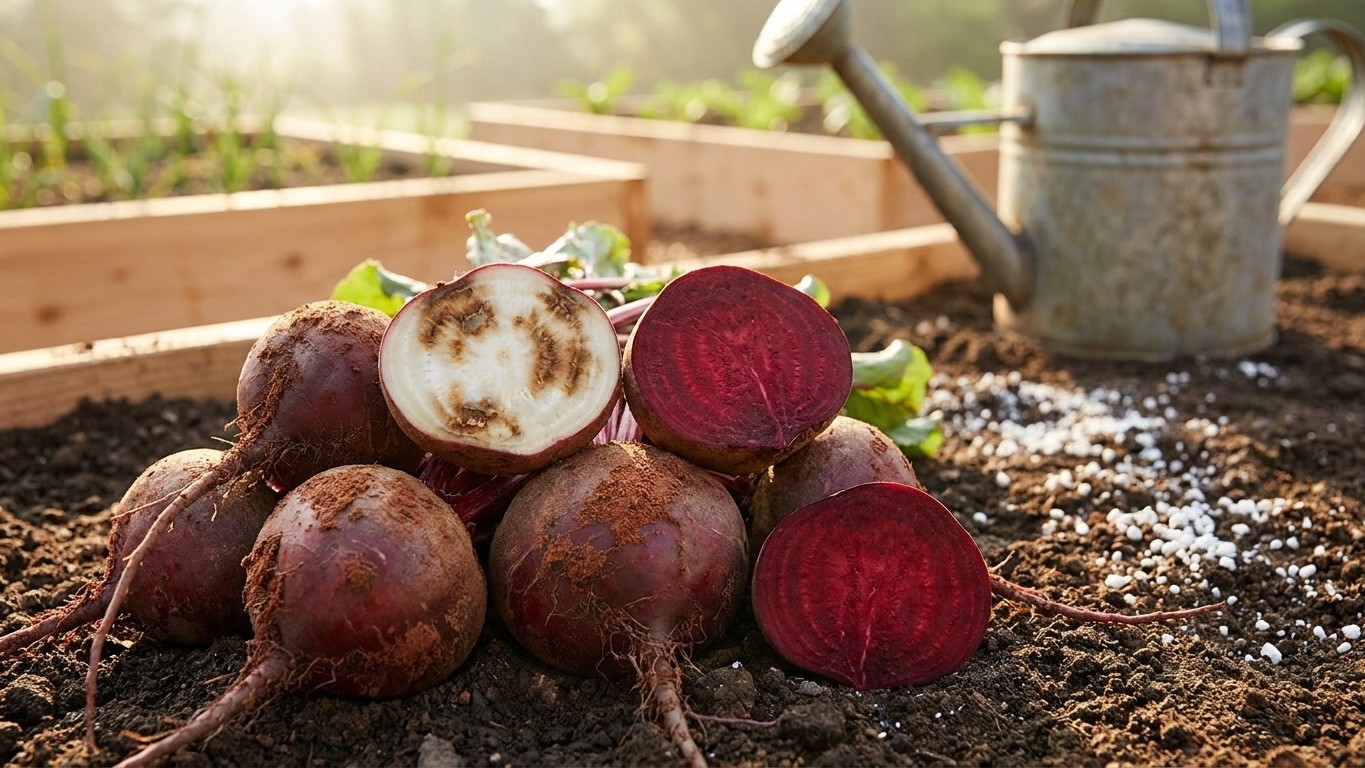

Pull beets 60 to 80 days after seeding, not after transplanting, because beets are sown in place. In South Carolina, a late-winter sowing puts that window in April and May, ahead of the heat that turns roots woody. Once the roots are out, colder is not better. Topped beets keep best at 33 to 36 F, and the 32 to 34 F range that suits other root crops brings more black spot and rot.
The short answer
Start with the ground. The soil USDA lists as representative of South Carolina is the Bohicket series, an Entisol, which means a very young soil with almost no profile development. USDA NRCS Soil Data Access gives representative surface values, taken from 27 mapped components, of 17 percent sand, 35 percent clay and 48 percent silt, with surface pH about 7.3 and organic matter about 15.0 percent. Drainage class: very poorly drained. That is heavy clay that holds water. Utah State University Extension says beets want the opposite, deep, sandy, well-drained soil rich in organic matter.
A state spans hundreds of soil series, so treat this as a starting point and not a diagnosis. Your back garden may be sandy Coastal Plain ground, Piedmont red clay, a river bottom, or fill a builder scraped flat. These figures describe the mapped surface layer of one series, not a worked garden bed, and the pH is not your pH.
What that ground tends to do to a beet
Dense, silty clay that drains poorly stays wet after rain and then firms up as it dries. Beet roots swell against that resistance. They run small, stall, or fork. The 15 percent organic matter at the mapped surface is already plenty, so piling on compost is not the fix. Utah State Extension caps amendments at no more than 1 inch of composted organic matter per 100 sq ft. Drainage is the bigger lever, and raised beds are the usual way to get it.
Heat, and why it matters later
Woodiness belongs to the other end of the season. Utah State Extension says heat above 85 F combined with water stress makes the root woody. The 85 F line sits below 90 F, so a count of days past 90 understates the problem. How many days a year Charleston passes 90 F is not published in the data behind this page, and I won’t guess at it. What the source does say is that a beet left in the ground as warm weather arrives is gambling with its texture.
Count 60 to 80 days from the day the seed goes in. A sowing between early February and the first days of March, by simple arithmetic, lands the pulling window between early April and late May. Pull on the early side of your packet’s range when the weather turns hot and dry. A smaller, tender beet beats a big woody one.
The six weeks that decide it here
Sowing 2 to 3 weeks before the last frost is the standard advice, and here it has a concrete shape. NOAA NCEI climate normals, using 32 F freeze probabilities in the 30 to 70 percent band at the Charleston airport station (USW00013880), put the last spring frost between February 28 and March 17. Count back 2 to 3 weeks and the sowing window opens in early February and closes in the first days of March. The first six weeks of those beets then run from late February or early March into mid-April.
Peninsular Charleston is milder than the airport station. Upstate South Carolina runs several weeks tighter at both ends, so a Greenville-area gardener should shift the whole calendar later and expect a shorter margin on both sides.
Where the bolting risk sits
Those six weeks are the ones Utah State Extension singles out. Water stress in the first 6 weeks causes premature flowering, which is bolting. The page holds no rainfall record for the state, so it can’t tell you whether a given March runs wet or dry. What the frost data does show is that the last freeze can fall anywhere across a span of more than two weeks. Spring here swings between warm days and cold snaps, and a seedling bed gets whipsawed between them.
Heavy clay can add its own twist. A bed that stays saturated during a wet spell invites shallow rooting. When a dry week follows, the surface bakes and the plant feels thirsty even though the ground below is damp. Even moisture through that stretch matters more than the total amount. A light mulch and a raised, loosened bed help, and so does checking soil a few inches down, not just the surface.
Why you can’t fix it later
Beets are sown in place, so there is no starting a flat indoors and setting out the survivors. A sowing that bolts from early thirst has to be resown. Spreading plantings over two or three weeks keeps one bad stretch from wiping out the lot. Bolting is an early failure from thirst. Woodiness is a later failure from heat plus thirst. Watering fixes the first and only partly addresses the second, which is why pulling on time is the real defense against it.
For the full picture of what a beet root meets underground, see Beet Soil in South Carolina: What the Root Will Meet. For the general growing calendar, start with Growing Beets in South Carolina.
What goes wrong here
The failures below come from the combination of heavy, wet ground, a swinging spring and an early-warming season. Each has its own remedy. Several happen after the pull, which is where the colder-is-better instinct does the damage.
- Bolting after early thirst. Seedlings that go dry in the first 6 weeks send up flower stalks. Keep the seedbed evenly moist from sowing through mid-April, mulch lightly, and stagger sowings so one dry week doesn’t take everything.
- Woody roots from late heat. This is a different failure. Heat above 85 F with water stress toughens the root. Pull on schedule, within the 60 to 80 days from seeding, before warm weather settles in, and keep water steady in the final weeks.
- Stunted or forked roots in heavy clay. With 35 percent clay and 48 percent silt at the surface, a beet root can stall. Loosen the bed deeply, build it up for drainage, and send a soil sample to your county Extension office before adding anything. Keep compost to no more than 1 inch per 100 sq ft.
- Standing water around the roots. A very poorly drained soil can stay saturated for days. Raised beds or ridged rows get the root zone above the wet.
- Storing in the coldest corner. USDA Agricultural Handbook 66 says storage at 32 to 34 F produces more black spot and rot than somewhat warmer storage. Aim for 33 to 36 F at 98 percent humidity for topped beets. In a pit or cellar, stay between 31 F and 41 F. Check with a thermometer; a fridge’s coldest shelf can sit right in the bad range.
- Leaving the tops on. Bunched beets with leaves keep 10 to 14 days at 32 F and above 98 percent humidity, and no longer. Top them first if you want them to last.
- Saving the wrong roots. Large roots keep much better than small ones, which lose water and shrivel faster. Eat the small beets first and store the big ones.
Pests are a separate matter and belong to their own calendar, covered in What Eats Beet in South Carolina, and When.
Common questions
How many days from sowing to pulling beets in South Carolina?
Sixty to 80 days, counted from seeding. Beets go into the ground as seed, so there is no transplant date to start from. A sowing in early February would be ready around early April at the short end, and one in the first days of March around late May at the long end.
Can I leave beets in the ground into summer?
It’s a bad bet. Utah State Extension says heat above 85 F with water stress makes the root woody. This page has no count of how many days the state passes 90 F, but the trouble starts below that line.
Does the state soil mean I can’t grow beets?
No. The Bohicket series is a starting point, a very poorly drained heavy clay, and a state spans hundreds of soil series. Your own bed may be sandier and better drained. A soil test gives your real numbers, and a raised bed helps in heavier ground.
How should I store beets after pulling them?
Cut the tops off first. Store topped roots at 33 to 36 F and 98 percent humidity, not at the colder 32 to 34 F range that brings more black spot and rot. Keep the large roots for storage and eat the small ones first. If you leave the tops on, plan to use the bunch within 10 to 14 days.